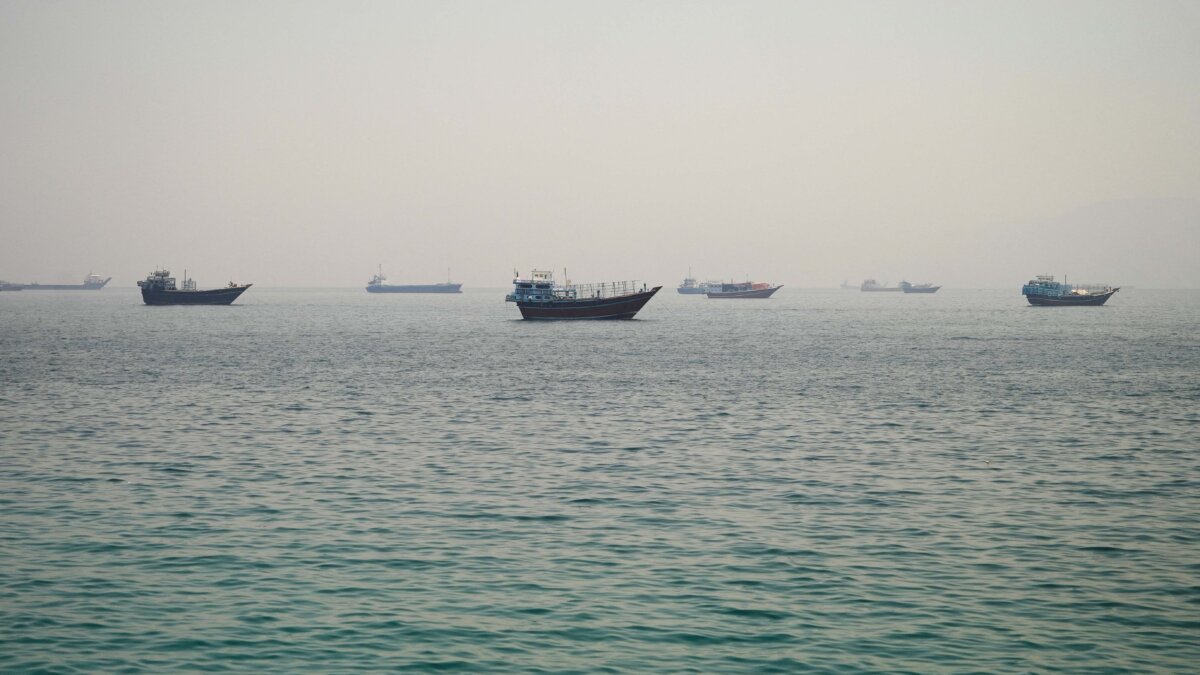

Confidence in resuming transit through the Strait of Hormuz could take weeks to rebuild, with navigation only likely to restart once safety is assured, according to shippers in Asia and Europe.
U.S. and Iranian officials are expected to sign a memorandum of understanding in Switzerland on Friday to end their war and reopen the strait.
President Donald Trump has said there is a “safe, secure, and pristine” route through the strait, which has been almost completely shut since late February.
Jotaro Tamura, chief executive of Mitsui OSK Lines, one of Japan’s largest shipping groups, told the Financial Times on June 15 that many operators would wait before restarting crossings despite the U.S.–Iran deal to reopen the strait.
Tamura said there had been multiple false starts regarding the waterway’s reopening since the Middle East conflict began in late February.
“What will have to come in place is not just a simple agreement between the relevant countries, but it has to be material and translated into the real situations in the Strait of Hormuz, so that shipping lines can make themselves comfortable to go through,” he said.
“Given the experiences in the last couple of months, I think it’s reasonable to assume that it may take at least a couple of weeks, or if not a month.”
U.S. or Iranian officials on Monday had not yet provided enough detail to prompt the ships to begin passing through the shipping lane, shipping and seafarers’ associations said.
“AIS data shows no wave of ships heading towards Hormuz this morning,” Jyske Bank analyst Haider Anjum said in a client note on June 15.
“The shipping companies probably want to wait until it is clear that the agreement holds, as we have already had Hormuz ‘open’ for a very short time twice before.”
Shipping association BIMCO said it still considers transit through the strait highly risky, with mines a key concern.
“The next step is for shipowners to be reassured that transiting the Strait of Hormuz is not only permitted, but also safe,” BIMCO’s chief safety and security officer Jakob Larsen said on Monday.
“The news of an agreement is clearly positive,” said Stefano Messina, head of Italian shipowners’ association Assarmatori.
“However, in recent months there have been several announcements of a halt to the conflict, or at least of a truce, and unfortunately they have never been followed by concrete action.”
A spokesperson for the Japanese Shipowners’ Association said that while it welcomed the peace agreement, it wanted to “wait a little longer for more concrete information.”
“Given the situation, we cannot simply say, ‘Right then, let’s go’ based on news of the agreement alone,” he added.
Nippon Yusen, Japan’s largest shipping company, said it hoped operations would return to normal as soon as possible.
German shipowners’ association VDR said it was “cautiously optimistic” about whether the deal could reopen the strait, while shipper Hapag-Lloyd said it hoped that vessels would be able to cross it this week.
Details of the agreement and the framework for any transit remain unclear, said the Norwegian Shipowners’ Association, as does the extent of mines laid in key shipping lanes.
Norway-headquartered shipping group Wallenius Wilhelmsen said it was “too early to comment on operational implications,” while Oslo-listed Frontline, one of the world’s largest tanker companies, said it viewed the development positively.
Danish shipping giant Maersk said it was making no changes yet to its operations in the Middle East. It welcomed the deal, but also said it was too early to assess its impact.
Reuters and Jack Phillips contributed to this report.
 Friends Read Free
Copy
Facebook
Tweet
Friends Read Free
Copy
Facebook
Tweet