
Recent data show that U.S. factory activity expanded for the fifth consecutive month in May, as President Donald Trump has made revitalizing the manufacturing industry a priority since the start of his second term.
Trade policy adviser Alex Krutz recently said that “there is real investment coming here.”
The expansion has coincided with a marked shift in investment priorities under the Trump administration, various reports show.
Manufacturing Activity
A June 1 report from the Institute for Supply Management shows that the manufacturing purchasing managers’ index rose to 54 in May from 52.7 in both April and March, exceeding forecasts of 53. The reading marked the strongest upswing in the manufacturing sector since May 2022 and the fifth consecutive month of expansion.
The new orders index registered 56.8 percent in May, marking the fifth consecutive month of expansion following four straight months of contraction, according to the report.
The production index increased by 0.9 percentage points from April to 54.3 percent in May, marking the seventh straight month of production expansion.
This comes as the Trump administration is seeking $20 trillion in investments in the U.S. manufacturing sector from domestic and foreign entities.
Phased Investments
Krutz, who served as deputy assistant secretary for manufacturing at the International Trade Administration within the Department of Commerce in 2025, told Siyamak Khorrami, host of EpochTV’s “Market Insider,” that the earmark is “very real” and represents investments from domestic firms, as well as foreign-owned businesses already operating in the United States and looking to expand with new facilities.
“You can go look at all the news clippings and the announcements that CEOs with the administration would be up there making announcements about last year,” he said. “It might not be exactly $20 trillion, maybe it’s 19 or 8 1/2, but somewhere in that area.”
Krutz said the investments will roll out in phases.
“You have to break ground, you have to do site selection, you have to build the factories, start construction—so that’s the first wave of investment that comes,” he said. “Then the next wave is machinery, and then the last kind of wave is the hiring of employees, and then buying raw materials and products.”
The White House is closely tracking these announcements as well. According to its investment-tracking webpage, total domestic and foreign investment currently stands at $10.6 trillion, with the United Arab Emirates, Qatar, and Japan ranking as the top three committers, announcing $1.4 trillion, $1.2 trillion, and $1 trillion, respectively. Major companies such as Meta and Apple have also announced hundreds of billions of dollars each in domestic investment.
Krutz said tariffs are effective in encouraging companies to invest and produce in the United States and said he believes that some level of tariffs will remain in place in the years ahead to maintain that momentum.
From Solar Panels to Shipyards
Krutz said the Trump administration is prioritizing heavy industries such as aerospace, defense, automotive, and shipbuilding, while also encouraging investment in semiconductors and other high-tech industries. This marks a significant shift from the Biden administration’s clean energy-focused investment policy.
According to Federal Reserve and Census Bureau data, the United States experienced a manufacturing construction spending boom during the Biden administration, which began accelerating at the end of 2021 and peaked at $240.1 billion in August 2024.
A November 2024 analysis by the Federal Reserve Bank of Boston suggests that the CHIPS and Science Act and the Inflation Reduction Act, signed into law by President Joe Biden in August 2022, spurred investment in the semiconductor and green energy industries, which were projected to reach at least $356 billion and $102 billion, respectively, over the six years ending in 2028.
A February Atlantic Council report indicates that under the priorities of both acts, construction was “overwhelmingly” concentrated in the computer, electronics, and electrical manufacturing sectors—“in other words, the goods needed to facilitate the green and digital transitions,” the report states.
The manufacturing construction boom has continued during Trump’s second term. Although spending eased to $196.2 billion in January this year, it still far exceeded the December 2021 level of about $94.5 billion, according to Census Bureau data.
A December 2025 report from Savills, a global real estate services and commercial property consulting firm headquartered in the UK, shows that aerospace and defense, grid and energy infrastructure, and digital infrastructure accounted for roughly 75 percent of new U.S. manufacturing projects announced in 2025.
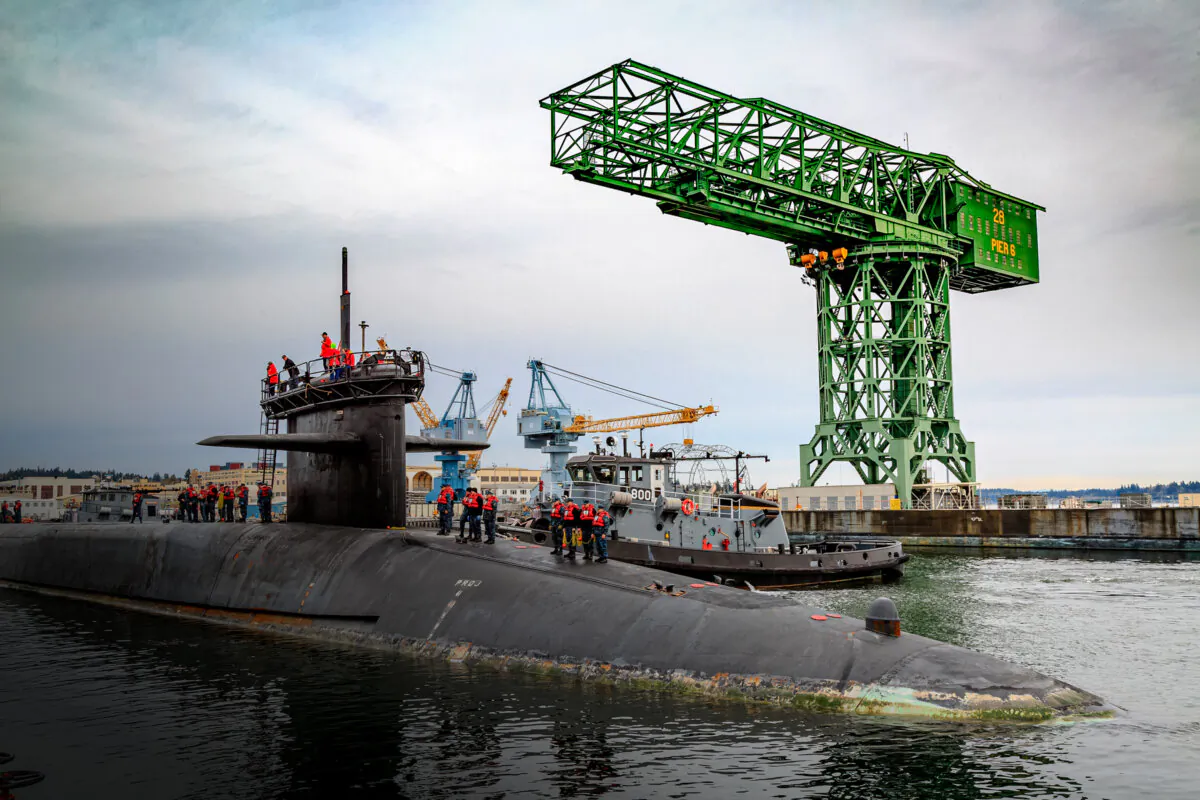
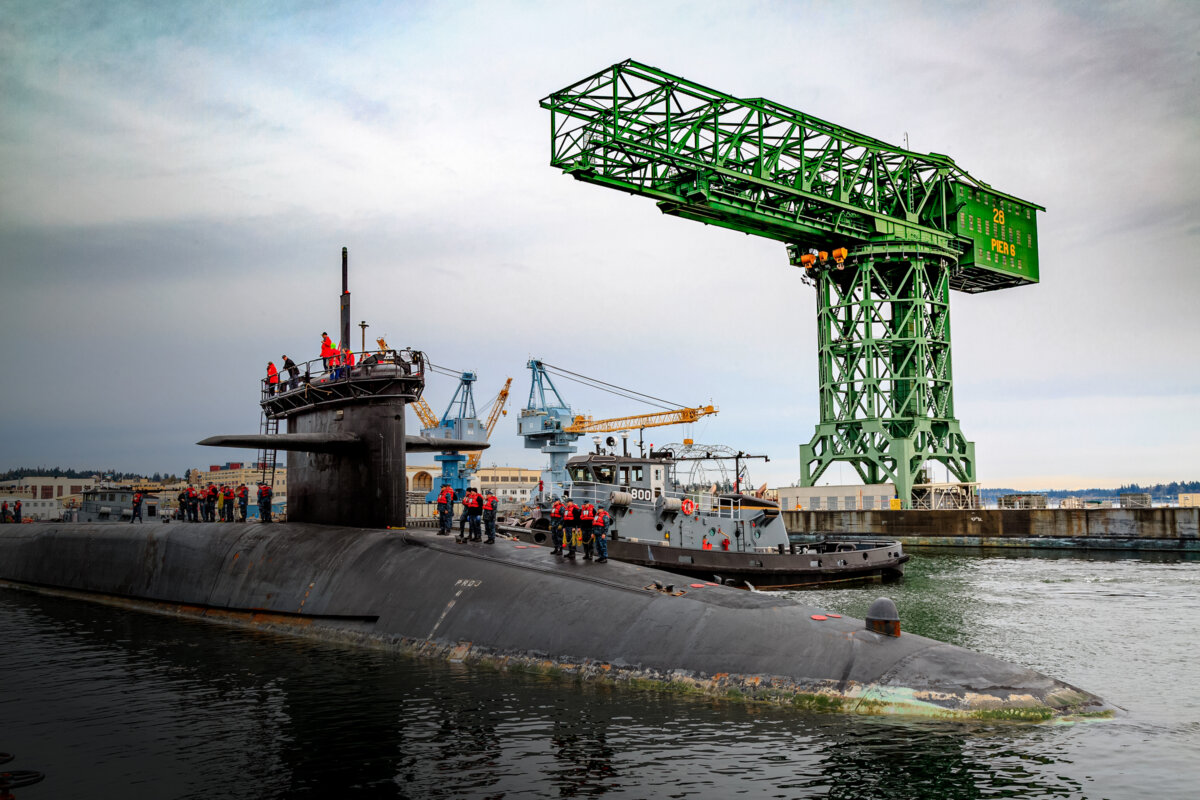
Krutz said the Trump administration is also “driving hard on shipbuilding,” including both commercial and military vessels. Trump’s April 2025 maritime dominance executive order calls for increased shipbuilding in the United States, which Krutz says currently builds less than 0.5 percent of the world’s ships.
According to Krutz, nearly 50 percent of shipbuilding occurs in China, with about 40 percent occurring in South Korea and Japan combined. These include automotive carriers, liquefied natural gas carriers, and oil tankers.
Currently, U.S. shipbuilders are not able to mass-produce larger ships because of a lack of facilities, Krutz noted.
“We produce one or two ships out of [a] shipyard a year; large shipyards of China or Korea are doing one or two per day,” he said, attributing lower overall costs of foreign shipbuilding to lower wages and steel prices, as well as more advanced technology.
As a trade policy adviser, Krutz recommends partnerships of American and foreign shipbuilders to help expand U.S. capacity.
“They’ll bring their technology, but it’ll be American workers and an American factory,” he said.
Manufacturing Employment
Krutz said that 20 years ago, manufacturing jobs accounted for about 20 percent of the U.S. workforce but now account for only about 9 percent. He said that he does not expect the United States to become “extremely” manufacturing-heavy but that he believes that returning to as much as 25 percent of employment in manufacturing is achievable.
The Institute for Supply Management report says the employment index increased by 2.2 percentage points to 48.6 percent in May, up from 46.4 percent in April. This marks the 32nd consecutive month of contraction since September 2023, indicating that manufacturers continued to reduce employment overall.
According to a May 5 report by the Environmental Defense Fund and Atlas Public Policy, the clean energy manufacturing sector posted a net loss of about 5,600 jobs in the first quarter as $1.4 billion in planned investments was canceled following federal rollbacks of clean energy incentives.
The Bureau of Labor Statistics projected in a May outlook report that overall manufacturing employment will see little change from 2024 to 2034, although several industries are expected to add jobs. Electrical equipment, semiconductors, aerospace, pharmaceuticals, and motor vehicles are among the fastest-growing sectors.
Strategic Sourcing
Krutz also offered suggestions for America’s CEOs.
He said companies once had large procurement departments staffed with talented employees who understood supply chains and were skilled at sourcing products at competitive prices. However, since companies began large-scale outsourcing to Asia and other regions 15 to 20 years ago, those departments have shrunk significantly, and many employees have been laid off.
“When you reduce that capability within your team, then you become dependent on just placing purchase orders overseas,” Krutz said. “I would say to CEOs, really look at your strategic sourcing capabilities within your company and improve that and grow that again.”
He said he does not think that outsourcing is wrong, but that “the pendulum swung too far.”
“There’s a good balance to figure out what America and companies in America should produce, and where we should have good partners that produce complementary manufactured products,” he said. “A lot of companies took profits and really took the outsourcing model to an extreme, and that hurt [a lot of] jobs, a lot of factories within America.”
Krutz also warned about the hidden costs of outsourcing. He said many companies prefer sourcing products from outside the United States because the upfront prices appear lower, but that once defect repairs, shipping expenses, delays, and other costs are factored in, the final cost can exceed that of domestic sourcing.
 Friends Read Free
Copy
Facebook
Tweet
Friends Read Free
Copy
Facebook
Tweet