
U.S. War Secretary Pete Hegseth has criticized Europe’s defense policies, telling NATO allies on the continent they need to strengthen their armed forces.
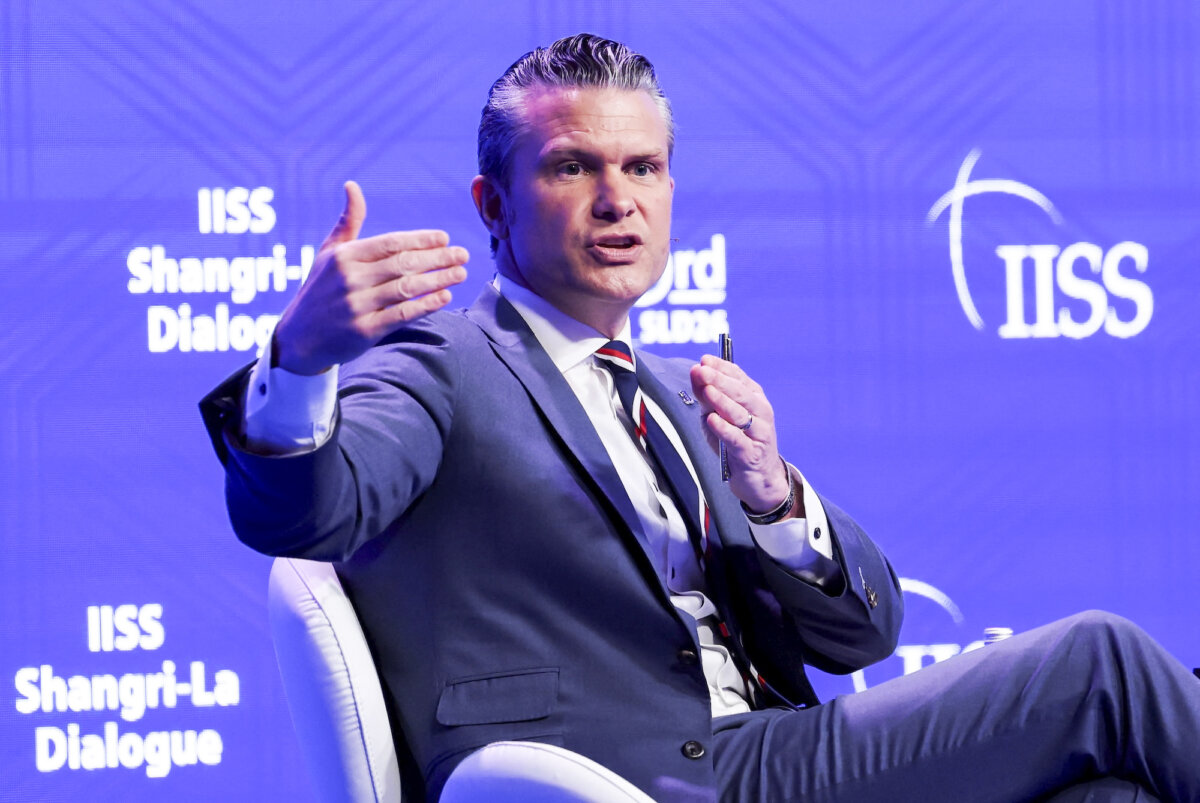
Hegseth made the remarks on May 30 at the Shangri-La Dialogue in Singapore, where he praised the United States’ Asian allies for maintaining a pragmatic defense model grounded in independence and “true partnership.”
“Our partners in Asia have long understood that the bedrock of a durable partnership is not based on idealistic values, but on the concrete alignment of national interests,” the secretary of war said, according to a transcript of his speech.
He said that this is what makes the United States’ Pacific allies “such reliable counterweights in the face of regional threats.”
He continued by contrasting this approach to that of Europe’s: “When our interests align, we act together with focused resolve. When our interests diverge, we adjust pragmatically without the drama or the moralizing. I think Western Europe might take note.”
“For too long, polite pleas from our European allies to spend more on their own defense fell on deaf ears,” Hegseth said.
“They are finally playing catch-up, and we let ourselves get distracted by empty globalist rhetoric about the rules-based international order, while European capitals threw open their borders and hollowed out their militaries.
“You can have all the rules you want, and rules are great, but if you can’t back them up with hard power, the rules are not worth the paper they are written on. Europe and NATO have some big decisions to make.”
The remarks come amid mounting pressure from Washington on Europe to commit more resources to its own regional defense, urging partners to increase defense spending to 5 percent of gross domestic product.
Meanwhile, the United States is reorienting its security priorities away from Europe and toward defense of the homeland and the Western Hemisphere.
The Pentagon, on Jan. 23, released its National Defense Strategy, which says that the United States would encourage partners in other parts of the world, including Europe, to take primary responsibility for their own defense “with critical but limited support from U.S. forces.”
Troop Withdrawal From Germany
On May 1, Hegseth ordered the withdrawal of about 5,000 U.S. troops from Germany.
U.S. Department of War spokesman Sean Parnell told The Epoch Times that the decision followed a review of the department’s force posture in Europe and “is in recognition of theater requirements and conditions on the ground.” He said the withdrawal could be completed over six to 12 months.
The following day, U.S. President Donald Trump said he may consider further cutting the numbers.
Trump had been considering reducing the U.S. troop presence in Germany since 2020, calling it expensive and unfair to U.S. taxpayers.
Adm. Giuseppe Cavo Dragone, chairman of the NATO Military Committee, has sought to downplay the troop withdrawal from Germany, saying that it was already planned and the alliance’s cohesion is unaffected.
“In a mature alliance, if one ally, which in this case is the principal stakeholder, needs to redirect some power somewhere else, he can do so, and the others must be able to step in,” Dragone said.
Nils Hilmer, state secretary at Germany’s Federal Ministry of Defense, said Berlin was accelerating military investment regardless of future U.S. deployments.
“What we know for sure … is that there’s going to be shifts in that field,” he said. “That’s why we are about to take the security in our own hands.”
Germany Takes Lead on Eastern Flank
Last week, Germany announced that, along with the Netherlands, it would lead a new NATO tactical headquarters to strengthen the alliance’s defense of its eastern flank.
German Defense Minister Boris Pistorius said on May 28 that the integration of this new corps headquarters in the region shows that Germany and the Netherlands “are assuming further responsibility for the security of Europe.”
Pistorius said that the two countries were committed to their roles and that this corps will provide a “success story of multinational cooperation.”
“This is what interoperability and responsibility for Europe look like,” he said.
In June 2025, NATO allies agreed to raise their defense spending targets from 2 percent of gross domestic product to 5 percent by 2035, with 3.5 percent spent on core defense, such as troops, arms, and equipment, and the remainder on other related areas such as security and infrastructure.
Poland said on May 6, however, that countries should endeavor to meet that target by the start of the next decade.
“There’s no point in waiting until 2035 for 5 percent—it must be achieved by 2030, because later may be too late,” Polish Deputy Prime Minister Wladyslaw Kosiniak-Kamysz said.
Reuters contributed to this report.
 Friends Read Free
Copy
Facebook
Tweet
Friends Read Free
Copy
Facebook
Tweet