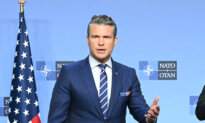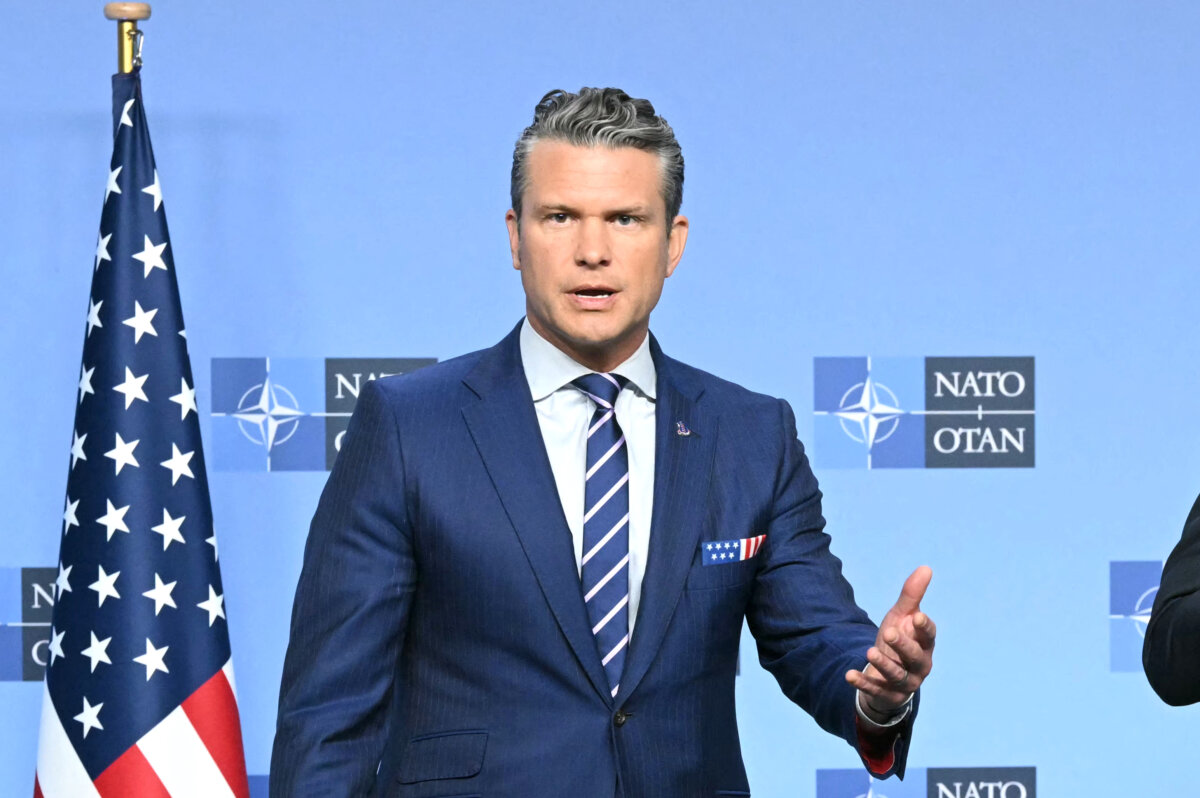

JOINT BASE ANDREWS, Md.—Secretary of War Pete Hegseth departed the U.S. national capital region shortly after 5 a.m. on June 17 for a gathering of NATO defense ministers in Belgium.
The gathering in Brussels comes at a moment when President Donald Trump and his administration continue to recalibrate the U.S. role in the transatlantic defense pact, and press its allies to shoulder more of the responsibility for the defense of Europe.
Hegseth has used other recent interactions with NATO counterparts to reinforce Trump’s messaging around burden-sharing across the alliance. He may do so again during this meeting, which begins in full on June 18.
NATO’s support for recent U.S. military operations in the Middle East could pose another point of contention going into the Brussels meeting. The Trump administration has criticized alliance members for providing little to no support, and in some cases limiting U.S. access to their bases and airspace to support strikes on Iran.
The Brussels gathering comes three weeks before a planned meeting of the various NATO heads of state, in Ankara, Turkey.
European Burden-Shift a Focus of US Strategy
The Trump administration has repeatedly described efforts to offload some of its NATO alliance burdens in recent months.
Last year, Trump led a successful push for alliance members to commit to boost their overall military spending. Starting in 2014, the alliance members had committed to spend 2 percent of their annual gross domestic product on their militaries, but have since raised their commitments to spending 3.5 percent on core military items and a further 1.5 percent on critical infrastructure and industrial capacity.
The Trump administration’s November 2025 National Security Strategy and January 2026 National Defense Strategy have since described a goal of having European allies take the primary responsibility for the security of the continent.
As he hosted Italian Defense Minister Guido Crosetto at the Pentagon on June 15, Hegseth credited Italian forces with taking on some of the burden, including by leading a NATO Multinational Battlegroup in Bulgaria.
“We see partners—and Italy’s certainly one of them … leaning forward in that aspect,” Hegseth told Crosetto.
While the Trump administration has been urging its European allies to step up, the U.S. military is increasingly pulling back more of its troops from NATO missions on the continent.
Last fall, the U.S. military canceled a brigade-sized troop rotation through Romania, Bulgaria, Hungary, and Slovakia.
In May, the U.S. military reduced its force footprint in Germany by about 5,000 troops, with Trump signaling more cuts to come. Later that month, a rotation of U.S. troops through Poland appeared set for cancellation or significant delay, before Trump reversed course and announced the United States would send about 5,000 more troops to the country after all.
On June 3, U.S. Air Force Gen. Alexus Grynkewich—commander of the U.S. European Command and supreme allied commander for NATO—said efforts to reduce the U.S. troop commitment to NATO missions in Europe would continue.
“Two areas where Canada and European Allies can step up now and in the near term … is with manned and unmanned aircraft, and with naval vessels,” Grynkewich said.
Trump Renews Ukraine Peace Push
This week’s meeting of NATO defense ministers will include the latest iteration of the Ukraine Defense Contact Group, a body organized for coordinating security assistance to Ukraine following the large-scale Russian assault on the country in February of 2022.
Russia previously wrested control of the Crimean peninsula from Ukraine in 2014. Since the start of the 2022 assault, Russia has expanded its control to about 20 percent of Ukraine’s pre-2014 land, with few major territorial changes over the past two years.
Trump had sought to quickly settle the Ukraine conflict early in his second term, but a diplomatic breakthrough has proven elusive.
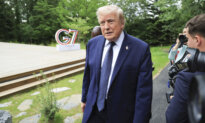
As he kicked off the G7 summit in the French town of Évian-les-Bains on June 16, Trump expressed renewed interest in brokering a peace between Russia and Ukraine, particularly following the peace memorandum he reached with Iran on June 14.
“Russia should make a deal. Russia has lost tremendous amounts of people and so has Ukraine,” he said.
Kremlin foreign policy adviser Yuri Ushakov, on June 14, said Trump spoke with Russian President Vladimir Putin by phone for about 55 minutes to discuss efforts to resolve the ongoing conflict in eastern Europe.
In an interview with CBS News in May, Ukrainian President Volodymyr Zelenskyy said he hoped to make progress with negotiations before the winter months, noting Ukrainian forces had notched some incremental gains in retaking territory from Russian forces.
“We need to find a way, [a] diplomatic way, to sit and to speak. But it depends [on] the pressure on Putin, the pressure in his society. And I think that is increasing, the pressure by sanctions—not to lift them, to put more. It’s good, it’s [a] diplomatic way,” Zelenskyy said.
Earlier this month, a bipartisan group of U.S. lawmakers in the House of Representatives passed a bill making $8 billion in loans for Ukraine and NATO allies to purchase new weapons and military equipment, and authorizing additional new economic sanctions against Russia. The bill, which still needs to pass the Senate, would represent the first major effort to direct Ukraine-related aid since the start of Trump’s second term.
House Republican leadership had opposed the Ukraine aid bill, calling for further coordination with the White House on efforts to support Ukraine and dissuade Russia from continuing the war.
Victoria Friedman contributed to this report.
 Friends Read Free
Copy
Facebook
Tweet
Friends Read Free
Copy
Facebook
Tweet