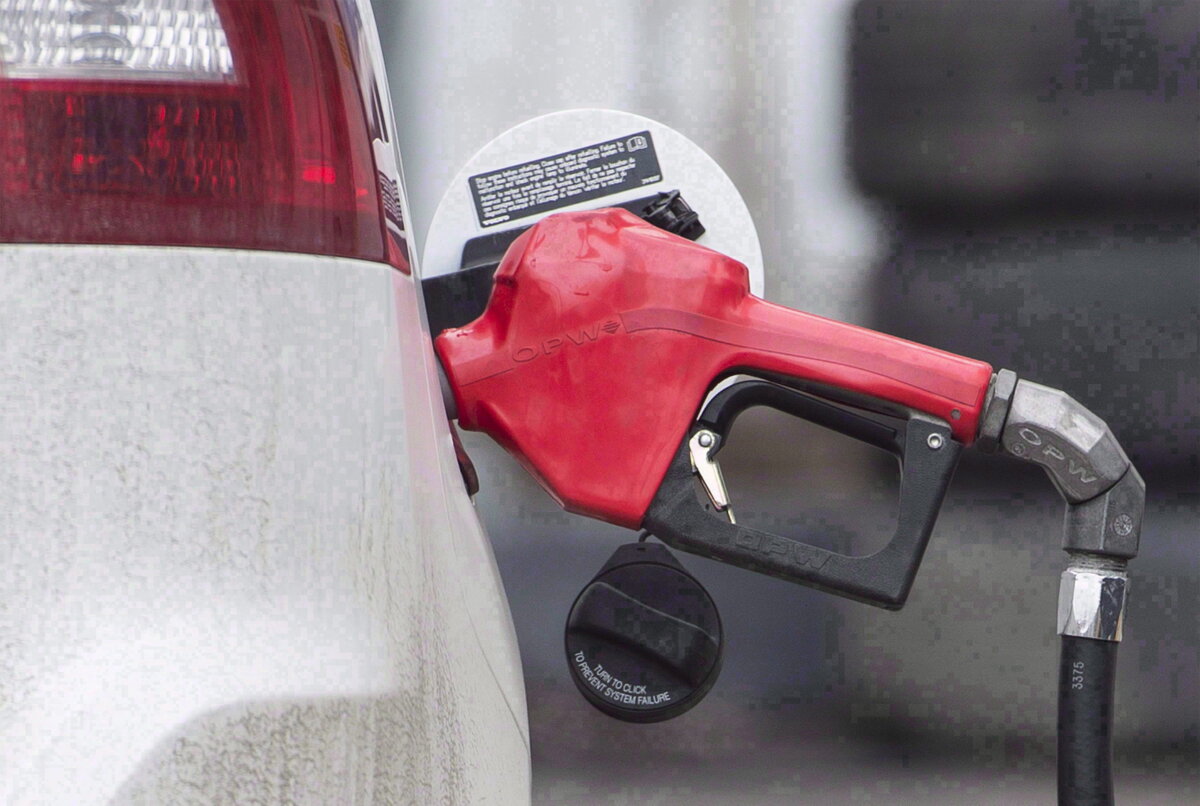

A consumer carbon tax may no longer be elevating prices at the gas pump, but there is another federal tax that has the same effect, a fiscal advocacy group says.
The Canadian Taxpayers Federation (CTF) notes motorists continue to face elevated prices when filling up their vehicles due to Ottawa’s Clean Fuel Regulations, a federal climate initiative launched in 2023 that is separate from the carbon tax.
A Jan. 15 press release from the CTF refers to the policy as a “hidden carbon tax,” saying it will increase the price of gasoline by up to seven cents per litre this year and that cost will climb each year until 2030.
The tax is embedded within federal fuel regulations that took effect on July 1, 2023. The Clean Fuel Regulations require suppliers to reduce the carbon content of the fuels they produce or import, with targets that increase annually.
If they can’t meet the requirements, they must purchase credits, increasing costs that are passed onto all Canadians who purchase gasoline or diesel, the CTF argues.
The national average gas price came in at roughly $1.25 per litre on Jan. 19, according to the CAA. A 2023 PBO report projected the Clean Fuel Regulations will lead to an increase of 17 cents per litre for gasoline and 16 cents per litre for diesel by 2030, the year when the rules achieve full stringency.
The PBO has also noted that cost will trickle down to consumers. The average national cost to lower-income households will be $231—or 0.62 percent of disposable income each year. Higher-income households can anticipate a cost of roughly $1,008, or 0.35 percent of disposable income.
The CTF has called on Prime Minister Mark Carney’s Liberal government to scrap the tax, noting there are no rebates to offset the increased cost of fuel.
The Epoch Times contacted the Prime Minister’s Office for comment but did not receive a response before publication. The government says the Clean Fuel Regulations aim to “accelerate the use of clean technologies and fuels, and support sustainable jobs in a diversified economy.”
“Under the Clean Fuel Regulations, the gasoline and diesel Canadians use every day will become progressively cleaner over time and affordable alternatives will be increasingly available to consumers,” the government said.
Cost by Province
The cost of the Clean Fuel Regulations varies from province-to-province, according to the PBO.
The expense associated with the Clean Fuel Regulations for the typical household in 2030 is projected to be the most significant in Saskatchewan, amounting to $1,117 or 0.87 percent of disposable income.
Alberta follows at $1,157, or 0.80 percent of disposable income, and Newfoundland and Labrador at $850, or 0.80 percent of disposable income.
The report said the cost reflects “the higher fossil fuel intensity of their economies.”
British Columbia will be the least affected by rising fuel prices, averaging an annual cost of $384, or 0.28 percent of disposable income. Also on the lower end of the spectrum are Quebec at $436, or 0.39 percent of disposable income, and Ontario at $495 or 0.35 percent of disposable income.
The PBO report says the Clean Fuel Regulations will impact the country’s gross domestic product (GDP), decreasing it by 0.3 percent, or up to $9 billion, in 2030.
Tory Opposition Leader Pierre Poilievre has referred to the policy as “carbon tax 2.0,” saying last fall that it is contributing to the “cost of living crisis.”
The Prime Minister’s Office has not commented on the cost to households but said in a statement last September that Ottawa “will also work closely” with provinces and territories to ensure “not only a stable, but a thriving, domestic low-carbon fuels industry now and in the future.”
Ottawa has also said the regulations will grow Canada’s clean fuels industry “at a time when the global market for clean fuels is rapidly expanding” as well as “create opportunities for companies producing renewable fuels and the farmers and foresters supplying their feedstock.”
How it Works
Ottawa’s Clean Fuel Regulations compel fuel suppliers to reduce the carbon intensity of fuels they produce or import.
The system was developed by Environment and Climate Change Canada and the federal ministry has said it is amongst the “most complex regulations” it has ever developed, according to the PBO report.
The rules use a credit system in which one credit equals one tonne of reduction in carbon dioxide equivalents. Suppliers can meet requirements in three different ways: They can invest in fossil fuel reduction through projects like carbon capture or on-site renewable power; they can supply low carbon intensity fuels such as ethanol or biodiesel; or they can supply fuel or energy to advanced vehicle technology.
The regulations were introduced by former Prime Minister Justin Trudeau as part of his climate plan to reach net-zero emissions by 2050.
The Carney government announced last September it would make targeted amendments to the Clean Fuel Regulations to strengthen its “resiliency” and support the development of Canada’s low-carbon fuel sector. It noted these amendments would not come at the expense of the regulations’ primary focus of lowering greenhouse gas emissions and transitioning to a low-carbon economy.
A paper from Environment Canada outlined two examples of regulatory options that could be designed to achieve this goal: Minimum domestic content approach or a credit multiplier approach.
Primary suppliers are required under the current rules to incorporate a minimum of 5 percent low-carbon intensity fuel content in the total volume of gasoline produced and imported for use in Canada, and 2 percent in diesel. Under a minimum domestic content framework, the volumetric stipulations of the regulations could be revised to mandate that compliance be achieved using low-carbon intensity fuel generated in Canada.
A credit multiplier approach, however, would result in more credits being created for domestic low-carbon intensity fuel than the same quantity of imported low-carbon intensity fuel.
The government closed its comment period on the amendments on Jan. 15 and plans to publish the draft amendments in its Canada Gazette publication in the coming weeks. It did not say if more changes would be made to the amendments or when they would be applied to the current rules.
 Friends Read Free
Copy
Facebook
Tweet
Friends Read Free
Copy
Facebook
Tweet