

News Analysis
While some economists view the current economic slowdown as mild compared with past recessions, they warn that stagnant per capita GDP and rising debt have left Canada in a weaker position to weather deteriorating economic conditions.
Statistics Canada reported on May 29 that Canada’s economy shrank for two straight quarters on an annualized basis—contracting in the first quarter of 2026 as well as the fourth quarter of 2025—meeting the common definition of a technical recession.
However, many economists say the GDP decline lacks the widespread job losses, collapsing consumer demand, or sharp drops in economic activity associated with major recessions.
The C.D. Howe Institute’s Business Cycle Council, widely seen as the authority on recessions in Canada, said last week that it’s too early to conclude the country has entered a recession. The council pointed out in a June 5 note that the cumulative contraction over the two quarters amounted to just 0.28 percent, far smaller than declines of previous Canadian recessions. For example, GDP declined by between 3.4 percent and 12.7 percent during the last four recessions.
But while economists say Canada is not currently experiencing a recession in the traditional sense, many warn that the country is facing deeper long-term economic problems, including stagnant productivity, weak per capita GDP growth, and rising government debt.
“A recession is a broad and persistent contraction in economic activity,” Trevor Tombe, a professor in the University of Calgary’s department of economics, told The Epoch Times. “How to define that is hard. There’s not some magic threshold that you cross.”
Tombe said previous recessions involved much larger contractions in GDP than the current one. However, he said Canadians’ living standards have continued to deteriorate even while the broader economy has avoided a major contraction.
“So it can feel like a recession for the average person, even if it’s not what we would normally label a recession,” he said.
Jack Mintz, president’s fellow at the University of Calgary School of Public Policy, said recessions are typically marked by sharp GDP declines and rising unemployment.
“This is nothing compared to what we saw earlier on,” Mintz said. “That’s why I don’t think we have a recession, but we are in a very slow growth period.”
Carleton University business professor Ian Lee said Canada’s long-term economic trajectory is more concerning than short-term quarterly GDP fluctuations.
“When you look at these over a 5-, or 10-, or 15-, or 20-year period, it is indisputable that Canada is in long-term structural decline,” Lee said.
He added that debates over quarterly GDP changes serve as a “distraction away from the much bigger question: Are we going in the right direction?”
Prior Recessions
Tombe said most recessions have “unique causes,” typically stemming from a “large shock to an influential segment of the economy.”
He said COVID-19 caused a large economic shock in 2020, while Canada’s 2008–09 recession was triggered by severe housing and banking issues in the United States.
The recession in the early 1980s followed an oil crisis that fuelled inflation and prompted sharp interest rate hikes, particularly in the United States, which weakened construction, housing, and other sectors, he said.
Mintz said the 1990–92 recession was also driven by high interest rates and worsened by the introduction of the GST, which further suppressed consumer spending.
According to the C.D. Howe Institute, Canada’s GDP declined by 5.3 percent during the 1981–82 recession, 3.4 percent during the 1990–92 recession, 4.4 percent during the 2008–09 recession, and 12.7 percent during the 2020 downturn.
The institute’s Business Cycle Council noted that employment levels have remained relatively stable this time around. Canada’s unemployment rate peaked at 12 percent in 1983, 11.4 percent in 1993, 8.5 percent in 2009, and 13.6 percent in early 2020. By contrast, unemployment improved from 7 percent in the third quarter of 2025 to 6.6 percent in the first quarter of 2026.
Canada also met the technical definition of a recession in early 2015 after GDP contracted in two straight quarters. However, the C.D. Howe Institute also said that the 2015 downturn did not qualify as a recession because it was restricted to a few industries and unemployment continued to decline.
Avery Shenfeld, chief economist at CIBC Capital Markets, told The Epoch Times that Canada’s economy is “broadly speaking” not as weak as it was during the 2008 or 2020 recessions.
That explains “why economists aren’t yet prepared to use the ‘r’ word for what we’ve seen in the past year,” Shenfeld said.
Still, he said Canada’s economic growth over the last few quarters has been “disappointing” because of declines in exports and business investment due to tariffs, and a weaker housing market.
Rising Debt Levels, Poor Productivity
While Canada has avoided the sharp rise in unemployment and low GDP growth seen in previous recessions, its debt burden is higher than in three of four of those periods.
Canada’s federal net debt-to-GDP ratio stood at around 23.8 percent in 1981 before rising to an all-time high of 68 percent in the 1990s. Ottawa implemented small tax increases and shrank the size of the government to bring the ratio back down, but that number has since risen back to 45.7 percent.
Federal deficits have also continued to grow, reaching a record $66.9 billion in the 2025–26 fiscal year. Ottawa has also abandoned its fiscal guardrail of maintaining a declining debt-to-GDP ratio.
Lee warned that growing deficits are limiting the government’s ability to respond to crises.
“We’re reducing the wiggle room … for a future government when a future crisis comes along,” he said.
Lee added that rising debt could weaken the Canadian dollar, discourage investment, and increase bond yields.
Canada has also fallen behind other developed countries in GDP per capita, which correlates with higher living standards. While Canada saw this metric steadily increase for decades after the 1960s, it has remained stagnant since 2014, rising by just 4.18 percent in total over the 12-year period from 2014 to 2025.
During the same period, U.S. total growth increased by 22.14 percent.
Canada’s per capita GDP has now fallen below that of Alabama, which has long been one of the poorest U.S. states.
Tombe said that per capita GDP growth has been declining due to “incredibly weak productivity performance.” The Fraser Institute has said this is the result of weak investment, high business and personal taxes, and government red tape.
Tombe said disposable income growth for the average Canadian family is now worse than that during both the 2008 and 1980 recessions.
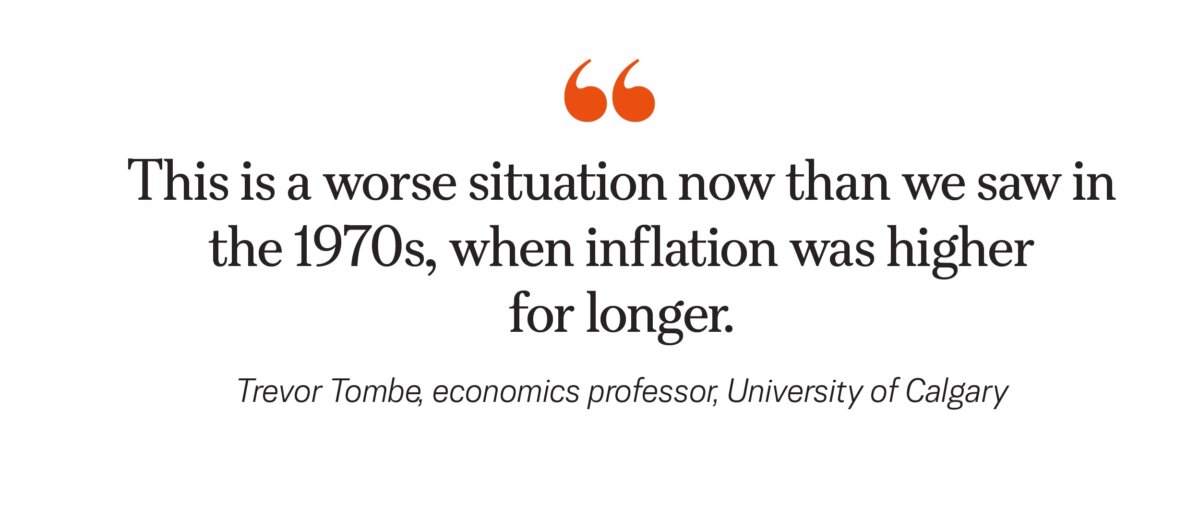
“And it’s not just because inflation was high over the past couple of years. This is a worse situation now than we saw in the 1970s, when inflation was higher for longer,” he said.
“So it can absolutely feel like a really challenging moment, regardless of whether economists call it a recession or not, and that is a very important distinction,” he added.
 Friends Read Free
Copy
Facebook
Tweet
Friends Read Free
Copy
Facebook
Tweet