
U.S. President Donald Trump agreed to a two-week ceasefire with the Islamic Republic of Iran on April 7. The agreement came just hours before a deadline he had set for Tehran to accept terms or face strikes on key infrastructure, including bridges and power plants. However, events before that moment show that Iranian authorities put civilians in danger, analysts and human rights advocates say.
Officials Urge Civilians to Form ‘Human Chains’
On April 6, a day before the deadline, Iranian officials and military figures called on civilians to gather around power plants and sensitive infrastructure. The call included children and teenagers.
The aim was to form what authorities described as human chains. This would have raised the civilian cost of any U.S. or Israeli strikes.
Officials provided specific instructions. On April 6, Alireza Rahimi, a senior government official, urged people to physically gather around power facilities at a specific time. Meanwhile, Hossein Yekta, an Islamic Revolutionary Guard Corps (IRGC) commander speaking on state television, directly addressed parents and encouraged them to send their children to sensitive locations. He said participation is a form of growth and resilience, using language that suggested that children should be sent to checkpoints to “become men.”
Bijan Kian, a security analyst, told the Persian edition of The Epoch Times on April 8 that the portrayal of voluntary public participation does not match what is happening on the ground.
“People who stand there with their children are not doing it willingly,” he said. “They are under pressure. If they don’t show up, they risk losing their jobs or facing consequences.”
Kian described the mobilization as “a staged performance,” saying that authorities rely on pressure and intimidation to project an image of public support. He said the Islamic Republic can always bring some people into the streets through threats to create the impression of public support.
Sources inside Iran who requested anonymity out of fear of reprisal told The Epoch Times that, during war periods, some people were encouraged to join pro-government gatherings in exchange for small payments, reportedly as little as $2 per night.
“But the real Iranian people are those who came to the streets and protested, tens of thousands of whom were killed,” Kian said. “They stood in front of bullets to say they do not want this system. This is a ridiculous theater created by the regime.”
Child Recruitment
In late March, the IRGC started a campaign to recruit children as young as 12 to serve as “defenders of the homeland.”
According to official descriptions, these children could be assigned work ranging from cooking and medical support to checkpoint duties, patrols, and even intelligence-related tasks. Although these are support roles, they still place children near military targets and expose them to danger.
Human Rights Watch said on March 30 that the Iranian regime’s recruitment of children as young as 12 puts their lives at serious risk.
The group noted that using children in military-related roles, especially during an active conflict, can constitute a serious violation of international law, and in cases involving children younger than 15, may amount to a war crime.
The Iranian regime has for decades incorporated minors into Basij structures, and in past conflicts, including the Iran–Iraq War (1980–1988), large numbers of children were mobilized, with many casualties. There is also documented evidence of underage Afghan migrants being recruited and sent to fight in Syria, where some as young as 14 were killed.
Kian said these practices reveal a deeper institutional mindset.
“When a system reaches a point where it depends on children to sustain its operations, it shows both weakness and disregard for human life,” he said.
Executions ‘to Suppress Dissent’
With a population of approximately 93 million, Iran ranks second only to China in the number of executions carried out annually, making it one of the world’s leading executioners.
Mai Sato, U.N. special rapporteur on human rights in Iran, reported on March 9 that at least 1,639 people were executed in 2025 and 975 in 2024. She noted that “in January 2026 alone,” at least 100 people were executed.
Since the start of the war involving the United States and Israel against Iran on Feb. 28, at least 14 prisoners have been executed on political and security-related charges.
Among them, seven individuals had been arrested and prosecuted during the nationwide protests and were accused of setting fire to a Basij base in Tehran’s Shahr-e Qods area.
Sato said the recent executions in Iran are “a continuation of a long-standing pattern of using the death penalty to suppress dissent.” She also noted that broadly defined “security crimes” in Iranian law allow authorities to criminalize almost any form of protest and are consistently used to silence opposition and restrict freedom of expression, association, and peaceful assembly.
Kian said this reflects a deep divide between the state and society.
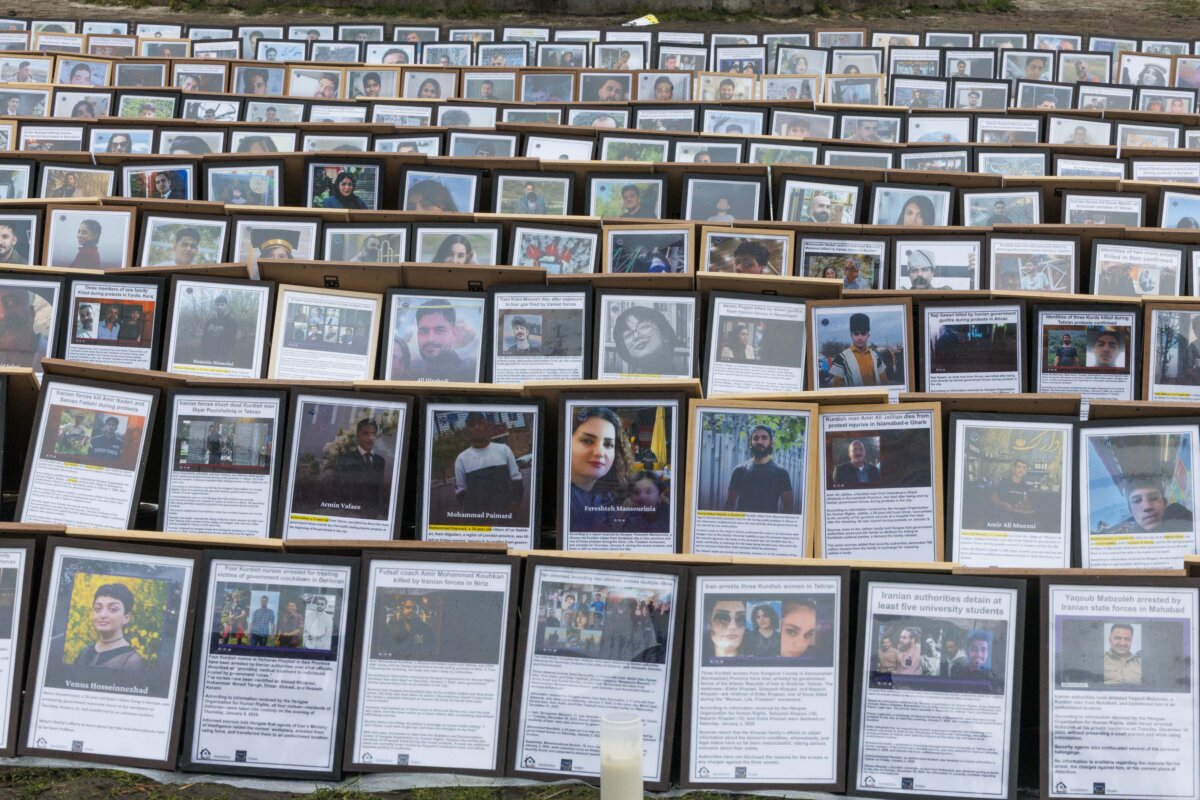
“There is a sea of blood between the people and the Islamic Republic,” he said. “These are people whose children were killed.”
Internet Blackout During Wartime
Iran has experienced a widespread internet shutdown for more than 38 days. Access remains extremely limited, with only partial connectivity available through satellite services or circumvention tools.
Officials have justified the blackout as a wartime necessity. On April 7, government spokesperson Fatemeh Mohajerani described the internet shutdown during wartime as natural, saying that “conditions during war require different considerations” and that “journalists, as messengers, have this access, and it is natural that the general public does not have access to the internet under wartime conditions.”
Her remarks referred to state-controlled journalists working for media aligned with the Islamic Republic and the IRGC, which function as mouthpieces of the regime.
Without reliable internet, many Iranians have been unable to receive emergency warnings, including evacuation alerts reportedly issued by Israel in certain areas. Others have struggled to communicate with family members or confirm their safety.
On April 1, Reza Pahlavi, opposition figure and crown prince in exile, described the situation as an attempt to silence the population. For more than a month, Iranians have been living in digital darkness, “without internet, without connection, and without a voice,” he said in a speech at Liberty University. He said that the blackout is not incidental, but part of a strategy to control information and suppress unrest.
In Ukraine, during the war with Russia, authorities have made efforts to maintain internet connectivity so civilians can access information and prepare for the attacks. In Iran, the opposite approach has been taken, limiting access at a time when information can be lifesaving.
Many Iranians no longer trust official claims about safe zones or shelters, fearing that such locations could have been used by the Islamic Republic and targeted by the United States or Israel, Kian said.
He said this disconnect between the state and society is central to understanding current events.
“The government’s greatest fear is not foreign attacks; it is the Iranian people,” Kian said.
 Friends Read Free
Copy
Facebook
Tweet
Friends Read Free
Copy
Facebook
Tweet