
News Analysis
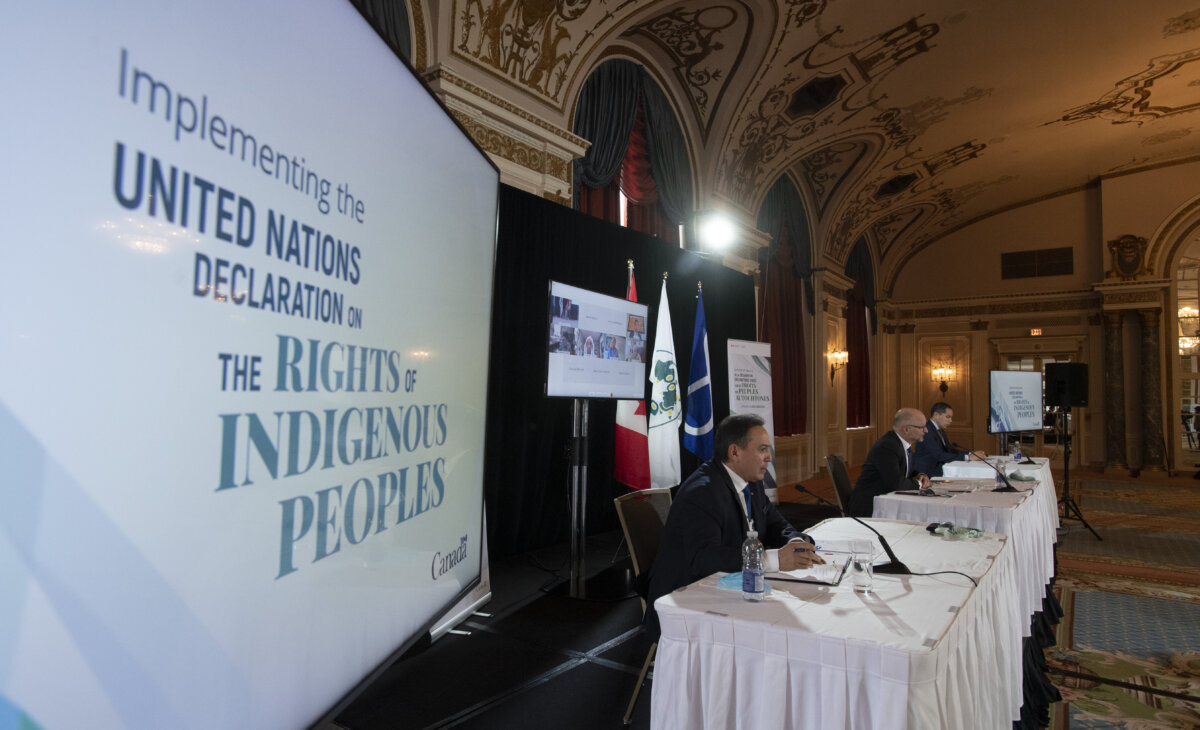
The United Nations Declaration on the Rights of Indigenous Peoples (UNDRIP) is a non-binding resolution from an international body. Even so, it is exerting a tangible influence in Canada on issues ranging from a move in B.C. to rename streets, towns, and cities, to a push to grant rivers “legal personhood.”
UNDRIP is a United Nations resolution passed in September 2007. The 15-page document contains 46 rules, or articles, that put forth a vision of the rights of indigenous peoples worldwide.
Some of the articles are simple and have few consequences for Canada, such as the right to “enjoy fully all rights established under applicable international and domestic labour law” in Article 17. Others have potentially far-reaching domestic ramifications, notably “the right to autonomy or self-government” in Article 4 and the right to promote indigenous “juridical systems or customs” in Article 34.
In 2010, the Harper government cautiously endorsed UNDRIP, calling it an “aspirational document” and noting that it is “not legally binding.” In 2016, the Trudeau government announced that Canada has become a full supporter of UNDRIP “without qualification.”
In June 2021, the United Nations Declaration on the Rights of Indigenous Peoples Act came into force, which provided a framework to advance implementation of the declaration at the federal level, requiring the federal government to “take all measures necessary to ensure the laws of Canada are consistent” with UNDRIP.
B.C. beat Ottawa to the punch, becoming the first jurisdiction in Canada to enshrine UNDRIP into law with the Declaration on the Rights of Indigenous Peoples Act in November 2019. In October 2023, the Northwest Territories became the first territory in the country to pass legislation implementing UNDRIP.
B.C. is the first and only province in Canada to have adopted UNDRIP into law, making it a test case of sorts for how this move can impact a region and what it could mean for other jurisdictions.
According to an August 2025 Angus Reid poll, only 48 percent of Canadians across all provinces have heard of UNDRIP—with that percentage being the highest in B.C., at 62 percent. If more provinces, territories, and municipalities adopt UNDRIP, the domestic implications of this international document are likely to amplify, and more Canadians may experience different applications of it in their everyday life.
Court Cases
B.C. has been making headlines across Canada of late for the Cowichan Tribes v. Canada ruling, in which the B.C. Supreme Court recognized aboriginal title over a swathe of Richmond, which includes private property.
Dwight Newman, constitutional law professor at the University of Saskatchewan, notes that B.C.’s adoption of UNDRIP was considered in the judge’s decision. In a blog post in August, Newman noted that the judge in the Cowichan decision referenced a provision in B.C.’s Interpretation Act, adopted after the province enshrined UNDRIP into law, that essentially “requires courts to try to interpret BC legislation consistently with UNDRIP.”
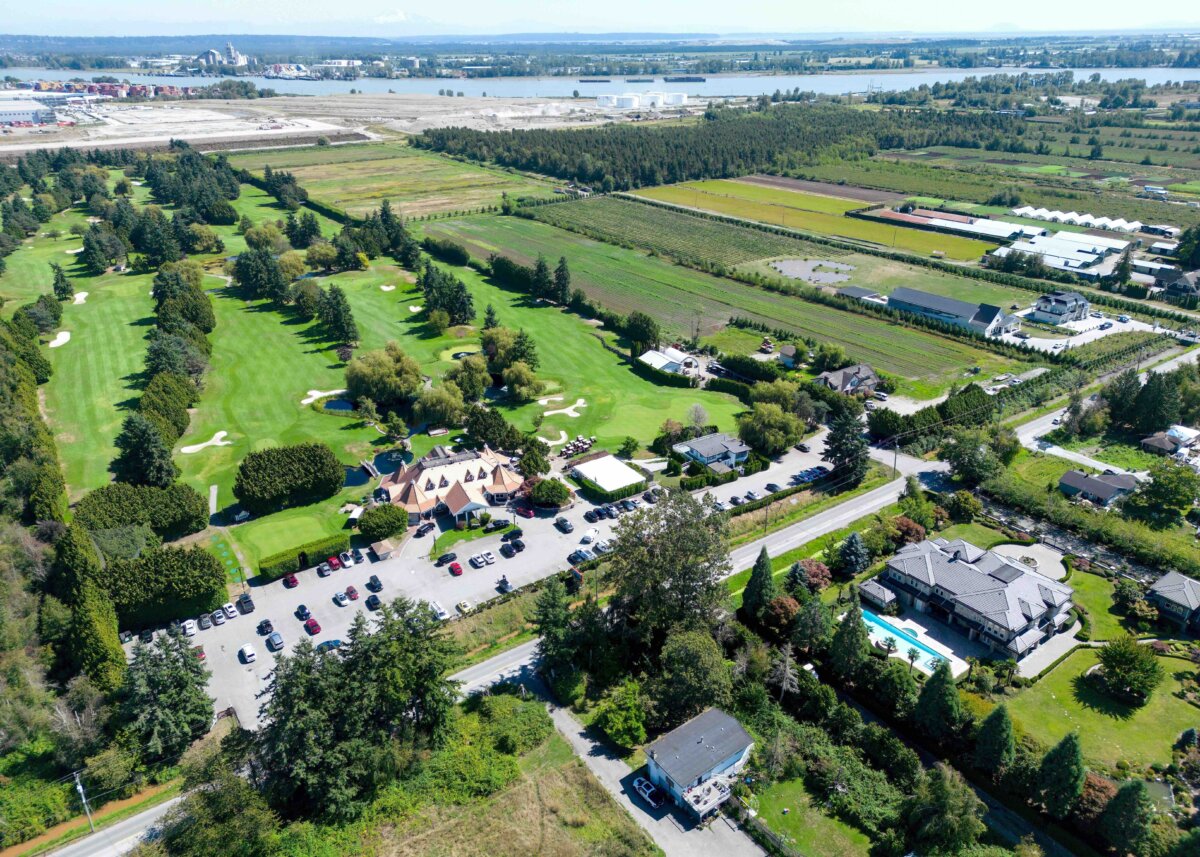
“UNDRIP and BC’s legislation on UNDRIP are used. And they’re used in support of (even if not as the main argument for) the idea that Aboriginal title could yet take priority over current private property rights,” Newman wrote.
He also noted that there are other recent court cases that have “used and interpreted UNDRIP.”
One such case that Newman co-authored about in a paper published in the journal Energy Regulation Quarterly in September 2025 is the February 2025 decision by the Federal Court in Kebaowek First Nation vs. Canadian Nuclear Laboratories. In this case, the court referred to the free, prior, and informed consent standard in UNDRIP, which has been adopted as federal law. On that basis, the court found that the Canadian Nuclear Safety Commission’s consultation process for approving a radioactive waste landfill near Deep River, Ont., was inadequate.
Municipal Naming
A particularly unexpected consequence of B.C.’s UNDRIP legislation is playing out in Okanagan Falls, on the south shore of Skaha Lake in Okanagan wine country.
In March 2025, the community voted to incorporate and become a municipality—B.C.’s first in 15 years. As part of the incorporation process, the new municipality may be required to adopt an official name, prompting debate over whether Okanagan Falls should keep or change its long-standing name.
This is because of an obscure provision in UNDRIP that affirms an indigenous right “to designate and retain their own names for communities, places and persons.” Chief Clarence Louie of the Osoyoos Indian Band, which is near Okanagan Falls, confirmed in a B.C. government news release that his band is advancing its “priorities on the naming and boundaries of the proposed new municipality.”
He said his band would work with the province and regional district “on an incorporation process that is compliant with the Declaration on the Rights of Indigenous Peoples Act.”
Meanwhile, on the picturesque northern Sunshine Coast of B.C., the City of Powell River has been roiled with debate about its own name, as a neighbouring First Nation seeks to rename the community.
The city is commonly believed to have been named for Israel Wood Powell, a businessman and politician during B.C.’s frontier days, who served as the superintendent of B.C.’s then-Department of Indian Affairs from 1872 to 1889.
Powell has a controversial reputation for his mixed record as B.C.’s superintendent of Indian Affairs. While the Dictionary of Canadian Geography describes him as “more sympathetic to native people than most of his contemporaries were,” he has been accused of supporting the expansion of residential schools in the province and of attempting to suppress potlatches—feast and gift-giving ceremonies important to the coastal B.C. First Nations.
The Tla’amin First Nation is asking for the city to be renamed and is using UNDRIP as one of its supporting arguments. In a June 2021 letter to Powell River Mayor and Council, the Tla’amin Nation Executive Council quoted the UNDRIP provision that affirms an indigenous right “to designate and retain their own names for communities, places and persons.”
Renaming Powell River remains an ongoing and contentious issue that has ignited significant debate in the community.
Meanwhile, in Vancouver, UNDRIP principles are already being cited as justification for renaming streets whose names are said to carry colonial associations. In June 2025, the City of Vancouver renamed Trutch Street to šxʷməθkʷəy̓əmasəm Street, which means Musqueamview Street in the language of the Musqueam First Nation.
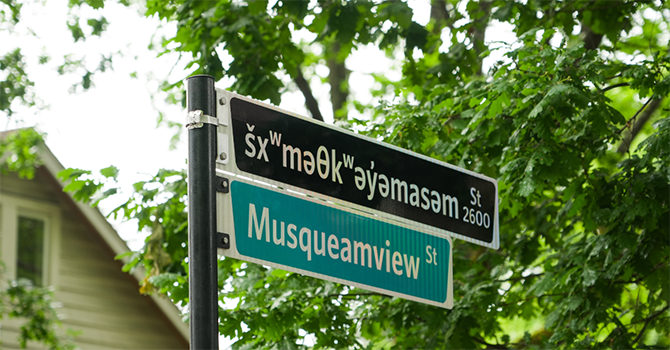
Joseph Trutch (1826–1904) was B.C.’s first lieutenant governor and has come under controversy in recent years for his decision to significantly reduce the size of Indian reserves in the province.
The report to Vancouver City Council that recommended the street renaming references the city’s endorsement of UNDRIP, and in particular cites the indigenous right “to designate and retain their own names for communities, places and persons”—the same UNDRIP provision cited as justification for renaming Okanagan Falls and Powell River.
Meanwhile, even if you live in a province that is unlikely to adopt UNDRIP, your municipality may choose to do so of its own accord. The cities of Saskatoon, Montreal, and Vancouver have gone this route.
National Parks Access
Another B.C. policy approach that is intertwined with UNDRIP is a string of temporary closures of certain provincial parks to non-indigenous visitors.
Joffre Lakes Park, whose stunning glacial lakes and snow-capped mountains have been featured in countless social media posts and selfies, has been temporarily closed three times this year. The park is located about 60 kilometres northeast of Whistler, B.C.
A B.C. government notice announcing the latest closure, effective from Sept. 2 to Oct. 3, said that closing the park gives “time and space for members of the Lil’wat Nation and N’Quatqua to reconnect with the land, carry out cultural and spiritual practices, and recognize the National Day for Truth and Reconciliation.”
While this has become a routine provincial policy, the first park closure was done unilaterally by the Lil‘wat and N’Quatqua First Nations in August 2023. At that time, a statement from the Lil‘wat Nation cited as justification for the closure Article 18 of UNDRIP, which affirms the indigenous right “to participate in decision-making in matters which would affect their rights, through representatives chosen by themselves in accordance with their own procedures.”
An August 2025 Angus Reid poll found that a majority of British Columbians would support holding a referendum on whether to maintain UNDRIP, including 57 percent of B.C. NDP voters and 69 percent of B.C. Conservative voters.
Waterways
While UNDRIP’s direct influence is strongest in B.C., there are some indications that downstream effects are being felt elsewhere in Canada—notably, a new push for rivers and other natural features to be granted “legal personhood.”
The first such instance in Canada was in February 2021, when the Magpie River in eastern Quebec was conferred “legal personhood” through parallel resolutions from the Innu Council of Ekuanitshit and the Minganie Regional County Municipality. The river was recognized as having nine specific rights, including “the right to flow” and the right to sue in a court of law (the river will not represent itself at court, but will be given “legal guardians” to do so on its behalf).
Granting rivers legal personhood is a growing trend worldwide, with the Whanganui River in New Zealand becoming the first river to receive this status in March 2017. This idea stems from the rights of nature movement, which posits that the natural world should be seen as a “rights bearing entity.”
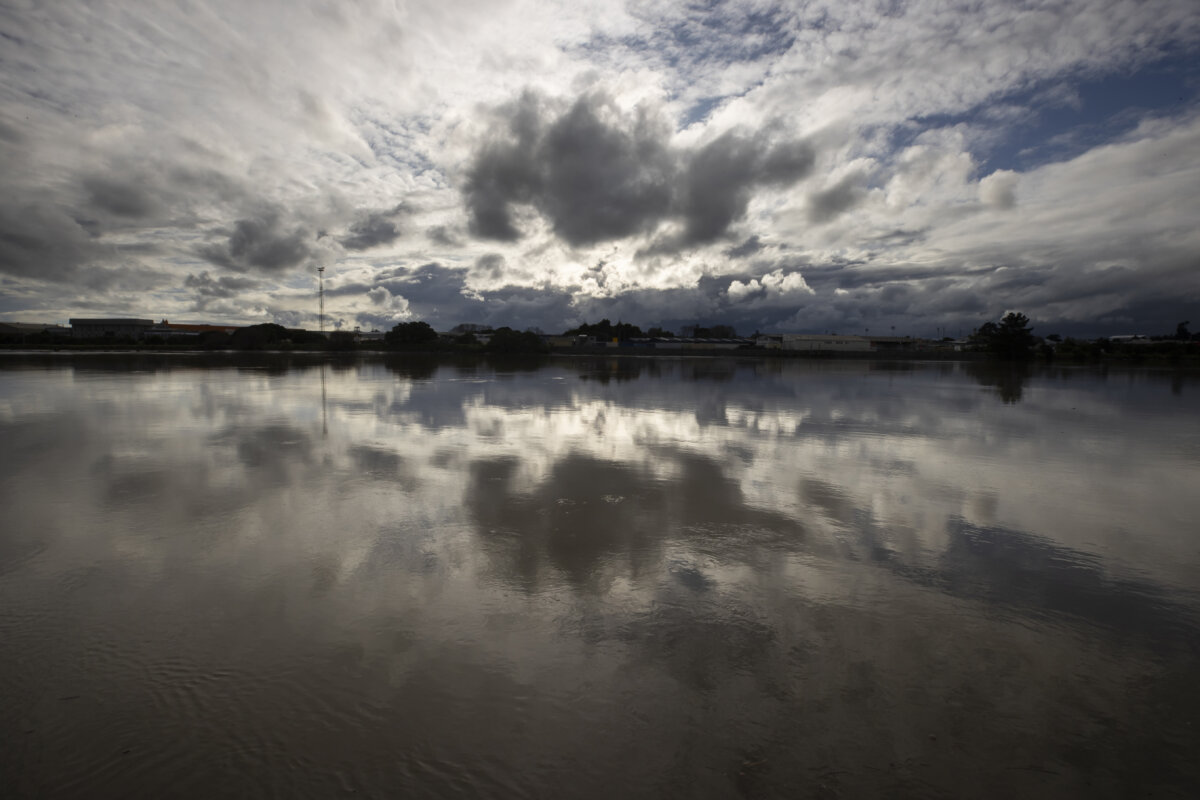
In Canada, this push for personhood to be granted to natural features has become intertwined with UNDRIP principles.
A Raincoast Conservation Foundation study investigating pathways to granting personhood to the Fraser River Estuary, where the Fraser River meets the Pacific in B.C.’s Lower Mainland, cites as justification eight different UNDRIP provisions.
The study argues that Canada’s legal system is currently “dominated by Eurocentric environmental regulations” but that Ottawa’s decision to enshrine UNDRIP nationally “represents a transformative potential to reimagine Canada’s resource laws alongside the revitalization of Indigenous laws and self-government.”
In April 2023, chiefs of the Assembly of First Nations Quebec-Labrador unanimously adopted a resolution to confer legal personhood on the St. Lawrence River, relying heavily on UNDRIP as the source of legitimacy for their declaration.
The resolution begins with the statement that UNDRIP is a “universal international human rights instrument whose principles are legitimately a source of interpretation for domestic law.” It goes on to argue that “the laws and legal traditions of the First Nations and all of their ancestral rights are prior and take precedence over other non-Indigenous legal orders.”
These moves highlight potential flashpoints in the future, as the personhood of rivers may present complications for economic interests using those waterways. Whereas the Magpie River is in remote eastern Quebec, the St. Lawrence River is the backbone of the St. Lawrence Seaway shipping artery, and the Fraser River Estuary is home to part of the Port of Vancouver.
In October 2025, the Alberta Energy Regulator (AER) dismissed a regulatory appeal filed by Ecojustice, an environmental law charity, on behalf of the Athabasca River Basin. The AER contended that “the Athabasca is neither a natural person (a human), nor is it a legal person as that term is defined.”
 Friends Read Free
Copy
Facebook
Tweet
Friends Read Free
Copy
Facebook
Tweet