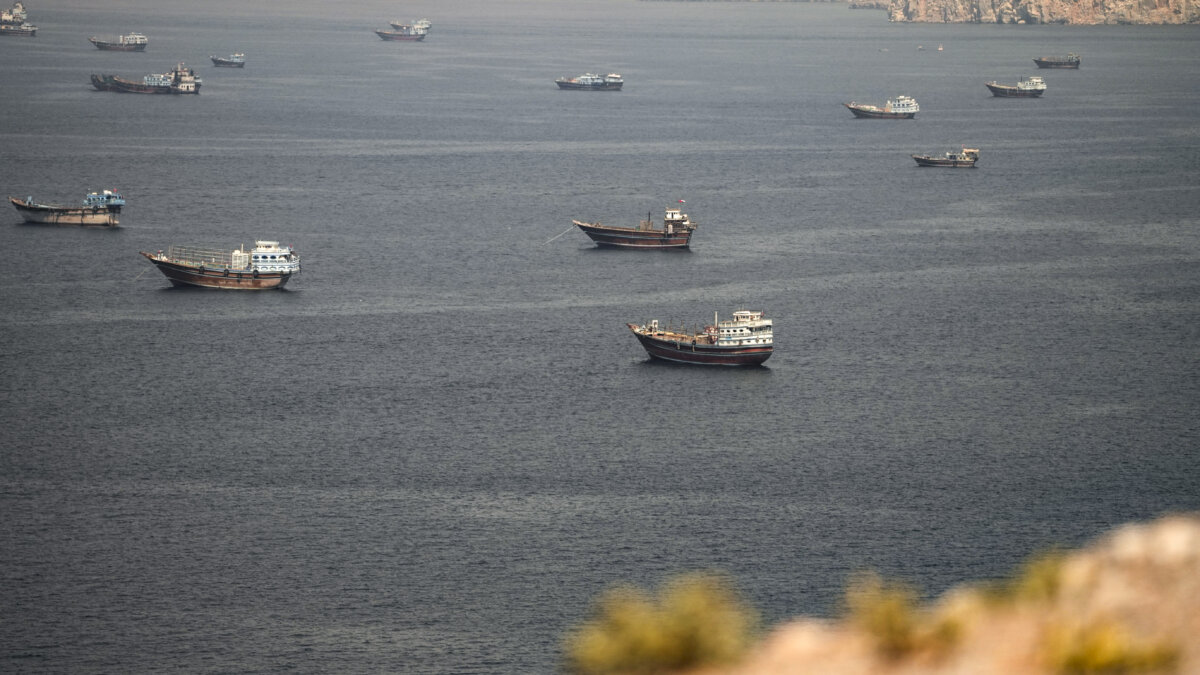

An Iranian official on Friday said that transit through the Strait of Hormuz is only possible via routes that have been approved by Tehran, coming after a commercial vessel was attacked in the strait a day earlier.
On Thursday, the UK Maritime Trade Organization (UKMTO) said that a ship traveling through the strait was struck by an unknown projectile, causing no injuries but damaging the vessel.
“Safe passage through the Strait of Hormuz, with ambiguous arrangements, parallel routes, or decision-making outside of Iran’s considerations as the coastal state, cannot be guaranteed,” Deputy Foreign Minister Kazem Gharibabadi said in a post on X. “Any credible framework must be based on coordination with Iran and the provisions of paragraph five of the Islamabad Memorandum of Understanding. Otherwise, the outcome will be the suspension of the designated parallel route.”
Trump administration officials have said that Iran cannot impose its control over the strait or force ships passing through to pay fees as the attack on the vessel Thursday is a new test of a memorandum that was signed between Washington and Tehran to reopen the strait.
Following reports of the attack on the ship, Iran’s Persian Gulf Strait Authority said in a post on X that transit outside its own routes “will not be covered by the guarantee of safe passage.” The authority was created in recent weeks in response to U.S. and Israeli strikes against Iran, which effectively shut down the strait until last week.
“The consequences arising from passage through unauthorized routes shall be the responsibility of the owner, operator, and vessel commander,” the authority added in the post, according to a translation.
Traffic through the strait increased in recent days but was still well below prewar levels, following the signing of a memorandum of understanding between Iran and the United States to open the strait, in part. Oil on Thursday briefly dipped below its last prewar price of just under $73 per barrel, a sign that the market believes the situation is improving.
Under the memorandum signed last week, the United States and Iran have 60 days to iron out the details. As talks are held behind closed doors, U.S. President Donald Trump and Iranian leaders have seemed to negotiate in public, trading threats and claiming concessions the other side denies.
U.S. Secretary of State Marco Rubio, who was wrapping up a tour of the Gulf to reassure nervous regional allies about the interim pact, told reporters on Thursday that if Iran threatened or blocked vessels in the strait, “we’re going to have a problem.”
In a joint statement released on Thursday, Rubio and the Gulf Cooperation Council also called for the “free, unconditional, and unrestricted navigation” in the waterway without tolls or “attempts to assert control” by any party.
“They stressed the need to maintain momentum and unity as negotiations proceed toward a more permanent end to hostilities and the shared objective of preventing Iran from ever developing or otherwise acquiring a nuclear weapon,” the statement said. “The ministers further emphasized that lasting regional peace and security requires addressing the full spectrum of Iran’s threats, including its ballistic missiles, drones, and support of proxies in the region.”
Officials in the countries that came under attack by Iran following the start of the war also said they “condemned attacks by Iranian proxies in Iraq” on Gulf member states, saying such attacks damaged “civilian facilities, critical infrastructure, and energy security.”
The Associated Press contributed to this report.
 Friends Read Free
Copy
Facebook
Tweet
Friends Read Free
Copy
Facebook
Tweet