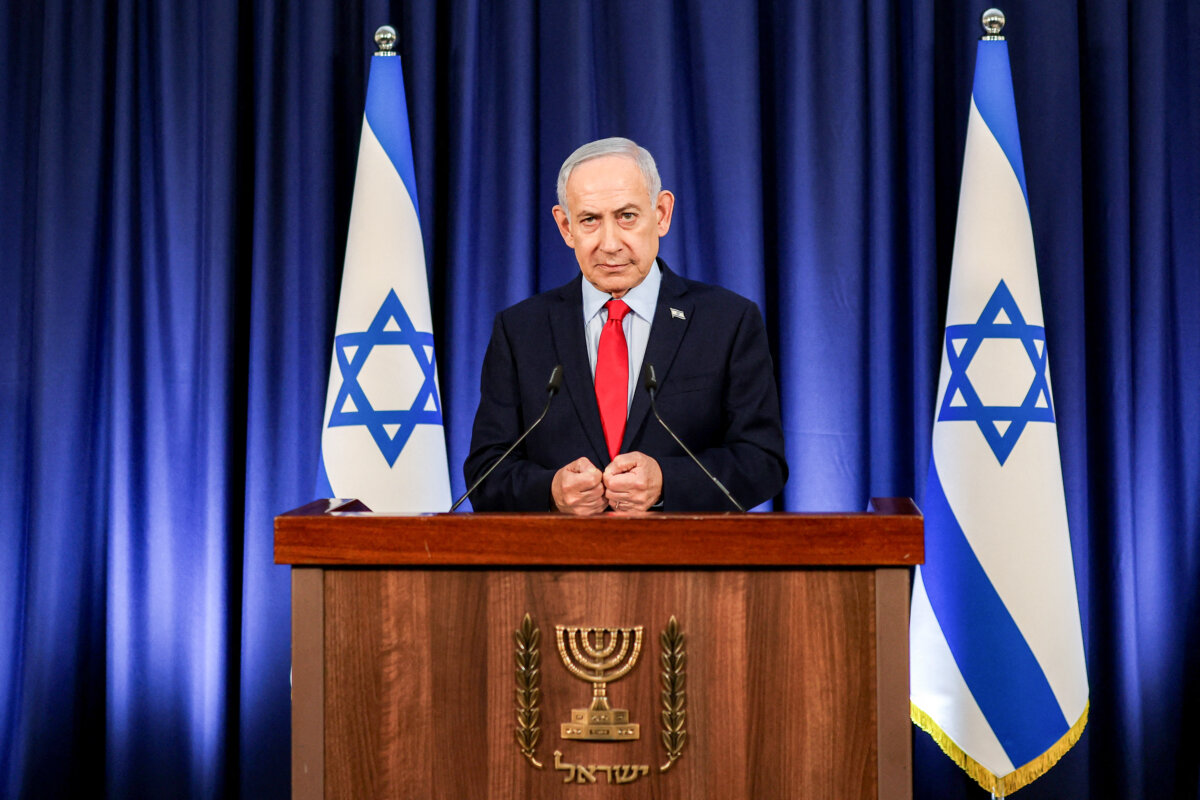
Israel’s war cabinet met overnight to weigh scenarios including a surprise Iranian attack, officials said.
Senior political officials told Epoch Magazine Israel on April 13 that Israeli Prime Minister Benjamin Netanyahu convened the security cabinet on April 12 to discuss a range of scenarios after the United States and Iran failed to reach a deal during negotiations in Islamabad, Pakistan.
Among the scenarios discussed was the possibility of a surprise Iranian attack against Israel, according to the officials, who noted that Israel is awaiting a decision by U.S. President Donald Trump and is preparing for all possibilities, including a security escalation if he decides to resume the campaign against Iran.
The discussions come as Israel is already in the midst of operations beyond Iran.
Trump announced a two-week ceasefire in the six-week war on April 7.
On April 8, the Israel Defense Forces (IDF) launched its largest coordinated strike in Lebanon, targeting more than 100 command centers and military sites of the Hezbollah terrorist group in Beirut, the Beqaa Valley, and southern Lebanon.
“The Iranians thought that the ceasefire included Lebanon, and it just didn’t,” U.S. Vice President JD Vance said at the time, according to an X post by the official White House Rapid Response. “We never made that promise. We never indicated that was going to be the case.”
Netanyahu said on April 9 that the strikes hit crossings allegedly used to transfer thousands of weapons, rockets, and launchers, as well as weapons depots, launchers, and Hezbollah headquarters.
Hezbollah leader Naim Qassem said on April 10 that his group would continue to fight Israel.
In an April 12 post on X, the IDF stated that it raided a hospital in Bint Jbeil in Southern Lebanon, about three miles from the Israeli border, where armed Hezbollah operatives had been holed up, killing about 20 gunmen and seizing weapons.
The IDF stated that “several Hezbollah terrorists were identified conducting surveillance from a hospital window and firing toward IDF soldiers,” also stating that troops “eliminated the terrorists” after identifying the threat.
The footage shows a weapons cache inside the hospital, alleging the site had been used by Hezbollah for “observation posts, concealment positions, and shelter for operatives,” as well as for the transfer and storage of weapons.
An Israeli military official told Reuters on April 13 that it expects that full operational control of the southern Lebanese town of Bint Jbeil will be achieved within days.
According to a 2024 Congress report, Hezbollah (“Party of God,” also spelled Hizballah) is an Iran-backed Lebanese Shia militia and U.S.-designated foreign terrorist organization.
It states that Hezbollah is a partner force of the Iranian regime, helping Tehran “project power across the region, train allied militias (reportedly including Hamas), threatening U.S. interests and allies across the region.”
It notes that Hezbollah has used Israel’s remaining presence in the Shebaa Farms and other disputed areas in the Lebanon–Syria–Israel tri-border region to justify ongoing violence against Israel.
Trump recently hinted at potential escalation, saying that the United States is fully “locked and loaded” and that its “military will finish up the little that is left of Iran.”
Trump said on April 12 that U.S. forces would “seek and interdict every vessel in International Waters that has paid a toll to Iran” and would prevent ships from entering or leaving the Strait of Hormuz.
“No one who pays an illegal toll will have safe passage on the high seas,” he said.
The U.S. Central Command later clarified that the blockade—set to begin on April 13 at 10 a.m. EDT—would apply specifically to vessels entering or exiting Iranian ports, not to broader commercial traffic moving through the strait.
Iran has described the move as an unlawful restriction on international waters and warned of wider consequences.
Iran charged some ships a $2 million toll to pass through the Strait of Hormuz last week. Five ships allegedly paid the fee.
Trump said he refuses to let the Iranian regime make a profit from the waterway, which had not happened before the conflict in the Middle East.
Reuters, Jacki Thrapp, Jack Phillips, and Tom Gantert contributed to this report.
 Friends Read Free
Copy
Facebook
Tweet
Friends Read Free
Copy
Facebook
Tweet