
Seoul has discussed a possible bilateral military logistics support pact with Tokyo, South Korea’s defense minister has said, although Seoul maintains reservations.
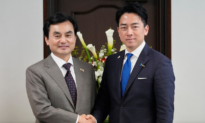
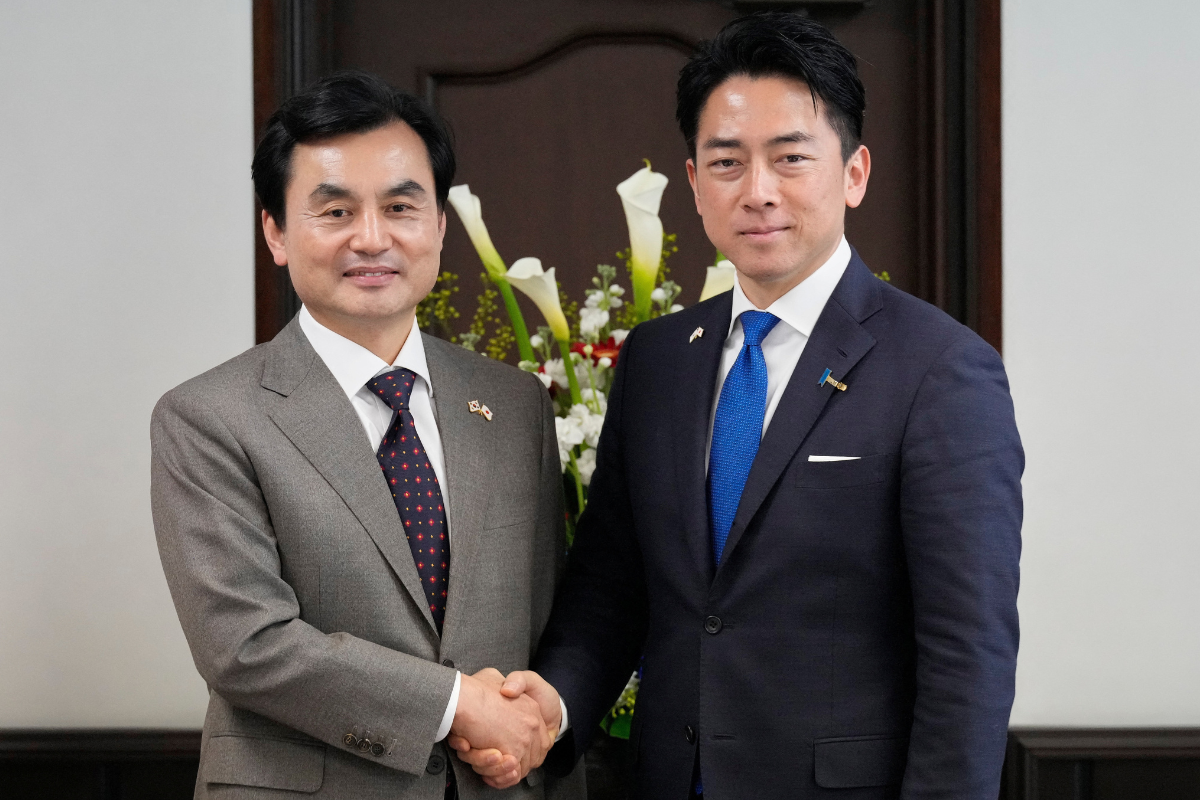
South Korean Defense Minister Ahn Gyu-back told reporters at the Shangri-La Dialogue in Singapore on May 31 that he had held discussions with Japanese Defense Minister Shinjiro Koizumi the day before regarding a potential acquisition and cross-servicing agreement, according to the Yonhap News Agency.
Ahn declined to give further details.
An acquisition and cross-servicing agreement would allow neighboring U.S. allies Japan and South Korea to share and mutually procure military logistics such as ammunition, fuel, and food.
“As this is a matter that requires understanding and persuasion from the peoples of both countries, we still believe that we should remain cautious,” Ahn said.
South Korea has been wary about agreeing to such a deal given sensitivities over Japan’s colonial rule over the Korean peninsula between 1910 and 1945, and public resistance to the possibility of Japanese troops operating in South Korea.
The Japanese Ministry of Defense also said in a May 30 statement that during Koizumi’s meeting with Ahn, the ministers agreed to conduct joint search-and-rescue exercises in June, the first such drills the two countries have conducted in about nine years.
“The two ministers also reaffirmed their intention to continue promoting Japan-South Korea and Japan-U.S.-South Korea defense cooperation,” the statement reads.
Japan Rejects Accusations of ‘New Militarism’
During a speech at the Shangri-La Dialogue on May 31, Koizumi rejected accusations that Tokyo was pursuing a “new militarism” and criticized Beijing for expanding its military with little transparency.
“China’s external approach and military activities are matters of serious concern for Japan and the international community at the same time,” Koizumi said.
“Think about it. There’s a country that has a huge arsenal of nuclear weapons and strategic bombers. Japan has neither of such weapons, and yet Japan is labeled ‘new militarism’?”
Koizumi said that since World War II, Tokyo has adhered to international law and is committed to the U.N. Charter.
At the same forum, Chinese delegate Maj. Gen. Meng Xiangqing criticized Japan, saying that he doubted whether Tokyo was qualified to talk about international defense cooperation and whether it could gain the trust of global partners.
Last month, China’s foreign ministry called on nations in the Asia-Pacific to be vigilant and resist actions of Japan’s “neo-militarism.”
Relations between Tokyo and Beijing have been strained after Japanese Prime Minister Sanae Takaichi said in November that an attack on Taiwan would be deemed an existential threat to her country.
Germany, Japan Reject Russian Criticism
Tokyo’s defense expansion has drawn similar criticisms from Russia.
Russian U.N. Ambassador Vassily Nebenzia said on May 26 that Japan’s—and Germany’s—“remilitarization” was a threat to global security that undermines the results of World War II.
Japanese envoy Kazuyuki Yamazaki rejected these claims, criticizing Russia for “continuing its aggression against Ukraine in violation of the charter.”
“Japan’s efforts to strengthen its defense capabilities are a response to an increasingly severe security environment and are not directed against any specific country,” Yamazaki said. “Japan has consistently maintained an exclusively defense-oriented policy under its constitution.
“It is ridiculous to criticize Japan’s defense posture as militaristic. It is even more so [coming from] a state continuing its own military aggression in clear violation of the U.N. Charter.”
German Minister of State for Europe Gunther Krichbaum called Nebenzia’s comments that criticized Germany “unjustified accusations.”
“We have been and continue to be crystal clear about our aim, which is to live in peace with our neighbors and prevent conflicts in and beyond Europe and around the world,” Krichbaum said.
Japan and Germany have been increasing their defense capacities in recent years in response to regional threats from the Chinese communist regime in the East China Sea and the Russian war in Ukraine on the doorstep of NATO.
Reuters contributed to this report.
 Friends Read Free
Copy
Facebook
Tweet
Friends Read Free
Copy
Facebook
Tweet