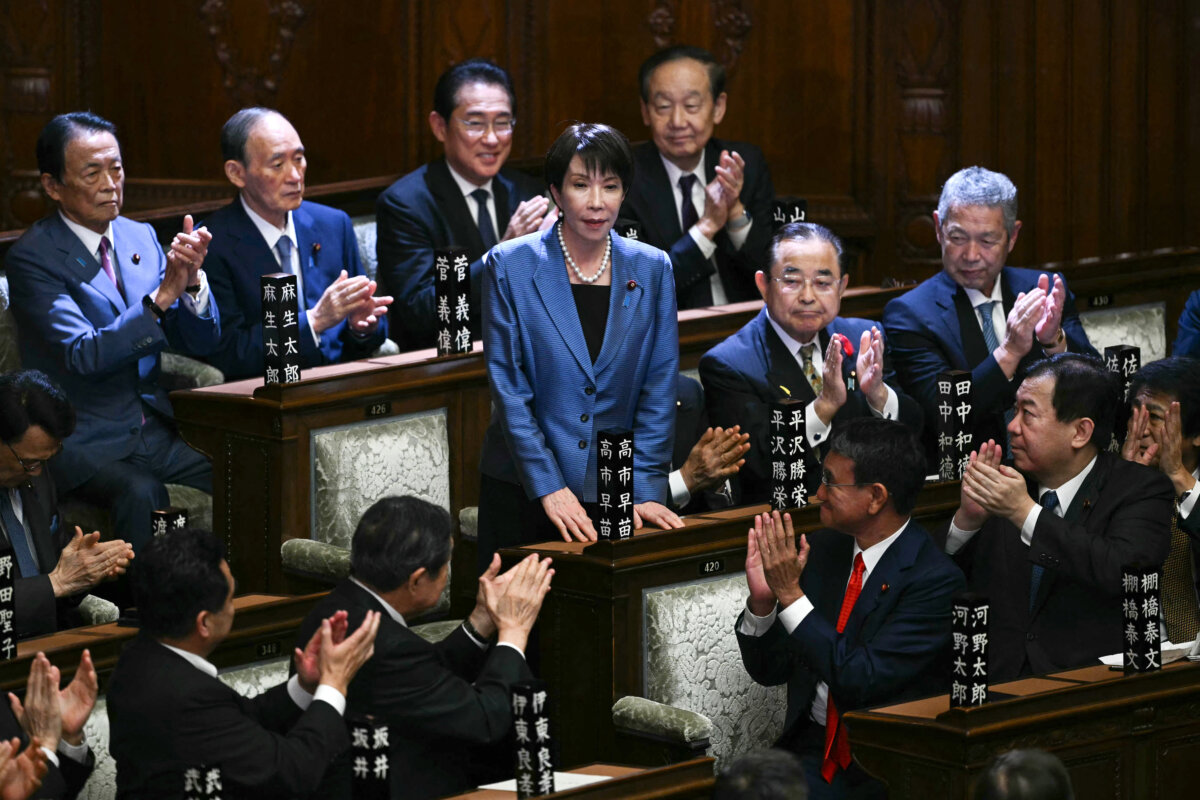

Japanese Prime Minister Sanae Takaichi has vowed to boost the country’s defense capabilities and revise its security strategy amid rising geopolitical tensions in the region.
Leader of the Liberal Democratic Party (LDP), Takaichi took office on Oct. 21, becoming Japan’s first female prime minister and forming a coalition government with the right-wing Japan Innovation Party.
Speaking to Japan’s parliament on Friday, Takaichi said her government will increase defense spending to 2 percent of GDP by March, and will revise its security strategy by the end of 2026.
The proactive push for what Takaichi called a “fundamental buildup” of Japan’s power comes amid rising tensions in the region with China, North Korea, and Russia.
“The free, open, and stable international order that we were accustomed to is violently shaken in the face of historic change of power balance and intensifying geopolitical competitions,” Takaichi said in her speech.
“In the region around Japan, military activities and other actions from our neighbors China, North Korea, and Russia are causing grave concerns.”
A day after Takaichi’s appointment, South Korea’s military said that North Korea test-fired multiple short-range ballistic missiles. The launches come ahead of President Donald Trump’s trip to the region.
Takaichi hasn’t elaborated on how her minority government will fund plans to upgrade its national security strategy, but a statement from her office said Japan will pursue a growth strategy focused on strategic investments to strengthen the economy and build resilience against future crises in partnership with the private sector.
The statement added that the government will maintain fiscal discipline while using proactive policies to raise incomes, encourage spending, and increase tax revenues.
To deliver on her policies, Takaichi needs the opposition’s cooperation.
A Trust-Based Partnership
Trump and Treasury Secretary Scott Bessent welcomed Takaichi’s appointment, with Bessent calling her “a valuable partner in deepening the relationship between Japan and the United States.”
U.S. Ambassador to Japan George Glass said that under Trump and Takaichi, the relationship between the two countries would reach new heights of cooperation in areas such as security, technology, energy, and trade.
Trump will fly to Tokyo on Oct. 27, as part of his upcoming trip to Asia, and will take part in a bilateral meeting with Takaichi on Oct. 28, the White House has confirmed.
Takaichi said she plans to talk with Trump about strengthening the Japan-U.S. alliance and building a stronger, trust-based personal relationship. She also said Japan needs a stable and constructive relationship with China, though there are still “security concerns” between the two countries.
Trump is also set to meet with Chinese leader Xi Jinping on Oct. 30, after visiting South Korea and taking part in events related to the Asia-Pacific Economic Cooperation forum before concluding his trip to the region.
The ‘Massive’ Trade Deal
In 2024, trade between the United States and Japan totaled $319.2 billion, up 4 percent from 2023.
In July, President Donald Trump announced what he called a “massive” trade deal with Japan.
Under the agreement, Japan will invest $550 billion in the United States, while tariffs on Japanese goods entering the country will be set at 15 percent, lower than the 25 percent Trump had previously threatened.
The deal also includes greater market access for U.S. exports, including automobiles, trucks, rice, and agricultural products.
A framework agreement outlining these terms was formally announced on July 22.
Immigration
Commenting on immigration, Takaichi said that Japan needs foreign workers to offset its labor shortage amid a rapidly aging population, but only those who abide by the country’s laws.
“It is a fact that unlawful activity and violation of rules by some foreigners are causing the sense of unease and unfairness among Japanese people,” Takaichi said in her speech to parliament.
“The government will respond decisively to these activities. It’s not xenophobia.”
Economic Security Minister Kimi Onoda has been tasked with tightening regulations on foreigners in Japan and examining potential restrictions on land purchases by foreigners, particularly Chinese buyers.
The Associated Press contributed to this report.
 Friends Read Free
Copy
Facebook
Tweet
Friends Read Free
Copy
Facebook
Tweet