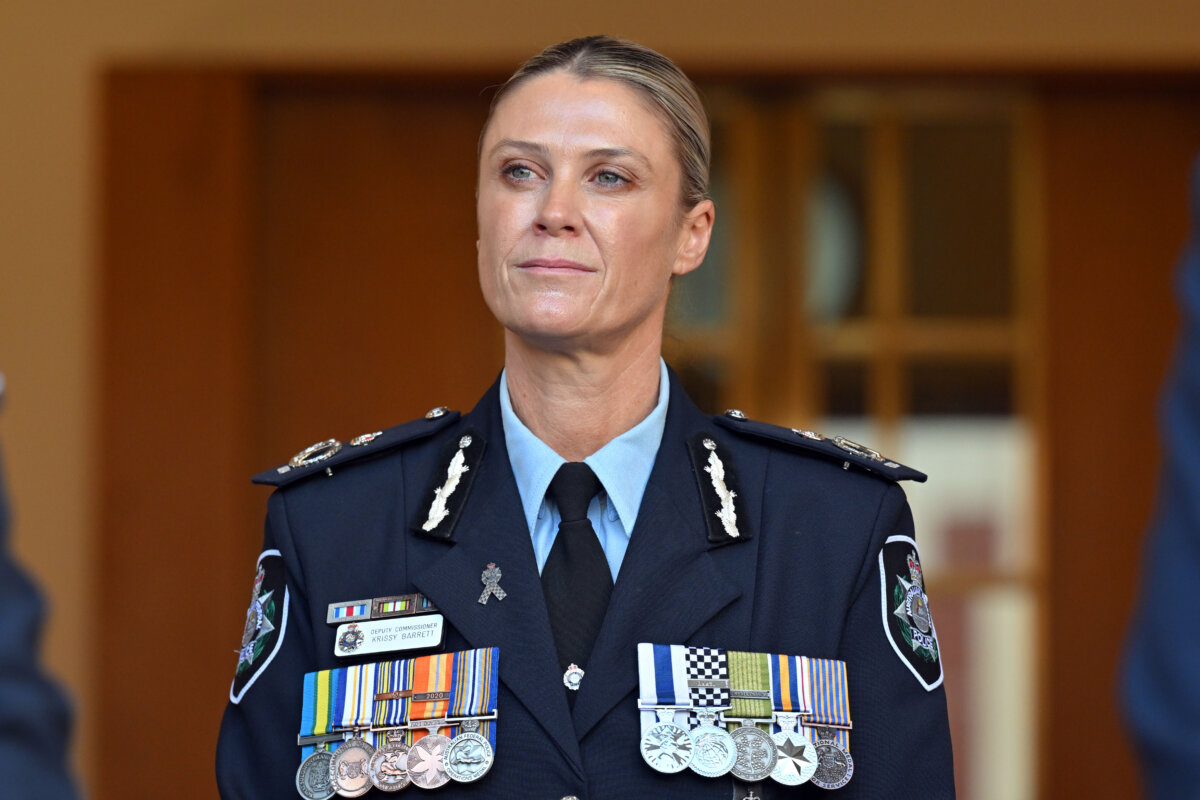

Krissy Barrett will become the first woman to lead the Australian Federal Police (AFP), officially taking over as commissioner on Oct. 4.
Barrett has nearly 25 years of policing experience and most recently served as deputy commissioner for national security.
She also played a role in the investigation into the Bali bombings.
Barrett replaces Reece Kershaw, who has been in the role since 2019.
Outlining her priorities, Barrett said she will focus on keeping Australians safe, protecting vulnerable people, and addressing emerging national security threats from criminals with increasingly complex motivations.
She added that strengthening social cohesion in the face of rising hate crimes will also be a focus.
“I will have more to say about my priorities as commissioner in the coming weeks,” she said.
Leadership, Legacy and Loyalty to the Force
Barrett paid tribute to outgoing Kershaw, describing him as a “true mentor” and thanking him for his leadership and guidance.
She also addressed AFP members directly, acknowledging their dedication and service. Barrett pledged to be their advocate and to uphold the values of the organisation.
“I promise I will do this uniform proud for you and to every Australian. I will be devoted to protecting you and our way of life, and I commit to working as hard as I can every single day, like every AFP Commissioner before me.”
Reflecting on her journey, Barrett recalled starting her career with the AFP as a 21-year-old administrative assistant in the Melbourne office.
“I never imagined that one day I would be leading this very fine organisation which now has a workforce of over 8,000 people and is posted in more than 30 countries across the world,” she said.
Albanese Calls Barrett’s Selection ‘Historic’
Prime Minister Anthony Albanese said Barrett’s selection marked a significant moment.
“Today’s announcement is a historic appointment for the Australian government and for the AFP, with Barrett becoming the first woman to hold the position of commissioner,” he said.
Burke shared that Kershaw had requested a private meeting to inform him of his plan to retire on Oct. 3, citing family considerations and a desire to spend more time with his grandchildren.
“I wasn’t expecting the announcement from him, but he leaves with his head held high and on the best possible terms with the government,” Burke said.
He praised Kershaw’s leadership in several areas, including organised crime, cyber security, and international cooperation.
“Commissioner Kershaw has led extraordinary work with respect to organised crime, setting up the foreign interference Task Force, confiscation of criminal assets now $1.2 billion, work in setting up the cyber capacity, and importantly, with respect to our relationship with the policing organisations throughout the Pacific,” Burke said.
 Friends Read Free
Copy
Facebook
Tweet
Friends Read Free
Copy
Facebook
Tweet