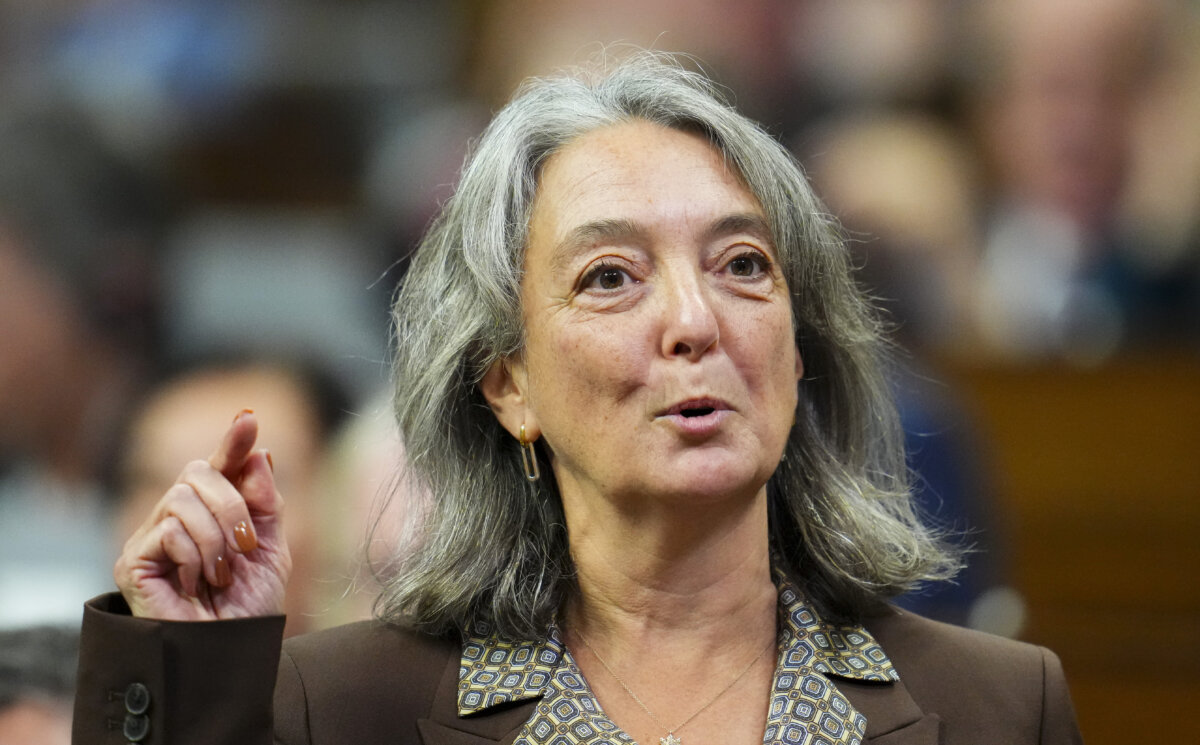

Federal Environment Minister Julie Dabrusin says Ottawa is acting with “urgency” to satisfy requirements outlined in the federal budget for abolishing the oil-and-gas emissions cap, but she did not provide a specific timeline for its removal during a weekend speech.
Dabrusin and Energy Minister Tim Hodgson held a press conference in Toronto on Nov. 9 to promote the government’s Climate Competitiveness Strategy and discuss how the budget will impact both the environment and the country’s economy.
One of the items in the climate strategy is moving away from the federal oil and gas emissions cap introduced by Prime Minister Mark Carney’s predecessor, Justin Trudeau, and so far maintained by the Carney government, while Alberta and Saskatchewan ask for it to be removed. The prairie provinces argue the cap acts as a de facto limit on oil and gas production, amounting to an infringement on their jurisdictions, while Ottawa maintains the policy is intended to reduce greenhouse gas emissions, falling under federal environmental authority.
Dabrusin said that the oil and gas emissions cap would not be required if the government fulfills its commitments to lower emissions via other strategies, such as updating industrial carbon markets and reinforcing the industrial carbon tax. She did not specify, however, whether it would take months or years for Canada to fulfill the requirements necessary to lift the emissions cap.
“We absolutely need to continue to work with urgency and it’s an imperative … that is the way that I’m approaching it, that our government is approaching it,” Dabrusin told reporters.
Hodgson also didn’t give any clues about a possible timeline, but said the government wants to clarify “our regulations to reduce emissions” so the private sector can focus more of its time on development and less on dealing with red tape.
He said carbon pricing for the industry is a key part of the Carney government’s strategy which is why it was part of the budget tabled on Nov. 4.
“This is a system that works, delivering more emissions reductions than any other policy at the lowest possible cost,” the energy minister said.
The federal Conservatives have criticized the industrial carbon tax, arguing that it drives away investment and increases costs for Canadian consumers.
“Mark Carney’s industrial carbon tax is pushing factories, jobs, and investment out of Canada, while driving prices higher here at home,” Conservative Party Leader Pierre Poilievre said on social media.
As part of its environmental plan, Ottawa also plans to boost investment through Clean Economy Investment Tax Credits, a program that gives credit for investing in either carbon capture and storage or clean technology property. The ministers said the credits will make it more affordable for Canadian industries to shift to clean energy, upgrade electricity grids, broaden renewable sources, grow energy storage, and fortify power links among the provinces.
As part of that, the government will implement a 15 percent Clean Electricity investment tax credit, extend the list of critical minerals eligible for the 30 percent Clean Technology Manufacturing investment tax credit, and offer clean technology and clean hydrogen tax credits.
Also on the list is clarification of greenhouse gas regulations, the ministers said. This will include finalizing enhanced methane regulations for the oil and gas sector. Alberta and Saskatchewan have been critical of the federal government’s cap on methane emissions, saying that in effect it will curtail production in the energy sector.
Ottawa also wants to modify “greenwashing” regulations within the Competition Act, which require companies to prove the merits of their environmental programs.
“These ‘greenwashing’ provisions are creating investment uncertainty and having the opposite of the desired effect, with some parties slowing or reversing efforts to protect the environment,” the budget said.
Business Council of Canada president and CEO Goldy Hyder said that plans to reform regulations fall short of what is needed to spur investments.
“Canada is experiencing an investment crisis,” Hyder said in a Nov. 5 statement. “The budget lacks sufficient new measures to reduce taxes or increase incentives on private sector investment, regulatory reform remains aspirational, projected deficits are at historically high levels and the plan is without strong fiscal anchors.”
Meanwhile, some groups focused on climate change criticized the federal government’s Climate Competitiveness Strategy, saying it doesn’t go far enough.
“This government, headed by PM Carney, hasn’t produced a credible plan to fight climate change or carve out a niche for Canada in the low-carbon economy,” Environmental Defence programs director Keith Brooks said in a Nov. 9 statement.
 Friends Read Free
Copy
Facebook
Tweet
Friends Read Free
Copy
Facebook
Tweet