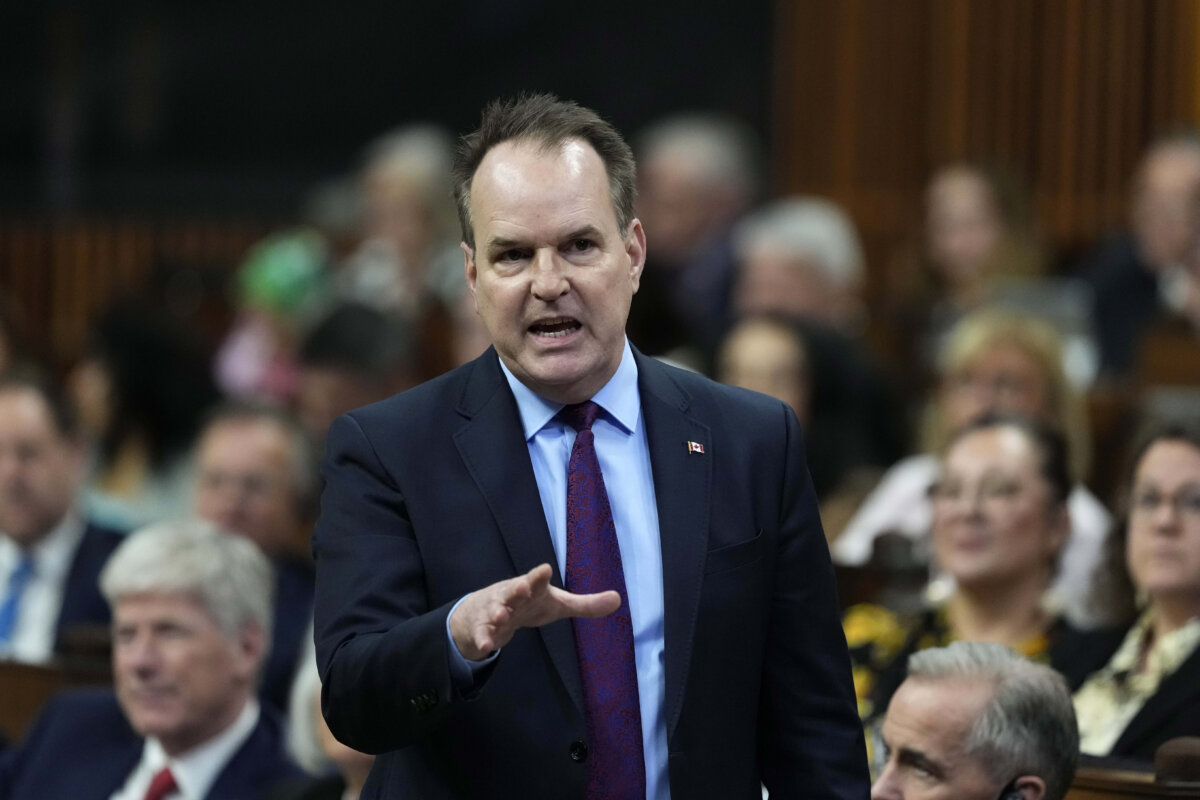

The Liberal government is moving to take control of most House of Commons committees after gaining majority status.
Government House Leader Steven MacKinnon gave notice of a motion on April 21 to amend the Commons’ standing orders adopted at the start of the 45th Parliament, when the Liberals had a minority government. A vote date on the motion has yet to be set, but it will almost certainly pass.
The standing orders adopted in the House last year stipulate that the structure of committees remain in place for the duration of the Parliament, but MacKinnon says the circumstances have changed with the Liberals gaining a majority.
The current rules dictate that the governing party and the opposition parties have an equal share of members in most committees. The Liberals have five seats, the Conservatives four, and the Bloc Québécois one. The NDP has no committee seats because it lost official party status in the last election.
MacKinnon is now proposing that most committees be composed of 12 members, with the Liberals taking seven seats.
Changes would also affect three committees that play a key role in scrutinizing government affairs, and where opposition parties hold a majority and Conservative MPs serve as chair. They would expand from nine to 10 members, with the Liberals taking five seats. The committees affected include ethics, government operations, and public accounts.
“We do not want to play silly partisan games that waste the time and the money of taxpayers in this place,” MacKinnon said on April 22 of his upcoming motion to change committee composition.
He defended the government’s plan to change the standing orders adopted after the April 2025 election when the Liberals had a minority.
“There is a longstanding principle: a party that has the majority of seats in the House also has a majority in committees,” he said.
The Liberals obtained a majority of 174 seats after five opposition MPs joined their ranks since November. The majority was confirmed with the Liberal Party reclaiming three recently loss seats in the April 13 byelections in Toronto and Terrebonne.
Tory House Leader Andrew Scheer accused the Liberals of “stacking the deck to avoid accountability.”
“They are giving themselves the power to shut down investigations into Liberal corruption; to block the release of documents; to hear from whistleblowers,” Scheer said in an April 21 X post.
Speaking to reporters on April 22, Scheer said his party will propose an amendment to the Liberal motion to preserve the opposition majority on the ethics, government operations, and public accounts committees. “Any excuse they might have about a legislative agenda does not apply to the oversight committees,” he said, noting those are crucial to keep the government accountable.
Scheer criticized the Liberals’ plan to take over committees last week, and MacKinnon told reporters this is the reason he decided not to consult with opposition parties on the matter.
The Liberals accuse the opposition of bogging down committee work and say they hope the upcoming change will help them carry out their agenda.
Conservatives have also accused the Liberals of filibustering in committee, including on their recent push to have Finance Minister François-Philippe Champagne testify before the ethics committee on his links to the Alto high-speed rail project.
Champagne’s partner, Anne-Marie Gaudet, is a vice-president with the Crown Corporation and he recused himself from decisions pertaining to the project last September. The ethics commissioner says Champagne is compliant with conflict-of-interest rules.
The ethics committee this week adopted a motion asking Champagne and the ethics commissioner to appear after the Liberals on the committee dragged out debate.
Asked by reporters why the Liberals led a filibuster on the issue, MacKinnon said it’s because Conservatives are leading a “deeply partisan and vexatious series of attacks” on Champagne.
Tory MP Michael Barrett, his party’s ethics critic, says Champagne took part in House votes related to the project and testified in the Senate in March that the Liberals are “delivering the goods” on the high-speed rail project.
Earlier this year, Conservatives extended debates in committee on hate crime legislation Bill C-9, as they sought to prevent the passing of an amendment to remove the religious defence to hate speech. The Liberals eventually passed a motion to curtail debate on the bill and force a vote, and the bill is currently in the Senate for review.
MacKinnon told reporters the government does not intend to go back on decisions that were made once it obtains a majority on committees. The Liberals supported the Bloc Québécois amendment in committee removing the religious defence in C-9 in order to get the support from one opposition party for their legislation.
 Friends Read Free
Copy
Facebook
Tweet
Friends Read Free
Copy
Facebook
Tweet