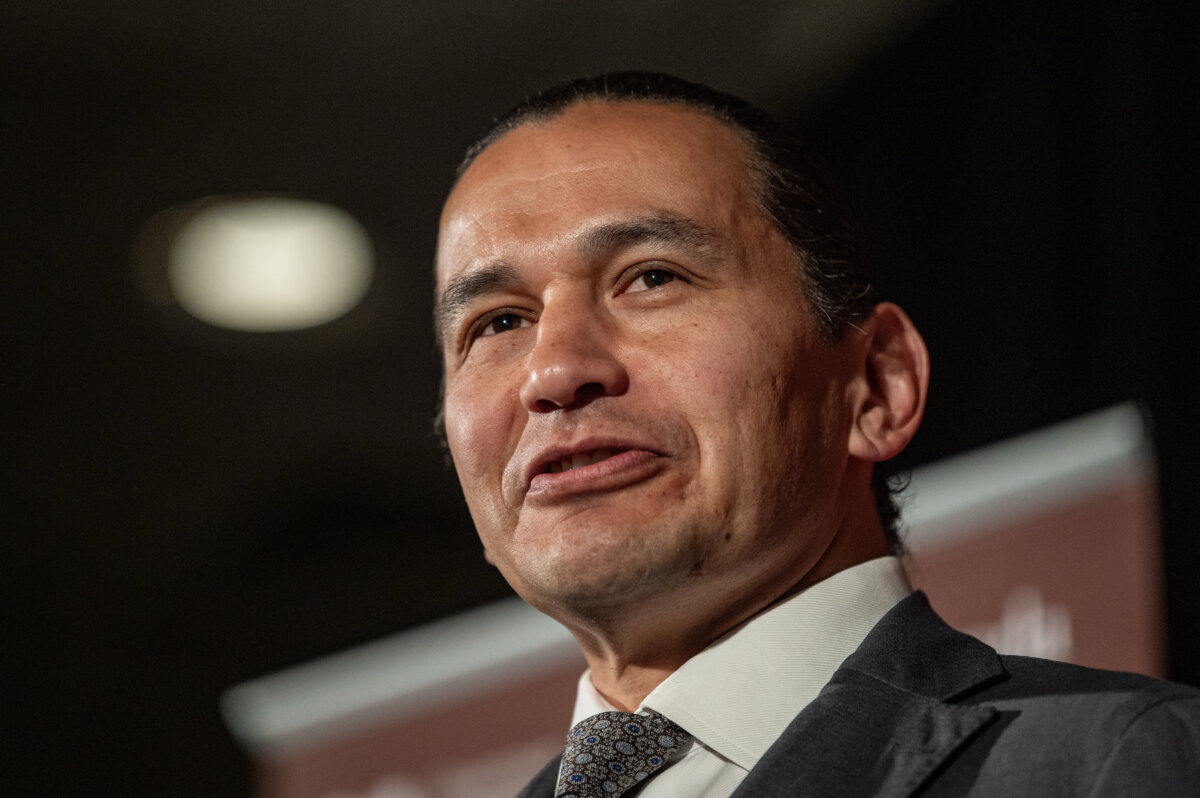

Manitoba Premier Wab Kinew is joining Conservative leaders in condemning a Supreme Court ruling that says mandatory minimum jail sentences for child pornography offences are unconstitutional.
“Child sexual abuse images and video, this is like one of the worst things that anyone can do,” Kinew told reporters at an unrelated event on Nov. 3.
“Not only should [you] go to prison for a long time, they should bury you under the prison. You shouldn’t get protective custody. They should put you into the general [prison] population, if you know what I mean.”
Canada’s top court ruled on Oct. 31 that the one-year mandatory minimum jail sentences for accessing or possessing child pornography are unconstitutional. In a narrow 5–4 decision, the highest court indicated that such minimum sentences strip judges of their discretion to impose alternative sentences to imprisonment when deemed suitable.
Conservative politicians, including Opposition Leader Pierre Poilievre, Alberta Premier Danielle Smith, and Ontario Premier Doug Ford, have called for Ottawa to use the notwithstanding clause to overturn the decision. The clause allows governments to bypass specific provisions of the Charter of Rights and Freedoms.
Kinew said during question period in the legislature that he agrees with their stance.
“Child sexual abuse images and videos are one of the worst things that people can be involved in, and we absolutely should bring the hammer down,” he said during the Nov. 3 session.
“There should be mandatory minimums. There should be no protective custody once incarcerated, for people messing around with this. And when it comes to Opposition Leader Pierre Poilievre, my colleagues Doug Ford, Danielle Smith, who’s weighed in on this, yes, I support their position.”
Manitoba Opposition Leader Obby Khan asked Kinew if he would stand behind his words and call Prime Minister Mark Carney to ask him to invoke the notwithstanding clause.
“I’ll do you one better. I’ll invoke the code of the streets,” Kinew responded. “Release these skinners into general population, and let’s see what happens.” Skinners is a slang word to refer to sex offenders.
Khan later criticized Kinew’s comment when speaking to reporters after question period, saying the premier should not be calling for “vigilante street justice.”
“That’s not leadership,” he said. “That’s not being a serious premier.”
The Criminal Defence Lawyers Association of Manitoba also criticized Kinew for suggesting vigilante justice.
“What disappoints us is the suggestion, from the highest elected official in our province, that extrajudicial vigilante justice is appropriate and even desirable,” the association said in a written statement.
“The system of laws that govern our society are designed to deal with all individuals fairly and provide just sentences that take into consideration a variety of competing interests in how they’re meted out. The premier’s comments are an affront to this system and an affront to the rule of law in general.”
The association urged Kinew to speak more cautiously when discussing court rulings, saying such comments are “unhelpful from an elected representative.”
The ruling addresses rare, theoretical situations in which conditions might justify a sentence less severe than a year in prison, the group added, noting that Kinew’s comments were made “likely without understanding what the decision is and is not.”
Notwithstanding Clause
Khan noted during question period that although Kinew expressed his support for opposing the Supreme Court’s ruling, he did not explicitly state whether he would advocate for the implementation of the notwithstanding clause. Khan encouraged the premier to take that step despite comments Kinew has made about its use in the past.
Kinew has been critical of Quebec, Alberta, and Saskatchewan for using the legal loophole, saying the governments in these provinces used it to undermine the rights of vulnerable individuals.
Saskatchewan invoked the clause for a law that prevents children under 16 from changing their names or pronouns at school without parental consent. Alberta has used the clause more than once, including last week as part of a bill ordering striking teachers back to work.
Quebec has used the notwithstanding clause several times, most recently to prevent public-sector workers in positions of authority from wearing religious symbols while at work.
Kinew introduced a bill last month that would require judges to provide input whenever the Manitoba government uses the notwithstanding clause to bypass Charter rights. Judges would not have the authority to prevent the government from acting, but would deliver an opinion on the constitutionality of the bill in the absence of the notwithstanding clause.
Court Ruling Controversy
Kinew is the latest leader to speak out about the Supreme Court’s decision.
Poilievre said a Conservative government would use the notwithstanding clause to legislate mandatory prison time for child porn offences, adding that those convicted of such offences “must face mandatory prison time.”
“The Supreme Court ruling today removing those penalties was dead wrong,” he said in an Oct. 31 post on X, noting in an earlier post that authors, distributors, and possessors of child pornography “must be severely punished.”
Ontario Premier Doug Ford also urged Ottawa to use the clause, saying in an X post that the “disgusting scumbags who prey on children” deserve to be “behind bars for the rest of their miserable lives.”
Alberta Premier Danielle Smith issued a similar call, saying on X that “a one-year minimum sentence is already far too lenient.”
The Supreme Court’s ruling stemmed from an argument by two Quebec men who pleaded guilty to child pornography offences, saying the mandatory one-year sentence infringed upon their Charter right to be free from “cruel and unusual treatment or punishment.”
The decision said such offences “can be committed in different ways, under different circumstances and by different offenders,” noting that the offence can cover “a very wide range of circumstances.”
The five judges who supported the decision said a “well-organized offender” that has “accumulated thousands of files” is completely different from a “young 18‑year‑old offender who, one day, keeps and views a file showing a 17‑year‑old victim that was sent to the offender without them having requested it.”
The dissenting opinion from the remaining four justices argued it had not been demonstrated that the minimum sentences for offences related to child pornography “constitute cruel and unusual punishment.”
The Canadian Press contributed to this report.
 Friends Read Free
Copy
Facebook
Tweet
Friends Read Free
Copy
Facebook
Tweet