
German Chancellor Friedrich Merz will travel to China this week to explore new areas of cooperation with Beijing, as official figures show China has once again become Germany’s most important trading partner.
Merz is expected to meet Chinese leader Xi Jinping in Beijing during a visit from Feb. 24 to 27.
Speaking at his party’s Ash Wednesday event last week in the western city of Trier, Merz said his goal was to talk “about future cooperation between Europe and Germany on this side and China on that side.”
“We have a strategic interest in finding partners in the world who think the way we do, who act the way we do, and who, above all, are prepared to shape the future together so that we remain a country with prosperity and a high level of social security,” he said.
Merz said that U.S. President Donald Trump’s tariff push has tested relations between Washington and its European allies.
“If the Americans believe that, with their tariff policy, they should exert influence around the world—if they believe that tariffs are more important than taxes at home—then that is something Americans can, of course, decide for themselves. But it is not our policy,” Merz said.
The comments came after Germany’s Federal Statistical Office, Destatis, released figures on Feb. 20 stating that “China is Germany’s most important trading partner once again in 2025.”
“With a foreign trade turnover (total of goods exports and imports) of 251.8 billion euros [$296 billion] the People’s Republic of China was Germany’s most important trading partner again in 2025, a title it also held in the period from 2016 to 2023,” the office said.
Trade with China rose 2.2 percent from 2024, when the United States had briefly taken the top spot.
Destatis added that China “therefore took over the top position from the United States, which was Germany’s most important trading partner in 2024.”
Merz will be accompanied by business leaders, including BMW CEO Oliver Zipse.
“Complex global challenges can only be solved by working together,” Zipse said on Feb. 19.
“With his trip to China, the chancellor is sending a strong signal for dialogue and cooperation.
“Those who close their minds to China’s enormous market and innovation potential are missing out on great opportunities for global growth and economic success.”
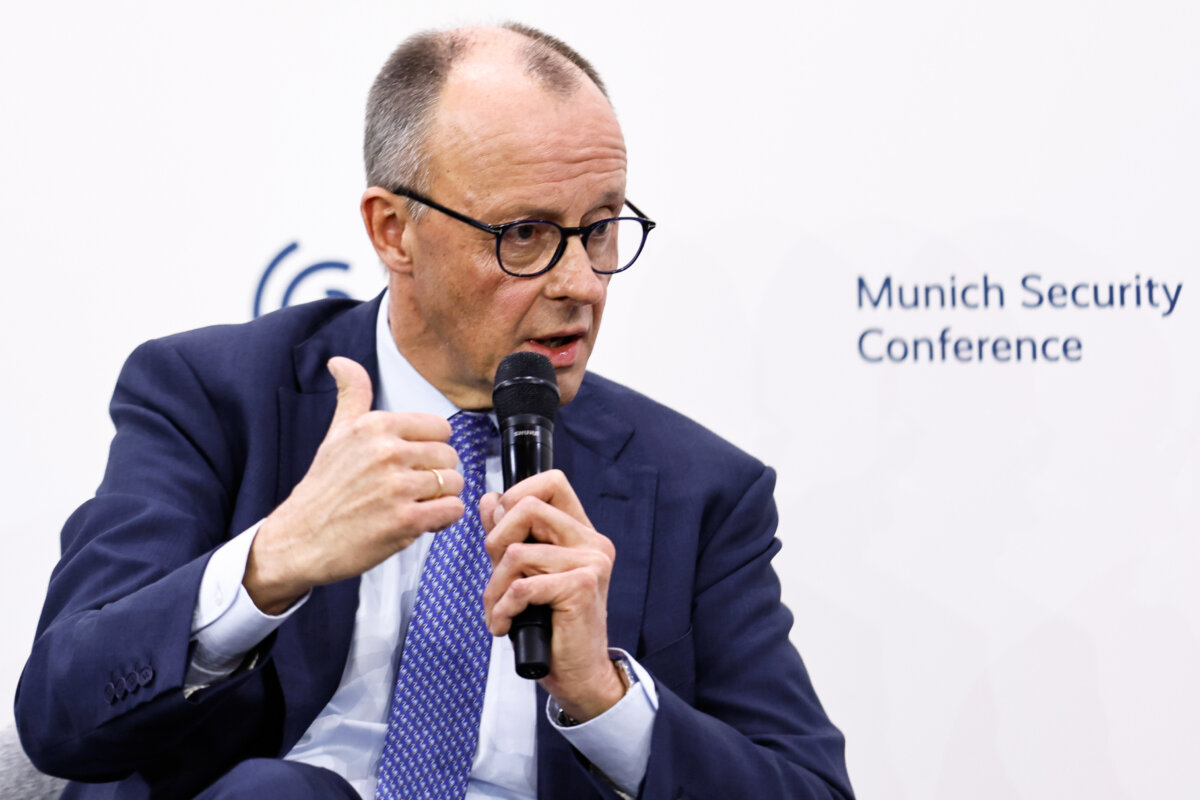
At the Munich Security Conference earlier this month, Merz said in a speech on Feb 18 that “China has the ambition to shape global affairs, laying the foundations for this over many years with strategic patience.”
“In the foreseeable future, Beijing could draw level with the US in terms of military might. China is systematically exploiting the dependencies of others, reinterpreting the international order on its own terms,” he added.
He said that the United States’ “claim to leadership is being challenged, perhaps even forfeited.”
Germany’s outreach comes as several European countries have stepped up engagement with the Chinese Communist Party (CCP) in recent months.
British Prime Minister Keir Starmer visited China in late January, traveling with more than 50 business representatives for talks with Xi and Chinese Premier Li Qiang.
“It doesn’t make sense to stick our head in the sand when it comes to China; it’s in our interests to engage,” Starmer said at the time.
Irish Prime Minister Micheál Martin also paid an official visit to China in early January. Martin reaffirmed Ireland’s support for the One China Policy during meetings in Beijing and Shanghai, meaning it does not recognize Taiwan as an independent nation.
Last year, Xi offered Spain’s King Felipe VI a vision of cooperation with “great global influence” during the first Spanish state visit to China in nearly two decades.
The Epoch Times has contacted the German government for comment.
Chris Summers and Reuters contributed to this report.
 Friends Read Free
Copy
Facebook
Tweet
Friends Read Free
Copy
Facebook
Tweet