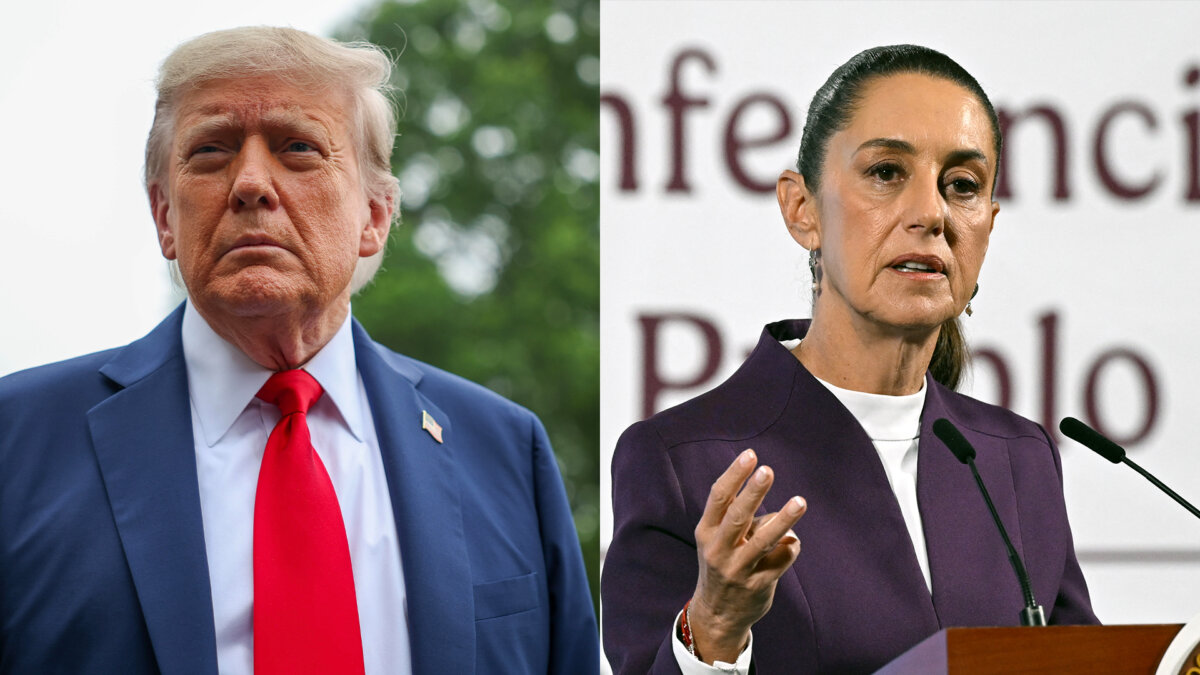

Mexican President Claudia Sheinbaum “should not have refused” the U.S. president’s help in fighting criminal cartels in her country, President Donald Trump told reporters at Joint Base Andrews on March 13.
Trump was asked about a post he made earlier about a remark Sheinbaum made at a recent press conference.
The Mexican president said: “It is good that President Trump says publicly that when he has proposed that the U.S. Army enters Mexico, we have said no. Because it is the truth, we have said no. And we proudly continue to say no.”
In response to her comment, Trump said: “I offered to get rid of the cartels in Mexico, and for some reason, she doesn’t want to do that.
“I like her very much. But she should get rid of the cartels because, the cartels are, whether we like it or not, the cartels are running Mexico. We can’t have that.”
Sheinbaum has maintained her stance on U.S. military intervention.
“The United States is not going to come to Mexico with the military,” the Mexican president said in August 2025. “We cooperate, we collaborate, but there is not going to be an invasion. That is ruled out. Absolutely ruled out.”
On Nov. 18, 2025, Sheinbaum again said U.S. strikes against cartels within Mexican territory were “not going to happen.”
This was in reply to Trump, who said a day earlier to reporters: “Would I want strikes in Mexico to stop drugs? OK with me, whatever we have to do to stop drugs.”
Sen. John Cornyn (R-Texas) said in a Feb. 23 interview with Fox that the cartel problem in Mexico has spilled over to the United States, harming Americans and requiring Washington to take action on the matter.
“[Mexicans are] very particular about their sovereignty,” Cornyn said. “And I get that. But if they’re not able to take care of the problem, and it’s spilling over to the United States and killing American citizens, it’s our problem. And we need to do something about it. And fortunately, President [Donald] Trump is willing to take this fight to those cartels.”
Mexico has long been controlled by the cartels, facilitated by corruption in the government, the lawmaker said.
“But fortunately, President Trump has gotten President Sheinbaum to extradite I think approximately 50 different cartel members to the United States. And I’m glad to see them taking the fight to the cartels in Mexico using U.S.-facilitated intelligence,” Cornyn said.
Action Against Cartels
In January, more than 70 House Democrats wrote a letter to Secretary of State Marco Rubio, warning against taking military action against Mexico, according to a Jan. 9 statement published by the House Foreign Affairs Committee.
“Unilateral military action against Mexico would be disastrous,” the letter said, citing U.S. trade with its neighbor and other factors.
Mexico is the United States’ top trading partner and also a critical security partner, the letter said. The country has “dramatically increased” its cooperation with the United States under Sheinbaum.
“The impacts of military action on American business interests would be far-reaching,” the letter reads. “U.S. foreign direct investment into Mexico surpassed $14.5 billion last year. More than one million American jobs are tied to cross-border commerce, and over five million U.S. jobs depend on commerce with Mexico.”
“Any unilateral U.S. military action inside Mexico without Mexico’s consent would destroy trust, eviscerate cooperation with Mexican authorities, and make it harder to keep drugs out of the communities we represent,” the lawmakers wrote.
For years, the Mexican cartels have facilitated the flow of illegal aliens over the southern border. Along with human smuggling, cartels have imported massive amounts of drugs into the country.
The drug trade has caused significant bloodshed in Mexico and the United States, and the U.S. Treasury took several decisive actions against the cartels in 2025.
In a Feb. 27 commentary published in The Epoch Times, Anders Corr, a principal at Corr Analytics Inc., which publishes the Journal of Political Risk, said the United States “could and should do far more” in the fight against Mexican cartels.
“Without systemic action against the cartels in Mexico, along with their international operations, the Mexican government will remain under cartel influence, the illicit drug flow will continue largely unabated into the United States, and the flow could rise in the future,” Corr wrote, highlighting the opioid crisis, which is causing tens of thousand of overdose deaths in the United States each year.
“The best approach to cartel violence is a campaign of complete eradication from the lowest to the highest levels of the organization, using all means available by both the U.S. and Mexican governments.”
Meanwhile, Trump is pushing ahead with strong action on criminal cartels across Latin America.
On March 7, the president announced a military coalition with leaders from the region during a summit in Florida. The Americas Counter Cartel Coalition seeks to “eradicate the criminal cartels plaguing” the region, Trump said at the summit.
The new partnership will leverage military assets, potentially including missiles, to deal with cartels.
The event was attended by the heads of state from Argentina, Bolivia, Chile, Costa Rica, the Dominican Republic, Ecuador, El Salvador, Honduras, Panama, Paraguay, and Trinidad and Tobago.
In January, the U.S. military captured Venezuelan leader Nicolás Maduro in Caracas and extradited him to New York City to face drug trafficking-related charges. Maduro has pleaded not guilty in a Manhattan federal court.
Reuters contributed to this report.
 Friends Read Free
Copy
Facebook
Tweet
Friends Read Free
Copy
Facebook
Tweet