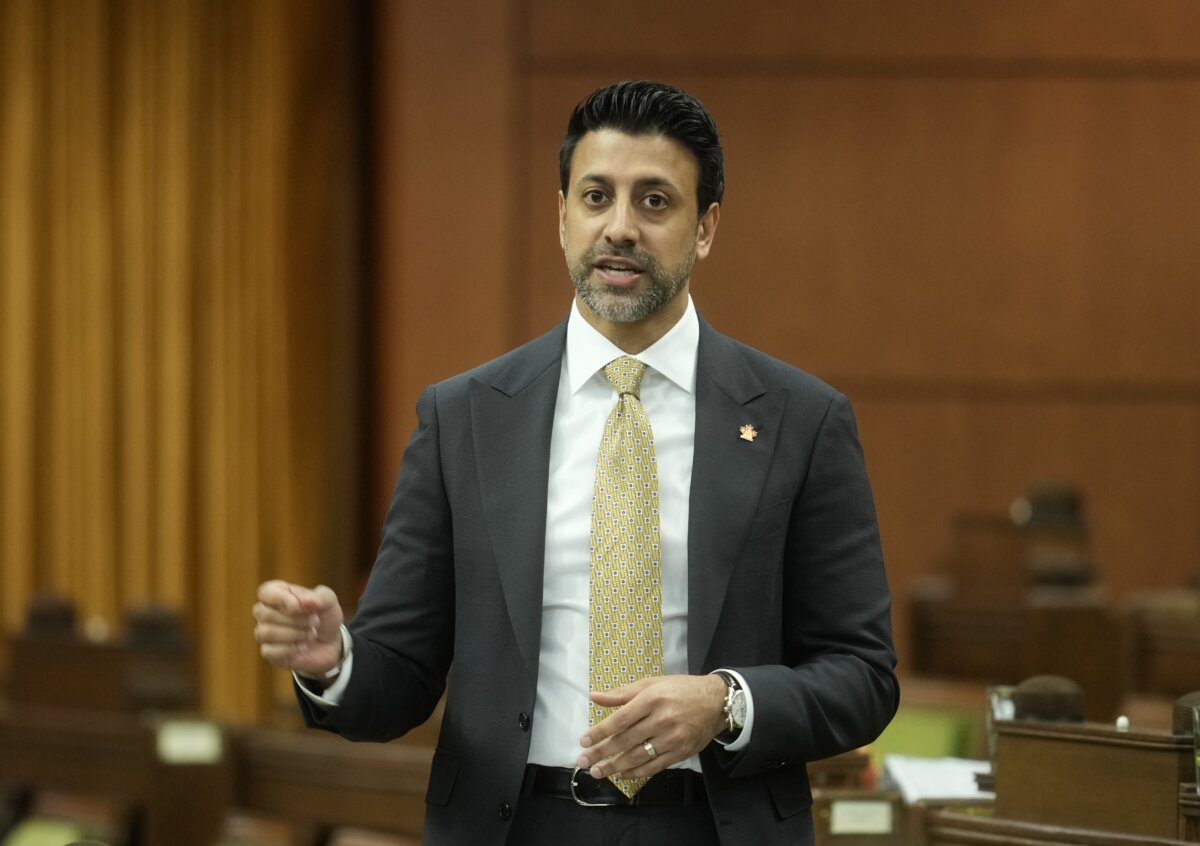

International Trade Minister Maninder Sidhu said he had a productive meeting with representatives of Chinese electric vehicle manufacturer Chery, as a number of Chinese automakers look into establishing Canadian operations.
Sidhu met with executives from Chery on June 10 and discussed the automaker’s joint ventures in other countries and explored how similar operations could be expanded in Canada.
He said in a post on social media that this would be done by “leveraging Canadian supply chains and Canadian workers while ensuring Canadians have access to affordable vehicles.” He noted Chery is one of China’s largest EV automakers.
The meeting comes as several Chinese automakers are exploring an expanded Canadian presence after Ottawa signed an agreement with Beijing in January to reduce tariffs on Chinese-branded EVs from 100 percent to 6.1 percent on up to 49,000 vehicles in the first year. The quota is expected to increase annually to 63,000 units by February 2031.
Chinese state media Xinhua reported in March that BYD was the first Chinese automaker to register a passenger car factory in Transport Canada’s system and several of its EV models are on the regulator’s preliminary review list. BYD’s executive vice president reportedly said the company was conducting a feasibility study on building a factory in Canada with plans to adhere to an independent operation model as opposed to a joint venture model.
Meanwhile, Chery submitted applications in Canada for several of its brands last year, and launched recruitment for Canadian market positions, formed a localization team, and entered the preparation stage in January, according to Xinhua.
Chinese automaker Geely is also planning to launch its Zeekr brand in Canada by leveraging its existing channels through Volvo and Polestar, and completed the brand’s trademark registration last year, the state media said, adding that Geely plans to enter the Canadian dealer network this year through its Lotus brand.
Xinhua said market experts also expect 15 to 20 additional Chinese automakers to follow suit and expand into Canada in the future.
Stellantis is also discussing options for building Chinese EVs at its idled plant in Brampton, Ont., in partnership with Chinese automaker Leapmotor, according to an April 1 Bloomberg report.
Stellantis acquired a roughly 21 percent stake in Leapmotor in 2023, and the two automakers later formed a joint venture, Leapmotor International, to expand production outside China, with Stellantis holding a 51 percent stake.
Ontario Premier Doug Ford was critical of the potential Brampton plant deal in early April, saying such an agreement would undermine Ontario auto workers as it would potentially involve the use of kits, where cars are largely built in China and then shipped overseas for final assembly.
Industry Minister Mélanie Joly was also critical of the alleged discussions between Stellantis and Leapmotor, and said Stellantis would need to ensure there are proper labour standards and conditions for workers, that production supports the local supply chain, and that the software in the vehicles is secure. She noted this is important for Canada’s obligations under the Canada–United States–Mexico Agreement on free trade.
Concerns
Brian Kingston, president and CEO of the Canadian Vehicle Manufacturers’ Association, told MPs during a June 9 parliamentary committee meeting that Ottawa’s agreement with Beijing puts the North American auto supply chain at risk, and that the U.S. auto market is essential to Canada’s auto industry.
He noted that China does not adhere to rules-based trade and investment principles and said there are no guardrails in the agreement to ensure a “level playing field” for manufacturers that have invested in Canada, or to protect Canadians from cyber risks.
China scholars, researchers, and former intelligence officials have warned about the security risks Chinese EVs pose to Canadians and national security.
Two U.S. lawmakers announced a bill in late May aimed at preventing Chinese connected vehicles from entering the United States via Canada and Mexico, amid growing concerns that the vehicles could collect and transmit data about drivers and their surroundings back to China.
U.S. Representative Haley Stevens and Senator Elissa Slotkin said connected vehicles present a “tremendous” risk to U.S. safety and security, and noted that the Chinese auto industry is heavily subsidized, which allows Beijing to “undercut competitors and quickly flood new markets.”
Recent data from Global Affairs Canada indicates 2,910 Chinese EVs were allowed into Canada for the first time in May.
 Friends Read Free
Copy
Facebook
Tweet
Friends Read Free
Copy
Facebook
Tweet