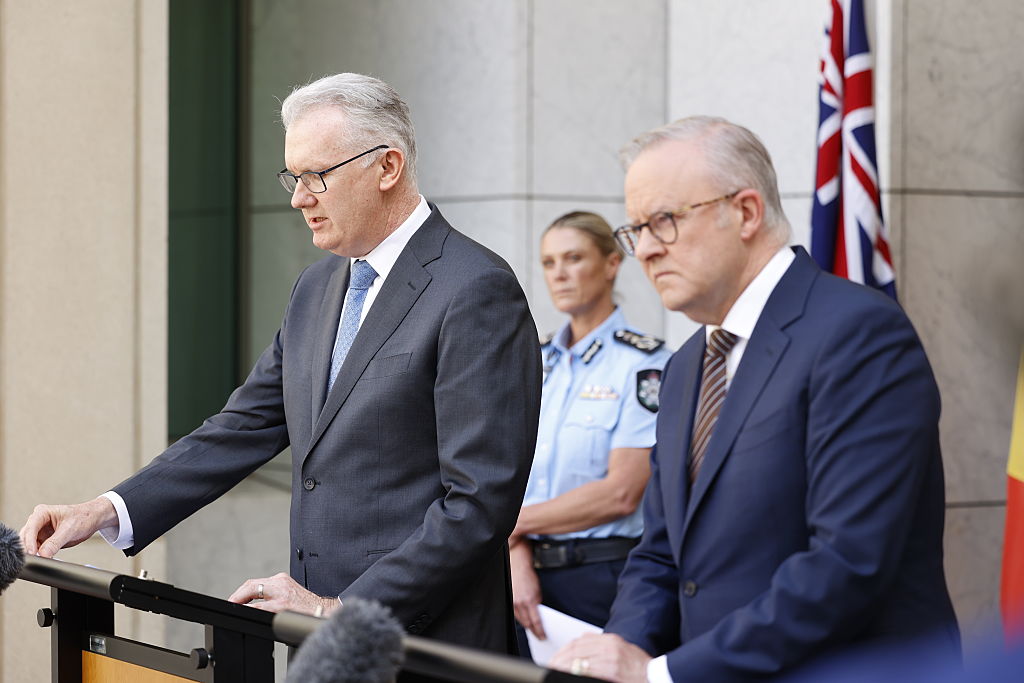

Immigrants to Australia who do not have citizenship may be deported if they have a history of hate speech or engage in it in the future, Home Affairs Minister Tony Burke has announced.
The government intends to introduce legislation to allow the minister and the attorney general to revoke the visa of anyone who “spreads hate, division, and radicalisation,” he explained at a press conference alongside Prime Minister Anthony Albanese.
A package of five reforms will be introduced when Parliament next sits, currently scheduled for Feb. 3, 2026. There will be increased penalties for breaking the current law that prohibits hate speech that promotes violent behaviour, and hate will become an aggravating factor in sentencing crimes of online threats and harassment.
There will also be a new offence for aggravated hate speech, which will apply to preachers and other community leaders who promote violence.
In addition, the government is also planning what Burke described as “a narrow federal offence for serious vilification based on race and/or advocating racial supremacy,” and a listing regime for organisations whose leaders engage in hate speech that promotes violence or racial hatred.
The Customs Act will also be amended to make it easier to seize hate symbols at the border.
Current Powers Inadequate, Minister Says
Burke acknowledged that he had already cancelled visas on character grounds, but said that power did not extend to the behaviour covered by the new law.
“At the moment when I’m cancelling visas and refusing visas, and I’ve been doing this actively since I came in [to office]. I always have to work it out from the perspective of ‘Does [letting someone into the country on a visa] incite discord in the community?'” he said.
“Establishing that somebody has engaged in hate and vilification on its own is not enough [under current law]. Now it will be.
“Somebody who engages, and has a history of engaging, in hate speech, in vilification, in displaying hate symbols, will, of itself, be enough to be able to cancel a visa.”
He said laws introduced during the previous Parliament covering hate symbols, hate crimes, and hate speech “have not resulted in the number of charges that we had hoped”—a concern he had raised some weeks ago with Australian Federal Police Commissioner Krissy Barrett.
“The Australian Federal Police came back to me with recommendations that I then forwarded … only a couple of weeks ago to the attorney-general,” he said.
“Effectively, we will be making it easier for the Australian Federal Police to successfully bring charges against those who use and display hate symbols.”
Burke’s announcement comes two days after New South Wales Premier Chris Minns said that state parliament will sit in emergency session to introduce laws banning specific hate slogans—including “globalise the intifada”—and to restrict protest activity for up to three months following terrorism-related incidents.
The draft legislation will also criminalise public display of symbols linked to proscribed organisations such as ISIS, Hamas, and Hezbollah. Penalties of up to two years’ imprisonment are proposed, and police will gain expanded powers to remove face coverings and order dispersal of unauthorised gatherings.
 Friends Read Free
Copy
Facebook
Tweet
Friends Read Free
Copy
Facebook
Tweet