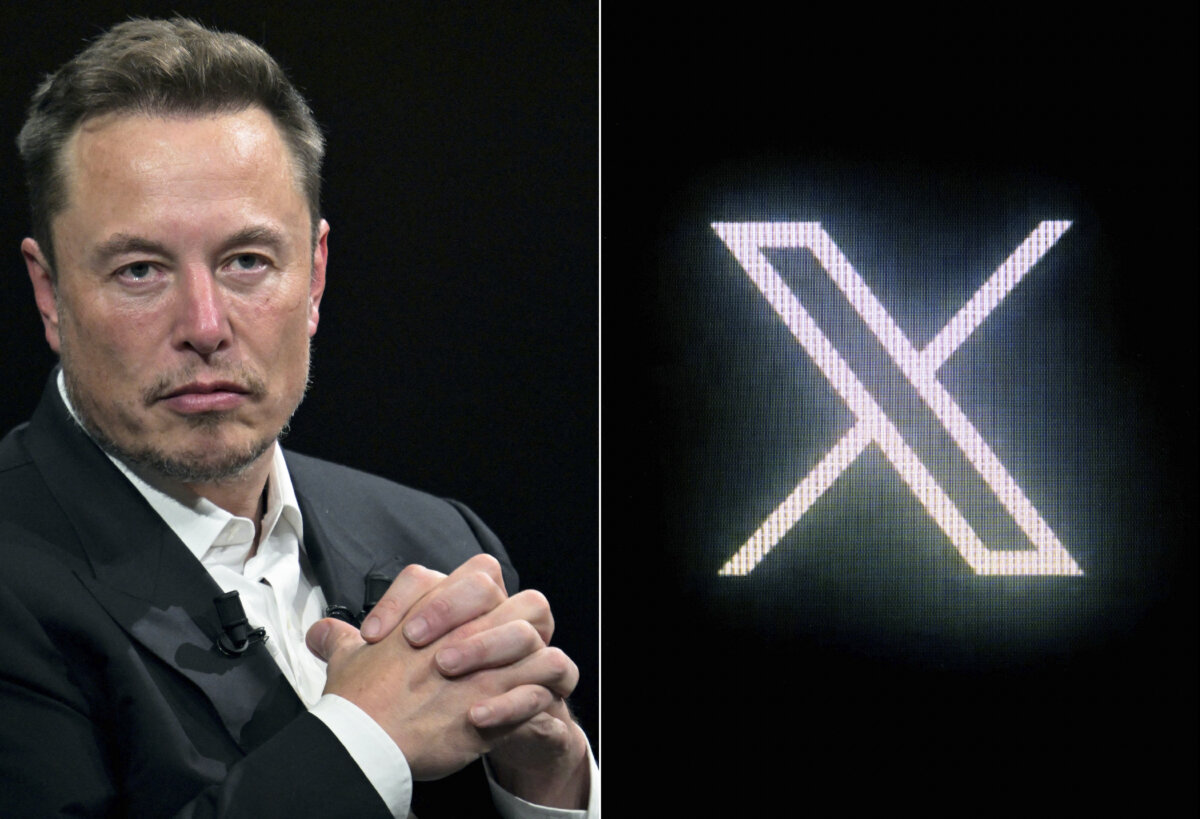

PARIS—Elon Musk did not appear Monday before the Paris prosecutor’s office, which had summoned him for a voluntary hearing in a criminal investigation targeting his platform X.
The prosecutor’s office confirmed the no-show the same day, stating it “takes note of the absence of the first persons summoned” and that “their presence or absence is not an obstacle to the continuation of the investigations.”
Former X CEO Linda Yaccarino, who was also summoned, likewise failed to appear.
The voluntary hearing, known in French law as audition libre, does not compel attendance and carries no penalty for non-appearance.
Hearings of X staff as witnesses are scheduled in Paris through April 24.
A Feb. 3 statement from French prosecutors framed the process as “constructive, with the aim of ultimately ensuring the compliance of the X platform with French laws.”
At this stage, X itself is not the subject of criminal proceedings. Should the offenses under investigation be pursued by the public prosecutor, however, the French courts could impose a prison sentence and fines on Elon Musk.
Could X also be banned in France? “If the French judiciary chooses to pursue this course, the court would most likely begin with intermediate sanctions rather than an outright ban,” Stéphanie Berland, a French lawyer specializing in intellectual property and technology law, told The Epoch Times.
“For example, it could require the X platform to implement content filtering measures. Should the platform fail to comply, the Public Prosecutor’s Office could open a second proceeding to establish the non-application of these measures. A ban on the platform in France would then become conceivable.”
The DOJ Letter
The no-show came days after the U.S. Justice Department refused to assist French investigators, describing the probe as a “politically charged criminal proceeding.”
“This investigation seeks to use the criminal legal system in France to regulate a public square for the free expression of ideas and opinions in a manner contrary to the First Amendment of the United States Constitution,” the DOJ stated in a letter to the French ministry of justice.
xAI welcomed the refusal. “We are grateful to the Justice Department for rejecting this effort by a prosecutor in Paris to compel our CEO and several employees to sit for interviews,” a spokesperson said.
Berland noted that, “In reality, the United States’ extraterritorial reach into European law did not start with the Trump administration. But it had never been expressed so openly. Until now, the tension was framed in procedural terms.”
Musk has called the French proceedings a “political attack.” X itself described a Feb. 3 search of its Paris offices as an “abusive act of law enforcement theater” driven by “political motivations.”
On April 20, Musk branded the French prosecutor a “puppet of left-wing NGOs,” replying to a post by a French citizen who argued that the “official actions in no way represent the opinion of the French people” because “the justice system, the media, education, all the key positions in the corridors of power are held by the left, even though the French are overwhelmingly right-wing according to recent polls.”
Origin of the Case
The investigation opened in January 2025 after two referrals to the cybercrime unit of the Paris prosecutor’s office, led by deputy prosecutor Johanna Brousse, who also handles the Telegram case involving CEO Pavel Durov.
One came from Éric Bothorel, a French National Assembly for Renaissance, Emmanuel Macron’s party. He flagged to the public prosecutor “a recent change in X’s algorithm,” a “lack of clarity” in “moderation decisions,” and Elon Musk’s “personal interventions,” notably in favor of conservative parties in Europe, calling the combination “a real danger and a threat to our democracies.”
The second referral came from a civil servant who filed an anonymous report denouncing changes to X’s algorithm that had led, in his view, to an overrepresentation of “noxious political content.”
The case widened through 2025. After a July update, Grok, X’s generative AI, was able to produce messages praising Hitler. In November, a post claiming that the gas chambers in Auschwitz were not used for the mass execution of Jews was viewed nearly a million times. The post also claimed that the Holocaust “narrative” “persists due to laws suppressing questioning, one-sided education, and a cultural taboo that discourages critical examination of the evidence.”
The Paris public prosecutor’s office announced that it had added these “negationist remarks (…) to the ongoing investigation.”
A separate wave of complaints followed when users repurposed Grok to generate sexualized photomontages of women and, in some cases, minors.
Prosecutors also flagged an 81.4 percent drop in X’s French reports to the U.S.-based National Center for Missing & Exploited Children between June and October 2025, after the platform replaced using the “Safer” child sexual abuse and exploitation detection tool by U.S.-based nonprofit Thorn, with an in-house system.
Another strand of the investigation concerns “the processing of personal data” by X and its partner companies. In June 2025, a study by the non-governmental organization AI Forensics claimed that X had allowed companies to run targeted advertising based on highly sensitive user data, including political, sexual, and religious orientation. The prosecutor’s office also stated that it is “carefully examining the effectiveness of the confidentiality of private messages exchanged by users on the platform.”
The Feb. 3 statement from Paris Public Prosecutor Laure Beccuau listed seven counts: complicity in possession of child sexual abuse material; complicity in its distribution “as part of a criminal gang;” sexual deepfakes; contestation of crimes against humanity; fraudulent data extraction and tampering with an automated processing system, both “as part of a criminal gang;” and administering an illegal online platform “as part of a criminal gang.”
‘A Clear Intent to Censor’
In an interview with The Epoch Times, Nicolas Conquer, founder of the Paris-based think tank Western Arc and former spokesman for Republicans Overseas, saw “a clear will of censorship” on the part of French authorities. He notes that Bothorel’s referral targeted X’s algorithm specifically, while sparing other platforms such as Instagram and Google, whose algorithms, Conquer argues, prioritize left-leaning content, media, and resources.
On Feb. 7, Conquer organized a protest denouncing the raid on X’s offices and what he called “the weaponization of the rule of law to intimidate a platform that refuses to bow before state censorship.”
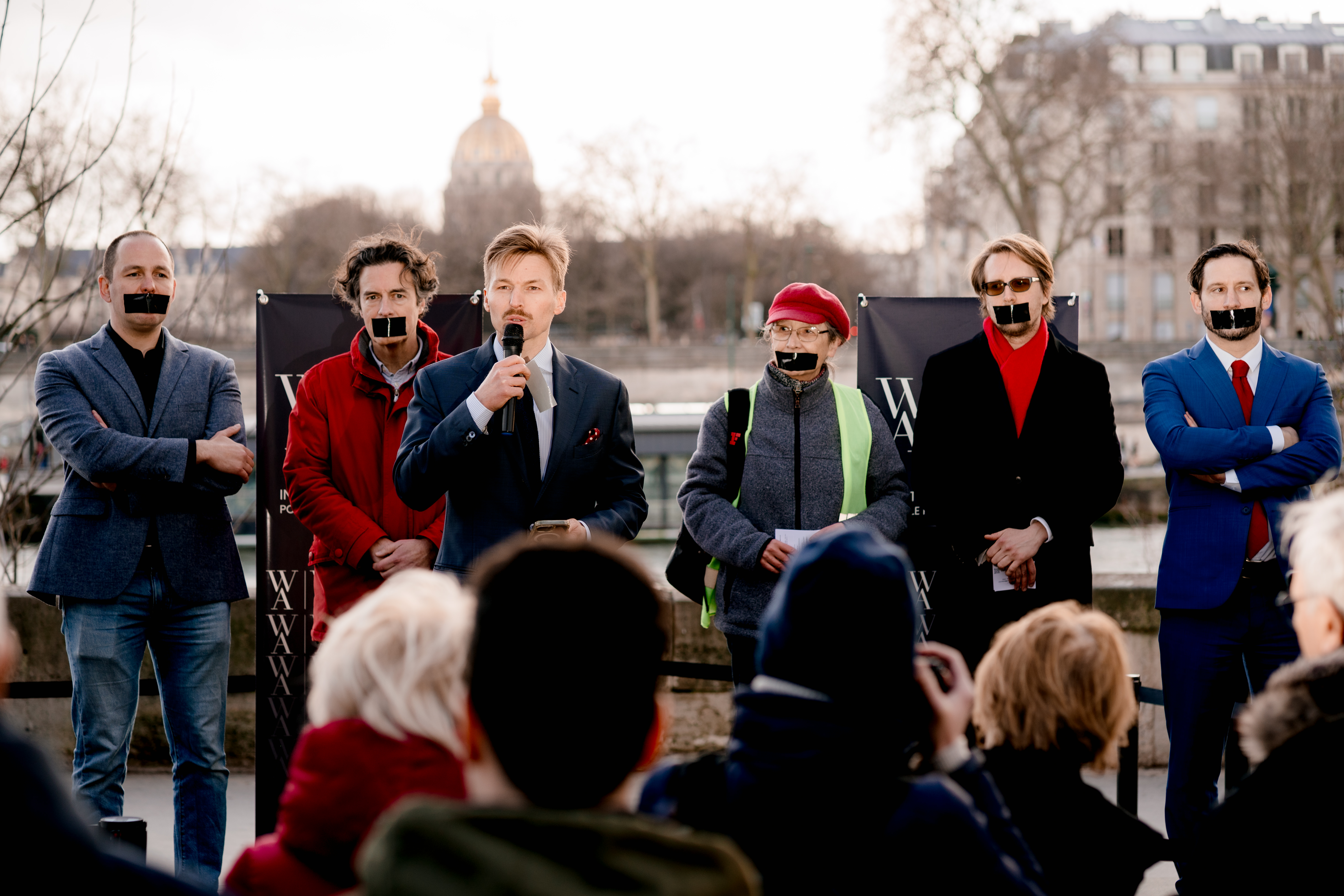
In his view, the push against X, like earlier moves against Telegram, is “skillfully concealed behind the pretext of child sexual abuse content, which obviously everyone condemns and must be removed.”
But the French government, he argues, barely hides its broader intent. He recalls that in February, Macron dismissed free speech as “pure [expletive],” while his foreign minister declared that social media must be “brought to heel” to counter what he called the “reactionary international.”
The prosecution has drawn sharp criticism from several right-wing politicians in France. In February, MEP Marion Maréchal, the niece of Marine Le Pen, founder of France’s right-wing Rassemblement National (RN) party, denounced the raid by the Paris public prosecutor’s office on X’s premises as “a new step in the authoritarian turn of a centrism that, from Paris to Brussels, is striving at all costs to control information.”
Maréchal contrasted this show of judicial force with what she described as government passivity on street crime, which she said was “poisoning the daily lives of the French.”
She went on to list a broader set of grievances: the “closure of opponents’ bank accounts;” pressure on private charitable initiatives such as “La Nuit du Bien Commun;” regulator Arcom’s crackdown on the conservative media channel CNews; the shutdown of the right-wing C8 television network; the Digital Services Act; the Avia law targeting online hate speech; and proposals to ban VPNs or monitor private conversations, “politicized judicial harassment,” and the “criminalization of criticism of immigration.”
She warned: “Our democracies will soon have no lessons left to give to authoritarian regimes.”
The Durov Precedent
Telegram founder Pavel Durov, indicted by the same Paris cybercrime unit in August 2024 on 12 counts tied to his platform, including complicity in the organized-group distribution of child sexual abuse material, has also publicly backed Musk.
“Macron’s France is losing its legitimacy by using criminal investigations as a weapon to restrict freedom of expression and undermine privacy,” Durov wrote on social media. “In Macron’s France, being investigated is the new Légion d’honneur.” He also criticized French prosecutors as “hired, fired, and promoted by the government.”
The remark echoes a long-running institutional debate in France: the European Court of Human Rights has ruled that the French prosecution service does not meet the standards of independence outlined in the European Convention for the Protection of Human Rights and Fundamental Freedoms: the executive branch’s minister of justice retains appointment power without a binding opinion from the High Council of the Judiciary.
Durov himself remained under judicial supervision in France until November 2025. The Telegram investigation continues.
France is not the only progressive government to have moved against X. The United Kingdom opened its own investigation in January, followed by Spain in February. In December, the European Commission fined X 120 million euro under the Digital Services Act (DSA), then opened a second DSA probe in January. X is appealing the fine through the EU General Court—a process that could take years.
 Friends Read Free
Copy
Facebook
Tweet
Friends Read Free
Copy
Facebook
Tweet