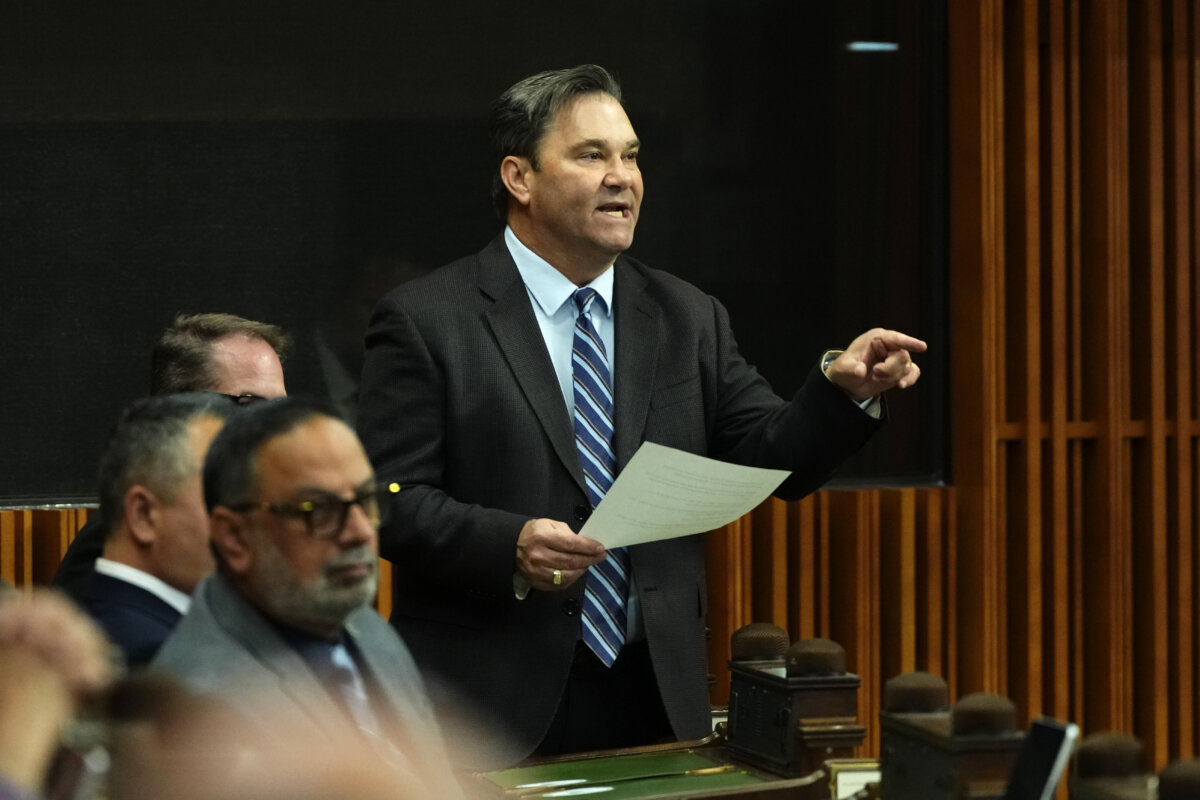

NDP interim leader Don Davies says his party has become too focused on “identity politics” and has lost its ability to resonate with working people in recent years.
Davies made the comments on the “The Paikin Podcast” hosted by Steve Paikin airing Aug. 28, ahead of the party officially kicking off its search for a new federal leader on Sept. 2.
Davies pointed to the NDP’s poor results in this year’s April 28 election, dropping from 24 seats to seven seats in its worst performance since 1935.
“What is it about us where we were unable to resonate, unable to connect, with working people? One of the questions is, have we veered too much from our class-based analysis to identity politics?” Davies asked. “My own view, this is just me speaking, is that we have.”
Davies said he still sees issues such as gender identity as important, but noted that there needs to be more “balance,” and that the party’s current status offers an opportunity to rebuild.
“We had the worst result in the history of our party going back to the Co-operative Commonwealth Federation. One of the few advantages of being burnt to the ground is you get to recreate your foundation,” he said. “There is a real opportunity here to ask those fundamental questions.”
Davies said the NDP’s campaign during the last election was “one of the worst campaigns” he’s ever seen, and part of a 14-year slide into becoming a small and uninfluential party. The focus on identity politics and socially progressive causes has contributed to the NDP’s downgrade, according to Davies.
“When we’re talking about drag reading in libraries or [transgender] women in sports, those issues may have their own impact or import,” he said, adding “I don’t think we’re talking about the real issues that most working people are struggling with. Can they pay their rent? Can they buy a house? Can they buy groceries?”
Davies, who formerly served as a lawyer for the Teamsters union, said he looks forward to seeing if the NDP can “reorient” itself to a more worker-focused message going forward, adding that he credits the Conservatives with doing a “pretty good job” in appealing to working-class voters. Davies said the Conservative Party’s criticism of former NDP leader Jagmeet Singh was also effective in diminishing the party’s standing and appeal to voters.
Davies also said he sees problems with the NDP’s strategic approach, including continuing to back the government in confidence votes last fall after Singh called the Liberals “selfish” and said he was tearing up the confidence and supply pact the month before. This contradiction rankled voters, according to Davies, who said it was the “beginning of the end” of Singh’s leadership and a further weakening of the party.
“Because of the supply and confidence agreement we were tied to the Liberals in a way that did impact us,” Davies said. “We tend to absorb all the negativity and dislike of the main government and don’t really get the credit for the good things. The question of, ‘Should we have done it? Would we do it over again?’ I think is a good one.”
Singh announced on April 28 he was stepping down after the party’s lacklustre showing in the federal election. In addition to the NDP dropping to just seven seats, Singh lost his own riding of Burnaby South in B.C.
Davies, who represents the riding of Vancouver Kingsway, was named interim leader on May 5.
NDP party members will cast their votes to choose Singh’s successor during a party convention next spring.
To be in the running, at least 50 percent of all support signatures obtained by candidates must be from people who don’t “identify as a cis man,” according to the party’s rules. “Cis” is a term used to refer to somebody whose gender identity aligns with the biological sex they were assigned at birth.
In addition, the NDP’s guidelines say a leadership candidate must have at least 100 signatures from people in “equity-seeking groups” such as disabled people, LGBT individuals, or “racialized” individuals.
The NDP was created in 1961 as a merger between the Co-operative Commonwealth Federation and the Canadian Labour Congress, led by Tommy Douglas. It was based on a platform of democratic socialism, building a strong welfare state, and supporting the rights and priorities of the working class.
 Friends Read Free
Copy
Facebook
Tweet
Friends Read Free
Copy
Facebook
Tweet