
Avi Lewis says he will push for government-run grocery stores, telecom services, and banking in Canada if he becomes the next NDP leader.
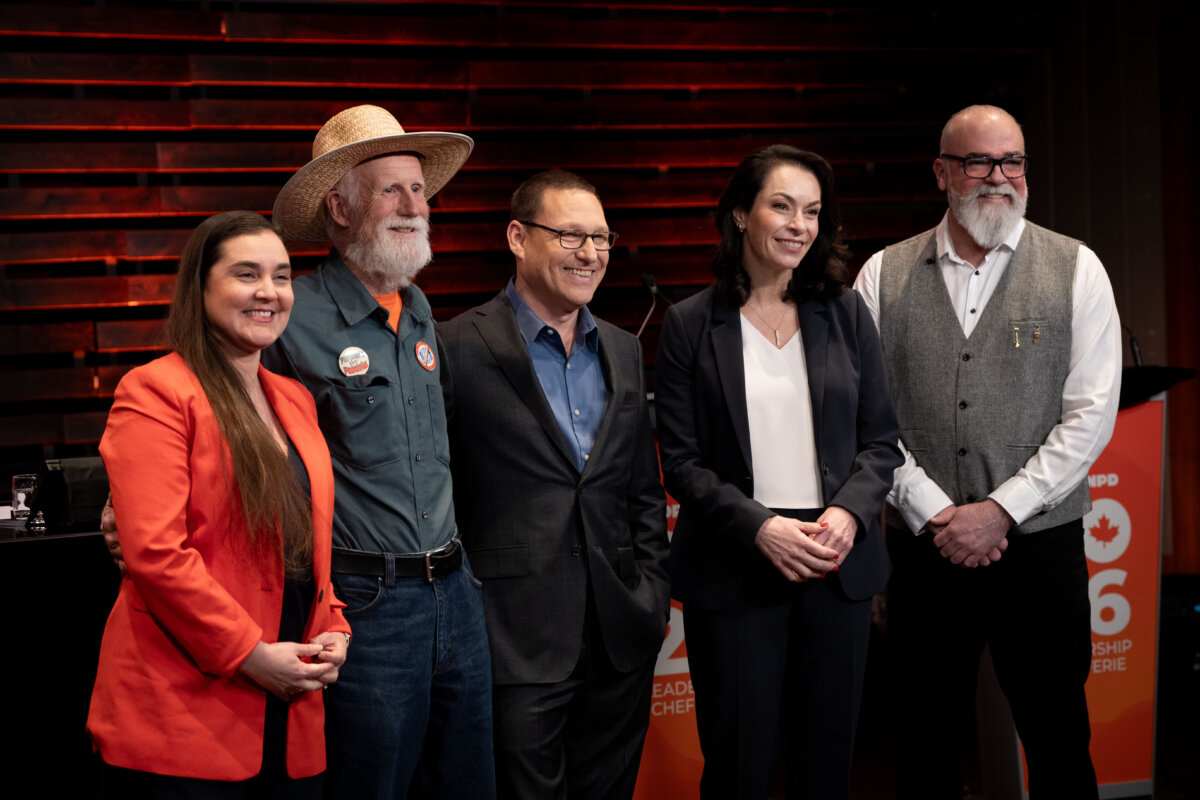
Lewis was one of five candidates to participate in the final NDP leadership debate on Feb. 19. He said his campaign has promoted the “essential role of public ownership” in Canada and noted that, in addition to public health care and child care, he would like to see a similar option for groceries and phone and internet services.
The former journalist and activist also floated the idea of a “public bank through Canada Post and postal banking.”
The debate in New Westminster, B.C., marked the second and final official event before voting begins for the new NDP leader. Voting kicks off on March 9, and the next leader will be announced on March 29 during the party’s convention in Winnipeg.
The other candidates appearing at the debate were NDP MP Heather McPherson, union leader Rob Ashton, social worker and Campbell River, B.C. city councillor Tanille Johnston, and agricultural producer Tony McQuail.
The debate touched on subjects like climate change, fossil fuels, housing, trade negotiations with the United States, and the future of the NDP in the House of Commons.
McPherson said the party needed to “push the government until we become the government.” She said the NDP had obtained some wins as the opposition, such as getting dental care and pharmacare implemented. But she said the Liberals under Prime Minister Mark Carney have shown “an unwillingness to work with the other parties.”
McPherson added that she has written to Carney to ask him to stop exporting weapons to the United States that she said are being used by Immigration and Customs Enforcement “against American citizens.” She said the NDP also needs to push the government to “live up to its obligations” to not send weapons to countries with a poor human rights record.
McPherson said Canada needed to be less reliant on its southern neighbour, saying U.S. President Donald Trump signed the United States-Mexico-Canada Agreement during his first term but later “broke it.”
Ashton said Carney “talks a tough game, but then he folds” when it comes to negotiations with Trump.
“We have to stand up for Canadian jobs in our industries. We have to invest in Canadian industries,” he said.
McQuail said Canada should implement a total embargo on military exports to the United States due to Trump’s comments on Canada becoming the 51st U.S. state. He also said trade in Canada is often “based on cheap labour here and cheap and expensive products there,” and that the country needed to consider ways to relocalize its products and become less dependent on other countries.
Johnston said while the Liberal government has focused on reducing interprovincial trade barriers, she wants agricultural trade barriers in Canada to be addressed, saying Ottawa has so far failed to achieve this.
“We’re sitting on such a beautiful country where we could easily feed ourselves and not have a major hunger problem… it’s mind blowing,” she said.
The NDP saw its national support fall dramatically during the last federal election, with the party’s seat count dropping from 24 to just seven. The NDP also lost official party status and then-leader Jagmeet Singh lost his seat. Singh announced his resignation on election night and MP Don Davies became interim leader of the party soon after.
The latest polling from aggregator 338Canada shows the NDP at 8 percent support, compared to 38 percent for the Conservative Party and 44 percent for the Liberals.
 Friends Read Free
Copy
Facebook
Tweet
Friends Read Free
Copy
Facebook
Tweet