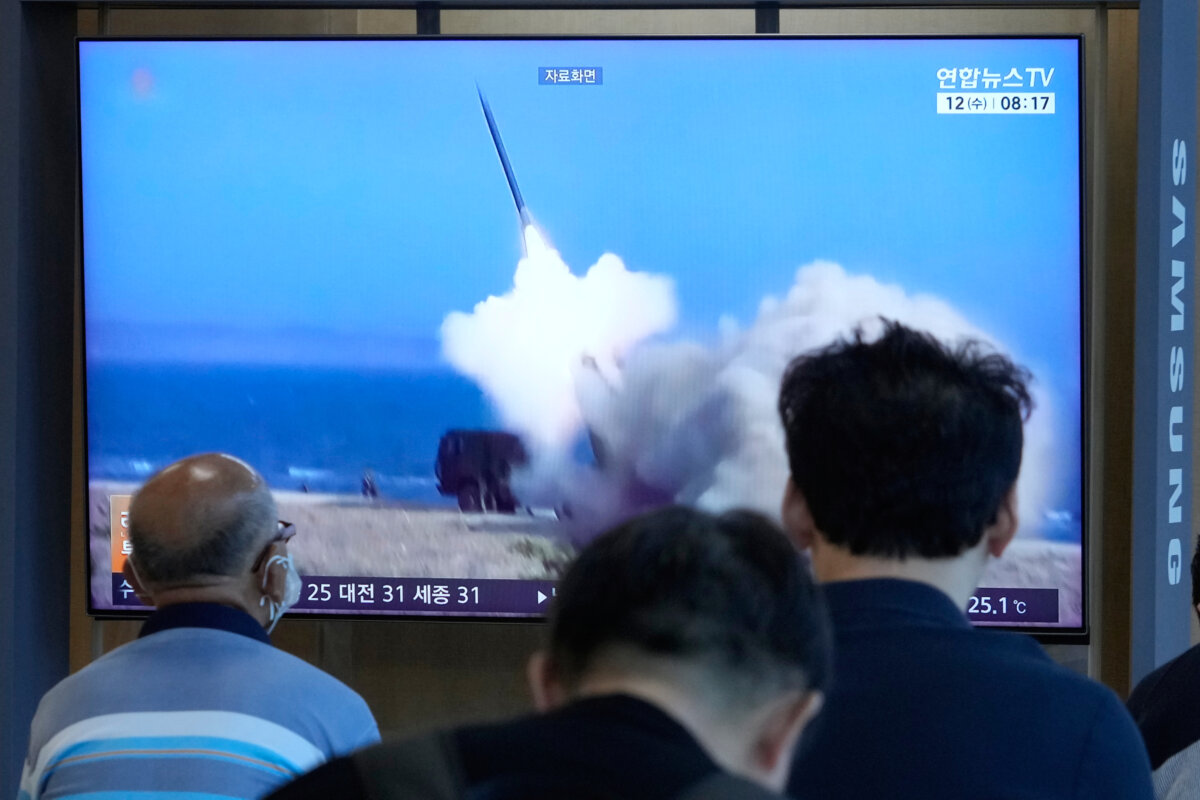

North Korea fired several missiles toward the sea off its eastern coast on Oct. 12, the South Korean military said, just days after Seoul test-fired a hypersonic weapon for the first time.
South Korea’s Joint Chiefs of Staff (JCS) detected the launch from the Pyongyang area at about 9:20 a.m. local time (8:20 p.m. EDT the previous day), saying at least one projectile traveled more than 900 km (559 miles).
“The South Korean military has stepped up its surveillance to prepare for additional launches and is maintaining an all-out readiness posture, while closely sharing relevant information with the United States and Japan,” the JCS said in a notice, according to South Korean news agency Yonhap.
South Korean Navy Capt. Jang Do-young, spokesperson for the JCS, said during a press briefing in Seoul that the military had assessed that several different types of ballistic missiles had been launched by Pyongyang but did not specify which, according to the Korea Herald.
The JCS said South Korea had upped surveillance and vigilance against potential further launches and was sharing information with Washington and Tokyo.
The Japanese Ministry of Defense also confirmed the launch, saying at least two missiles had been detected within 20 minutes of each other; the first reached a maximum altitude of about 20 km (12 miles) and flew for about 220 km (137 miles), while the second reached a maximum altitude of about 70 km (43 miles) and flew for more than 910 km (510 miles).
The ministry stated that projectiles landed “near the east coast of North Korea or in the Sea of Japan,” saying that there was no confirmation yet whether the missiles had violated Japan’s territorial waters or exclusive economic zone.
“The series of actions by North Korea, including the repeated launches of ballistic missiles and other projectiles, threatens the peace and security of Japan, the region, and the international community,” the ministry said.
It also stated that the launches violate U.N. Security Council resolutions and “constitute a serious issue concerning the safety” of Japanese citizens.
“Japan has lodged a strong protest with North Korea and strongly condemned their actions,” the ministry stated.
The test firings from Pyongyang come at a time of heightened tensions between the two Koreas and follow Seoul’s test of a hypersonic missile on Oct. 8.
South Korean President Lee Jae-myung observed the launch of the hypersonic glide vehicle (HGV), which was the first time Seoul had tested the weapon, Yonhap reported.
An HGV is a missile system that uses a booster to reach the upper atmosphere, then jettisons the booster to glide at hypersonic speeds (five times the speed of sound or more) at lower altitudes.
South Korean presidential spokesperson Kang Yu-jung said that the launch was successful and that it marked a “major milestone” in securing a “new deterrent.”
After the launch, Lee praised the team behind the HGV’s development but said that Seoul couldn’t afford to rest on this initial success.
He said that South Korea must “further refine this technology so that the HGV becomes a reliable strategic asset that protects our security in the future.”
North Korea test-fired its own hypersonic weapon in a launch on Oct. 3, Pyongyang’s Korean Central News Agency reported on Oct. 4.
Alongside the missile launches from North and South Korea, tensions have been further strained after a pair of Seoul’s troops were injured in a mine blast in the demilitarized zone, which divides the two countries, last month.
Both Seoul and the U.N. Command, the body that formally decides whether the armistice between the two Koreas has been breached, conducted investigations that laid the blame for the explosion at Pyongyang’s feet in September.
North Korea, however, dismissed these findings as a “farce,” accusing the South of engaging in “provocation.”
 Friends Read Free
Copy
Facebook
Tweet
Friends Read Free
Copy
Facebook
Tweet