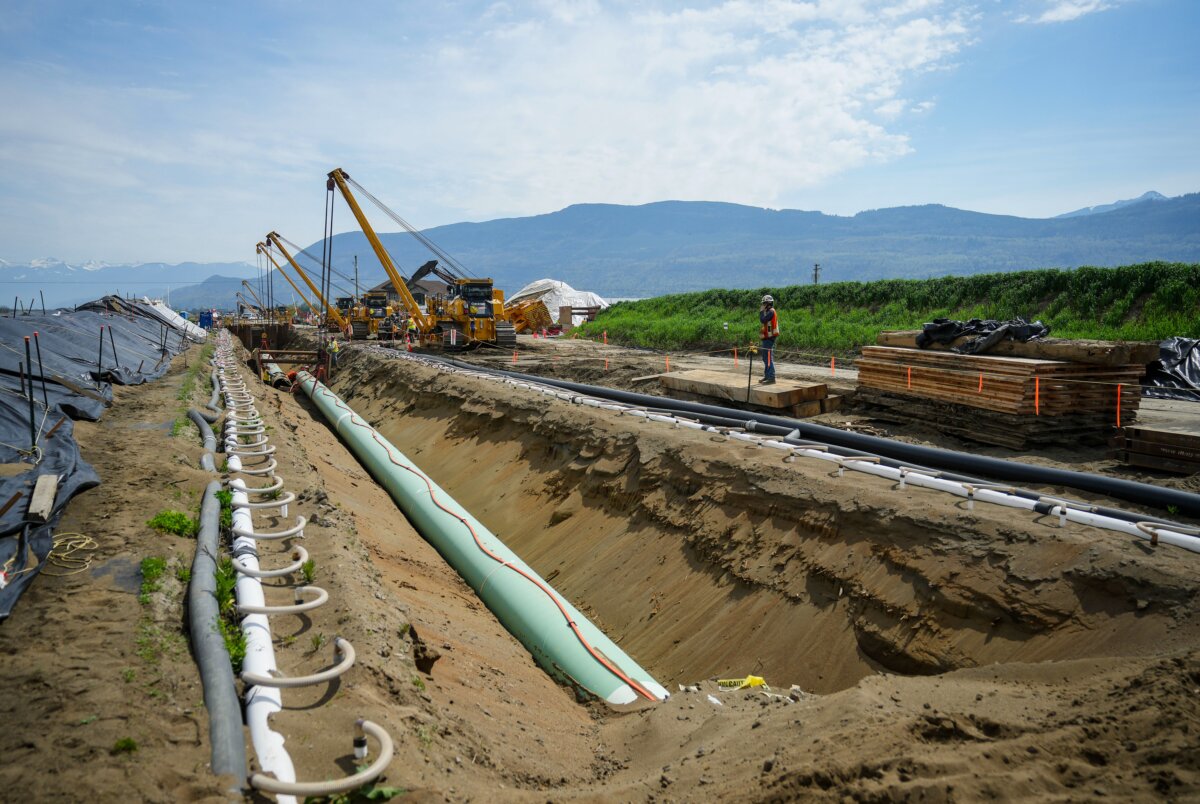

The Ontario government announced it has awarded a contract to complete a feasibility study on establishing new pipelines running from Alberta to Ontario.
“This nation-building pipeline and energy corridor will unite our country and help unlock new markets for Canada’s energy resources that will reduce our dependence on the United States, all while creating new jobs and opportunities for Canadian workers,” Ontario Premier Doug Ford said in a statement on Oct. 30.
The study will examine the benefits of building pipelines that would bring oil and gas from Alberta and Saskatchewan to new and established refineries located in southern Ontario, as well as new ports on the Great Lakes and on the Hudson Bay in northern Ontario. The pipelines would also be built using Canadian steel, according to a press release from the Ontario government.
The feasibility study, to be completed in 2026, will also evaluate development opportunities across Ontario, such as mineral exports, upgrades to the energy grid, a strategic petroleum reserve, and all-season roads leading to the “Ring of Fire” mineral deposit in northern Ontario.
Ontario said that as the project is undertaken, the province will “honour its duty to consult with Indigenous communities and will continue to advance economic reconciliation, including pathways to indigenous equity participation.”
In July, the provinces of Ontario, Alberta, and Saskatchewan signed a memorandum of understanding that committed them to identifying areas of future collaboration in trade and energy infrastructure, critical minerals, and natural resources.
Alberta Premier Danielle Smith said in a Oct. 30 statement that the three provinces are “proving what’s possible when provinces lead and stand together to advance a shared vision of responsible development, economic freedom, and common sense.”
The federal government passed the One Canadian Economy Act, also known as Bill C-5, in June. The legislation enables the government to streamline federal approval processes to have major projects built faster, with the aim of speeding up approval times from five years to a maximum of two years.
In September, Prime Minister Mark Carney announced the first five major projects being referred to the newly created Major Projects Office for consideration. A pipeline was not included in the five projects, but the government also outlined six projects that are “at an earlier stage and require further development”—including a Pathways Plus carbon capture and storage project and “pipeline that will substantially reduce emissions” in Alberta.
Smith told the House of Commons Environment Committee on Oct. 23 that there is capacity for more oil to be shipped via a pipeline to B.C., as well as through another pipeline to Churchill, Man., on the Hudson Bay, or to James Bay in Northern Ontario. She said representatives from other countries have also shown a “very high level of interest” in Canadian energy exports.
Smith is also pitching an Alberta-B.C. pipeline project to the Major Projects Office, saying she wants to advance the project through the initial regulatory requirements to attract private investment for it. She says the move is necessary because existing federal legislation such as the Impact Assessment Act are driving away private investment by creating uncertainty and regulatory burden.
However, B.C. Premier David Eby has repeatedly expressed skepticism about the prospects of a pipeline to the West Coast, saying such a project would require the federal government to scrap its ban on oil tankers operating in the region, and that the pipeline has not secured a private proponent or environmental assessment approval.
 Friends Read Free
Copy
Facebook
Tweet
Friends Read Free
Copy
Facebook
Tweet