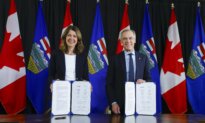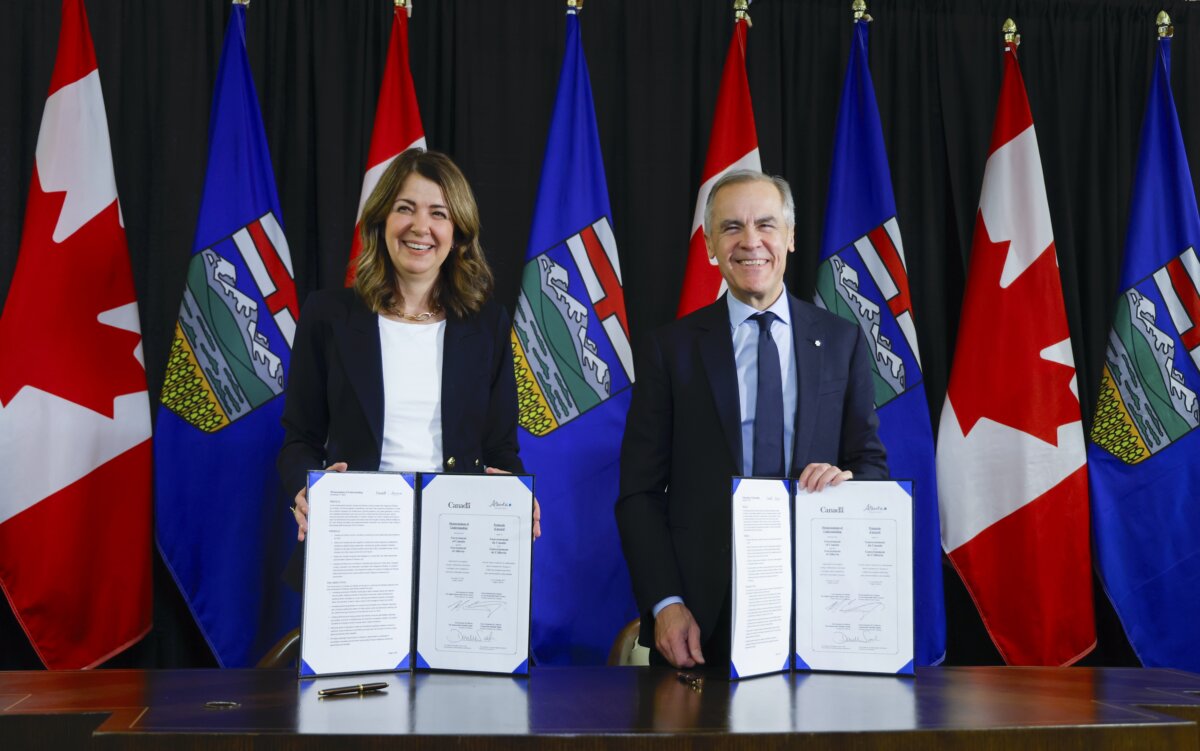

The federal government and the province of Alberta have reached a prospective deal that they say will streamline the approval process for major projects.
The agreement-in-principle will implement a “one project, one review” approach to assess the potential impacts of major projects, especially concerning the environment, the two governments said in a March 6 press release.
A preliminary version of the agreement indicates that projects within Alberta’s jurisdiction, especially in the non-renewable resource sector, will rely on the province’s regulatory processes. It also says Alberta’s process will be integrated with Ottawa’s for projects that involve federal land and jurisdiction.
The joint press release says both Canada and Alberta are committed to improving the efficiency of the assessment and permitting processes, which the governments described as critical to increasing regulatory certainty and to attracting investment in major projects, as well as ensuring environmental protections and the rights of indigenous people are respected.
“This agreement is a meaningful next step toward faster, more efficient project reviews, and removes the need for federal approvals of projects that are squarely within the province’s jurisdiction,” Alberta Premier Danielle Smith said in the release. “This will see Alberta projects approved faster, and shovels in the ground sooner.”
Prime Minister Mark Carney said the new agreement represents the next phase in the partnership between both governments following the energy deal established last year.
“Together, we will build big and build fast to create a stronger, more sustainable, more independent economy for Albertans and all Canadians,” Carney said in the press release.
Alberta has a longstanding history of conflict with Ottawa regarding its energy project regulations.
The province contested the constitutionality of the federal Impact Assessment Act (IAA) in court and the Supreme Court of Canada sided with Alberta in 2023, ruling that the act exceeded Ottawa’s legislative authority. The IAA is a legislative framework requiring federal reviews of major projects such as mines, oil sands, and pipelines to assess environmental, health, social, and economic impacts.
Ottawa amended the act under the leadership of then-Prime Minister Justin Trudeau, but Alberta launched a second challenge in 2024, saying the changes didn’t go far enough. A hearing for this challenge began in Calgary last month.
The newly announced agreement acknowledges the existing legal dispute, and says that Alberta’s involvement in the deal doesn’t indicate a change in its stance.
The preliminary agreement further states that by signing on, neither government is yielding jurisdiction or its powers as defined by the law.
Builds on MOU
The new deal builds on the memorandum of understanding (MOU) signed by Carney and Smith last fall.
The MOU outlined commitments to advance a pathway for a pipeline to be built from Alberta to British Columbia’s northwest coast if a private proponent comes forward. The agreement reached last year between Smith and Carney also opened the door for a potential pipeline co-ownership with indigenous groups as well as the possible retraction of some environmental policies that had been considered obstacles to the project, such as the proposed emissions cap and the West Coast tanker ban.
Ottawa and Alberta are rapidly approaching an April 1 deadline to reach an agreement on an industrial carbon price and methane emissions, as pledged last year in the MOU.
Alberta has also established a July 1 deadline to present plans for the pipeline to Ottawa’s Major Projects Office.
Alberta said negotiations related to methane emissions reduction and carbon pricing are “ongoing” between the governments, adding that “the province is confident an agreement that supports industry’s ability to increase the development of our oil and gas resources will be reached.”
The Impact Assessment Agency of Canada will post the draft agreement for public comment for a period of 21 days before the agreement is finalized, the press release said. Feedback will be reviewed at the end of the comment period, and the agreement will then be finalized between Alberta and Canada.
The Canadian Press contributed to this report.
 Friends Read Free
Copy
Facebook
Tweet
Friends Read Free
Copy
Facebook
Tweet