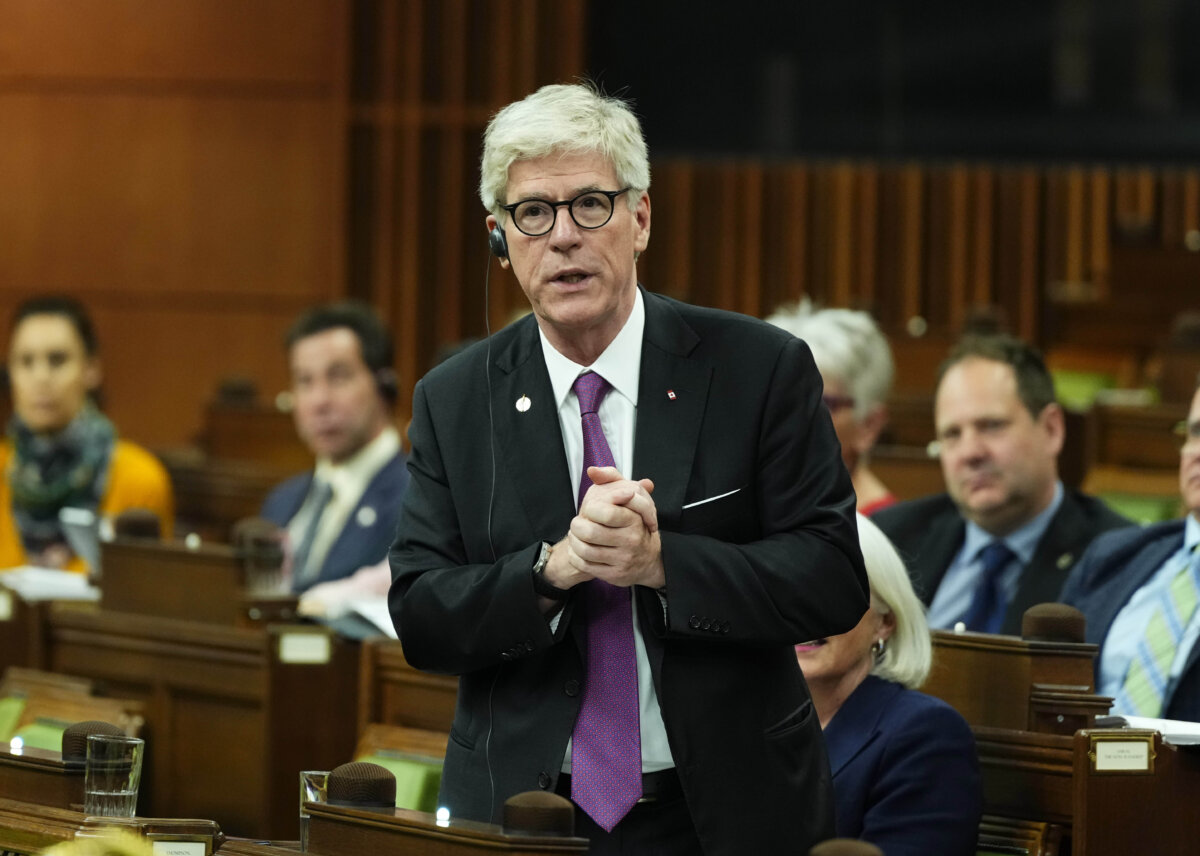

Energy Minister Tim Hodgson says Ottawa isn’t set on any particular route for sending more energy to the United States, but “will do whatever we can” to help revive the Keystone XL Pipeline.
“We have indicated to the Americans, as part of a broader solution for the challenges, that we are open to sharing more of our energy with the Americans. We aren’t hung up on any one particular route,” Hodgson told National Post in an interview published on Oct. 28. He noted that Canada is open to talking about Keystone XL with the United States.
“If we have a bigger solution, we will do whatever we can to help them with what they need.”
Although trade discussions with the United States came to a halt after U.S. President Donald Trump terminated trade negotiations with Canada on Oct. 23 over an Ontario TV advertising campaign opposing U.S. tariffs, momentum had appeared to be building in trade talks following Prime Minister Mark Carney’s visit to the White House on Oct. 7.
Several media outlets reported from unidentified sources on Oct. 8 that Carney had raised the idea of reviving Keystone XL during his meeting with Trump, and that Trump was receptive. While neither administration immediately commented publicly on the matter, the Carney government signalled that energy is considered part of the equation to reach a deal with Trump on tariffs.
Canada-U.S. Trade Minister Dominic LeBlanc was at the White House with Carney and told reporters after the Oct. 7 meeting that strengthening the energy partnership with the United States was discussed. He said the two leaders directed their teams to “quickly land deals” on steel, aluminum, and energy to bring “greater certainty.”
The Keystone XL project consisted of 1,930 kilometres of pipes to bring crude oil from Hardisty, Alberta, to Steel City, Nebraska. It would have been able to handle 830,000 barrels a day destined for refineries further south in Oklahoma and on the Gulf coast.
Hodgson told National Post the pipeline remains fully permitted on the Canadian side of the border if it were to run along the same route.
“The pipe is in the ground for a significant portion of that route. The Americans have to decide what they want to do on their side of the border,” he said, adding that Canada is “open to facilitating” if it’s part of a “bigger solution.” Hodgson declined to specify what steps Canada could take, but said “there are always things that we can do to make it easier.”
The minister is set to meet with U.S. Energy Secretary Chris Wright this week at a G7 energy and environment ministers meeting hosted by Canada in Toronto. Hodgson said the two ministers would continue to look for “shared interests” on the issue of energy security, and noted his discussions are separate from the terminated trade talks issue between the two countries.
“We can grow our relationship with the U.S.,” Hodgson said, defending Canada’s offer to send more energy to the United States. “No one’s suggesting we don’t want to have a relationship with the U.S. We want it on a fair basis.”
Tory Support
Alberta Premier Danielle Smith and federal Conservative Leader Pierre Poilievre have both welcomed the reports of interest in reviving the project on both sides of the border.
Speaking to reporters at an Oct. 27 press conference, Smith said she was “very encouraged” by Carney’s recent visit to the White House, which she said appeared to include discussions on “a new deal on an energy pipeline that would be a replacement for Keystone as a way of leveraging [U.S.] demand for energy to get a deal on steel and aluminum.”
Poilievre said in an Oct. 8 statement that Carney would have the Opposition’s support if he gets the Keystone XL project moving, noting the Stephen Harper government had approved the new pipeline in 2010.
The project ended in 2021 after U.S. President Joe Biden revoked its presidential permit on his first day in office. The previous Liberal government supported the project, with then-Prime Minister Justin Trudeau saying his government was “disappointed” by Biden’s decision.
Meanwhile, Trump had approved the project as one of his first decrees during his first term in 2017. Early in his second term, Trump called for the company behind the project, TC Energy, to “come back to America, and get it built — NOW!”
South Bow, an offshoot company of TC Energy that was assigned to handle the pipeline last year, said it had “moved on” from Keystone following Trump’s comment.
However, South Bow told The Canadian Press earlier this month that it is “supportive of efforts to find solutions that increase the transportation of Canadian crude oil” and will continue to “explore opportunities that leverage our existing corridor with our customers and others in the industry.”
Noé Chartier and The Canadian Press contributed to this report.
 Friends Read Free
Copy
Facebook
Tweet
Friends Read Free
Copy
Facebook
Tweet