Brazilian President Luiz Inácio Lula da Silva said the world does not need an emperor and reiterated his view that global trade needs alternatives to the U.S. dollar, following a threat by former President Donald Trump to impose tariffs on countries aligning with BRICS policies.
The BRICS alliance—made up of countries including Brazil, Russia, India, China, and South Africa—views itself as a counterweight to Western-led institutions.
Trump said on July 6 that an additional 10 percent tariff would be imposed on countries aligning with BRICS policies.
“Any Country aligning themselves with the Anti-American policies of BRICS, will be charged an ADDITIONAL 10 percent Tariff. There will be no exceptions to this policy,” he stated on Truth Social.
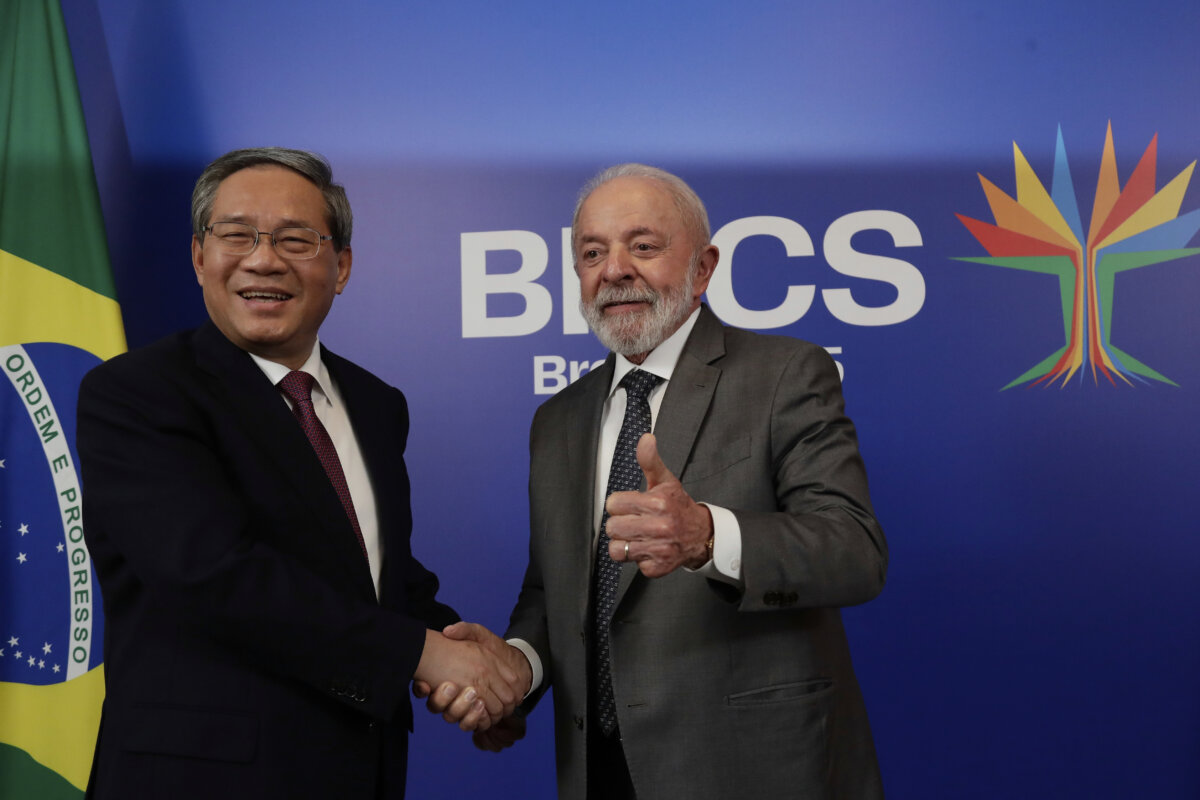
On the final day of the 17th BRICS Leaders’ Summit in Rio de Janeiro, Lula was asked about Trump’s tariff threat.
“We don’t want an emperor, our countries are sovereign,” he said. “If Trump issues tariffs, other countries have the right to do the same. There is the reciprocity law.”
Lula said it is irresponsible for a president of a country such as the United States to threaten the world with tariffs on social media.
“Honestly, there are other forums for the president of a country the size of the United States to talk to other countries,” Lula said.
He said that the BRICS group “was not formed to confront anyone, it just wants to be another model, another way to do politics.”
When asked about Trump’s warning, South African President Cyril Ramaphosa told reporters that BRICS is “a center of power” and “does not seek to compete with any other power.”
Without mentioning Trump or the United States, the BRICS nations said in a joint statement on the same day that “proliferation of trade-restrictive actions, whether in the form of indiscriminate rising of tariffs and non-tariff measures, or protectionism under the guise of environmental objectives threatens to further reduce global trade, disrupt global supply chains, and introduce uncertainty into international economic and trade activities, potentially exacerbating existing economic disparities and affecting prospects for global economic development.”
Leaders gathered in Rio included Indian Prime Minister Narendra Modi, Russian Foreign Minister Sergey Lavrov, Iranian Foreign Minister Abbas Araghchi, and South African President Cyril Ramaphosa. Chinese leader Xi Jinping sent Premier Li Qiang in his place.
The summit called on wealthy countries to help poorer nations transition to net zero and condemned recent military strikes against Iran.
Lula opened the summit with a speech in which he drew a parallel to the Cold War-era Non-Aligned Movement, a group of developing nations that sought to remain neutral and avoid aligning with either the United States or the Soviet Union.
“BRICS is the heir to the Non-Aligned Movement,” Lula told leaders. “With multilateralism under attack, our autonomy is once again in check.”
The BRIC group’s first formal summit was in 2009, with leaders from Brazil, Russia, India, and China. It now includes South Africa, Egypt, the United Arab Emirates, Ethiopia, Indonesia, and Iran.
On Monday, Lula criticized the U.S. dollar’s dominance in global trade transactions.
“We need to find a way for our trade relations not to have to go through the dollar. When it’s with the United States, it goes through the dollar, but when it’s with Argentina, it doesn’t have to. When it’s with China, it doesn’t have to. When it’s with India, it doesn’t have to … When it’s with Europe, we can discuss using the euro,” Lula told journalists.
“Obviously, we all have the responsibility to handle this very carefully. Our central banks need to discuss this with the central banks of other countries. … It will happen gradually, and it will keep happening until it becomes consolidated.”
Trump has previously warned the BRICS group about attempts to de-dollarize.
Shortly after the November 2024 election, Trump threatened to impose tariffs on BRICS nations that tried to replace the U.S. dollar as a reserve currency.
He told reporters that BRICS was established “for a bad purpose.”
“They’re afraid to talk about it because I told them, if they want to play games with the dollar, then they’re going to be hit with a 100 percent tariff,” Trump said. “We have them over a barrel.”
In January, Trump wrote on social media platform Truth Social that “there is no chance that BRICS will replace the U.S. Dollar in International Trade, or anywhere else, and any Country that tries should say hello to Tariffs, and goodbye to America!”
Andrew Moran contributed to this report.
 Friends Read Free
Copy
Facebook
Tweet
Friends Read Free
Copy
Facebook
Tweet