
President Donald Trump said on July 6 that an additional 10 percent tariff will be imposed on countries aligning with BRICS policies. He made the remarks after the bloc warned against “the proliferation of trade-restrictive actions,” such as tariff hikes.
“Any Country aligning themselves with the Anti-American policies of BRICS, will be charged an ADDITIONAL 10 percent Tariff. There will be no exceptions to this policy,” he stated on Truth Social.
BRICS is a bloc of countries, which includes Brazil, Russia, India, China, South Africa, Egypt, the United Arab Emirates, Ethiopia, Indonesia, and Iran, focused on strengthening economic and social cooperation among members and boosting the influence of Global South nations in international governance.
At a July 7 press briefing, White House press secretary Karoline Leavitt told reporters that the president believes the coalition of emerging countries “is seeking to undermine the interests of the United States.”
“It’s the president’s utmost responsibility to put the interests of the United States first,” Leavitt said.
“So he’s going to ensure that America is fairly treated on the world stage, and he’ll take any action necessary to prevent countries from taking advantage of the United States and our people.”
Hours after announcing 25 percent tariffs on Japan and South Korea, the president released additional levies, including on South Africa.
South Africa will be subject to a 30 percent tariff starting on Aug. 1.
“Please understand that the 30% number is far less than what is needed to eliminate the trade deficit disparity we have with your country,” the letter to South African President Cyril Ramaphosa said.
“Tariffs would be eliminated if South Africa or domestic companies build or manufacture products in the United States.”
According to the Trade Representative’s Office, the U.S. total goods trade deficit with South Africa was $8.8 billion last year, up 29 percent from 2023.
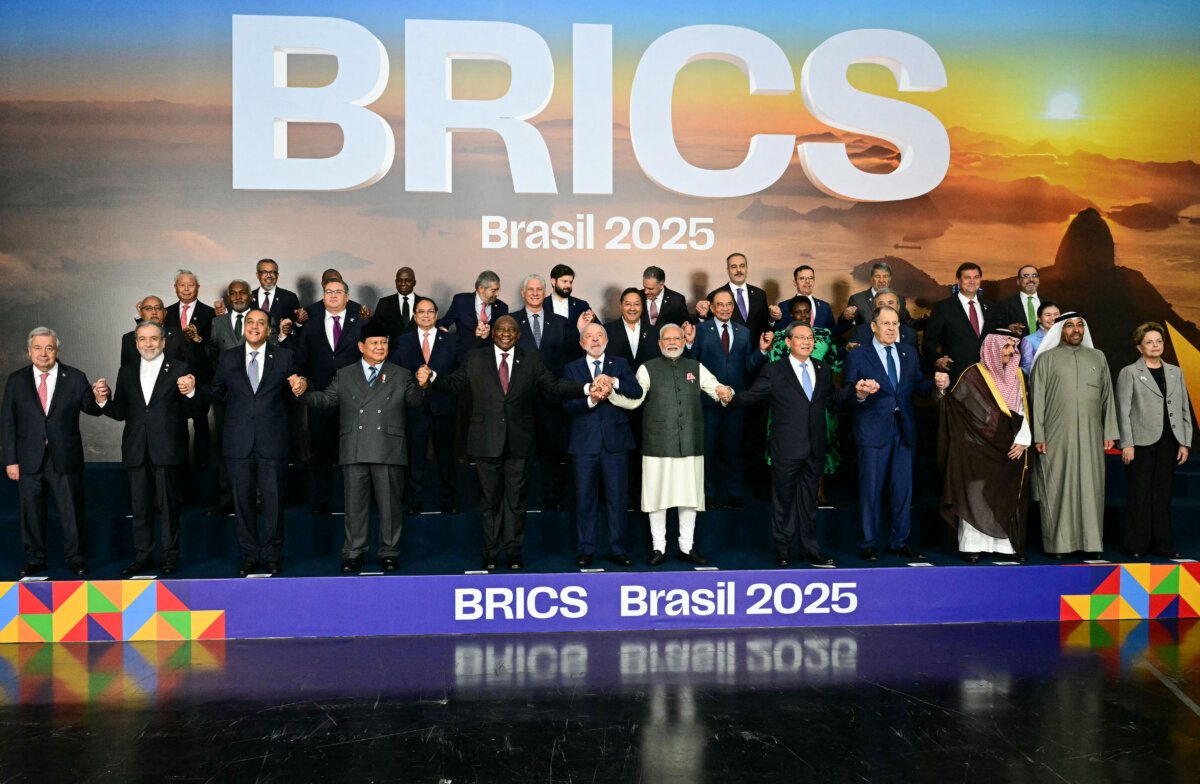
Trump did not specify the policies that he considered to be anti-American. His July 6 post came as leaders of the bloc gathered at a summit in Rio de Janeiro. Russian President Vladimir Putin was absent because of an arrest warrant from the International Criminal Court, with Foreign Minister Sergei Lavrov attending on his behalf.
BRICS leaders issued a joint statement following the summit, stating that the “proliferation of trade-restrictive actions, whether in the form of indiscriminate rising of tariffs and non-tariff measures, or protectionism under the guise of environmental objectives,” could disrupt the global economy and exacerbate the existing economic disparities.
“We voice serious concerns about the rise of unilateral tariff and non-tariff measures which distort trade and are inconsistent with [World Trade Organization] rules,” they stated.
The bloc also announced Indonesia as a new member and designated Belarus, Kazakhstan, Nigeria, Cuba, Malaysia, Vietnam, and Thailand as BRICS partner countries.
The joint statement made no mention of the United States. In April, Trump imposed a 10 percent baseline tariff and reciprocal tariffs on nearly all trade partners in a move to address trade deficits but later paused the reciprocal tariffs for 90 days to allow time for negotiations. The 90-day pause will expire on July 9.
A trade ministry spokesperson for BRICS member South Africa denied being “anti-American” and said the country still wants to negotiate a trade deal.
“We still await formal communication from the U.S. in respect our trade deal, but our conversations remain constructive and fruitful,” trade ministry spokesman Kaamil Alli told Reuters.
In a social media post on July 6, Trump said that tariff letters would be delivered to countries starting at noon Eastern time on July 7. He told reporters on July 6 that up to 15 letters could be sent out as part of trade deals.
“So we’re going to have a combination of letters and some deals have been made,” the president said before boarding Air Force One, without naming the countries.
Treasury Secretary Scott Bessent told CNN on July 6 that the tariffs will revert to the levels imposed on April 2 if the nations fail to reach a deal with the United States by Aug. 1.
The treasury secretary denied the notion that Trump was making Aug. 1 the new tariff negotiation deadline but said the new date could still give some U.S. trading partners more time to renegotiate import levies.
“We are saying this is when it’s happening,” Bessent said. “If you want to speed things up, have at it. If you want to go back to the old rate, that’s your choice.”
European Commission President Ursula von der Leyen and Trump had a “good exchange” on July 6, a European Commission spokesperson said on July 7, adding that the European Union’s aim to reach a trade deal with Washington by July 9 remained.
“We want to reach a deal with the U.S. We want to avoid tariffs. We believe they cause pain. We want to achieve win-win outcomes, not lose-lose outcomes”, the spokesperson told reporters during a daily news briefing.
Jacob Burg and Reuters contributed to this report.
 Friends Read Free
Copy
Facebook
Tweet
Friends Read Free
Copy
Facebook
Tweet