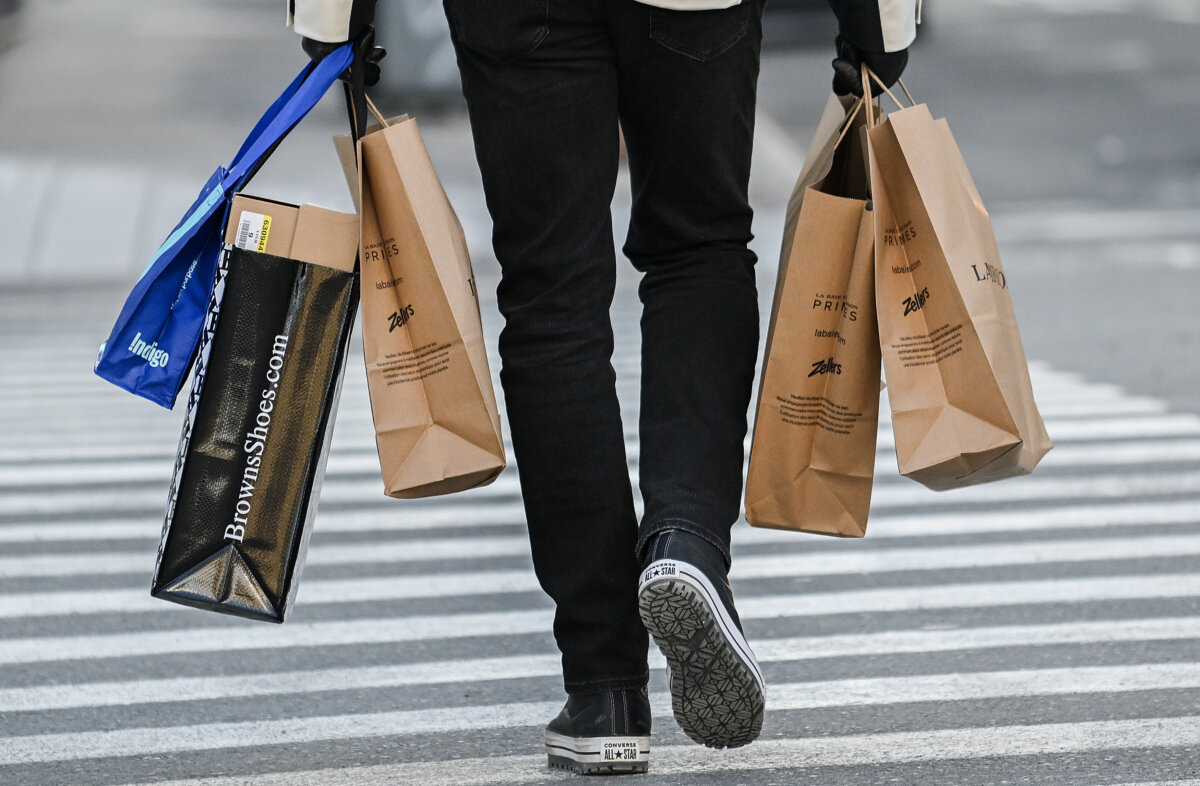

Canadians are changing the way they shop this holiday season, with some saying they will spend less while others say they have already shopped early to avoid possible price hikes from tariffs, a recent survey by the Bank of Montreal (BMO) indicates.
The poll released on Nov. 14 said that 61 percent of Canadians have adjusted their holiday spending plans this year due to concerns about tariffs, and 41 percent are planning to cut back on spending amid concerns about the rising cost of living. One quarter (25 percent) of the respondents said they started buying gifts and other holiday items earlier this year to avoid potential price increases due to tariffs.
BMO senior economist Sal Guatieri noted that the economic challenges Canada has faced of late have put a chill on holiday spending this season.
“In the wake of recent tariff increases, rising unemployment, and an upturn in inflation, it’s not surprising that Canadian consumers are feeling a sense of trepidation heading into the holiday season,” Guatieri said in the news release on the poll, adding that those factors play a key role in “undermining consumer confidence and income growth.”
U.S. President Donald Trump placed a 35 percent tariff effective the beginning of August on all Canadian products not included in the United States-Mexico-Canada Agreement, and he has also imposed higher sectoral tariffs on steel, aluminum, copper, softwood lumber, and autos.
Additional trade tensions include China’s 100 percent duties on Canadian canola oil, oil cakes, and peas this past March in response to a 100 percent levy Canada placed on Chinese electric vehicles in August 2024. Beijing also applied duties of up to 75.8 percent on Canadian canola seed imports in August.
Cutbacks
The BMO survey, conducted by Ipsos on behalf of the bank from Sept. 3 to Oct. 11 with 2,500 Canadians aged 18 and above, indicated that 37 percent of respondents said they were trying to buy gifts “minimally affected by tariffs,” including buying more goods made in Canada.
As well, respondents said they intend to prioritize their purchases based on “what matters most” and by cutting back on certain items. For instance, 46 percent said they plan to cut spending most on holiday decorations, while others plan to cut on travel (43 percent), dining out (42 percent), toys and games (40 percent), alcohol (38 percent), clothing (36 percent), and entertaining (36 percent). Meanwhile, 25 percent indicated they plan to spend more on food and groceries this holiday season compared to last year.
Specifically, respondents said they plan to spend an average of $2,310 this holiday season, with $57 allocated to holiday decorations; $545 on flights, tickets, and accommodations; $184 on dining out; $95 on toys and games; $119 on alcohol; $160 on clothing; $178 on entertaining; and $517 on food and groceries.
These sentiments mostly align with the recent data released by Statistics Canada and the Bank of Canada on inflation, unemployment, and business outlook.
On Oct. 21, Statistics Canada reported that the country’s annual inflation rate rose to 2.4 percent in September, with the year-over-year increase in consumer prices being half a percentage point higher than the 1.9 percent rise recorded in August. Food prices also rose by 4 percent on an annual basis, with the federal agency saying that this was the most substantial year-over-year rise in grocery prices since the latest low recorded in April 2024.
In early October, the agency published data showing that although Canada’s overall unemployment rate held steady at 7.1 percent in September, it remained the highest level since May 2016, aside from the pandemic period. Though the rate subsequently improved to 6.9 percent, with 67,000 jobs added in October, the numbers were primarily attributed to part-time positions.
A survey conducted by the Bank of Canada between Aug. 7 and Sept. 3, and released on Oct. 20, suggested that Canadian companies are hesitant to grow investments or increase hiring due to concerns about U.S. tariffs and global economic uncertainty.
Stocking Up on Savings
Anthony Tintinalli, BMO’s head of specialized sales, noted a shift in consumers’ shopping habits amid the challenging environment they face. “Canadians are showing resilience by budgeting earlier, shopping mindfully, and prioritizing what matters most,” he said in the news release on the poll results.
The poll indicated that 42 percent of Canadians are now focusing their attention on sale or clearance items or both. Other changing habits include buying less expensive gifts (38 percent), shopping at discount retailers or more affordable brands (32 percent), and spreading their purchases over several weeks and months (27 percent).
To build their savings, nearly 4 in 10 Canadians (38 percent) said they have reduced spending on other gifts for occasions such as birthdays and anniversaries in order to have more wiggle room in their budgets for holiday gifts. Another 17 percent said they have saved throughout the year so as to be able to afford their holiday spending plans.
Jennifer Cowan, Olivia Gomm, and Paul Rowan Brian contributed to this report.
 Friends Read Free
Copy
Facebook
Tweet
Friends Read Free
Copy
Facebook
Tweet