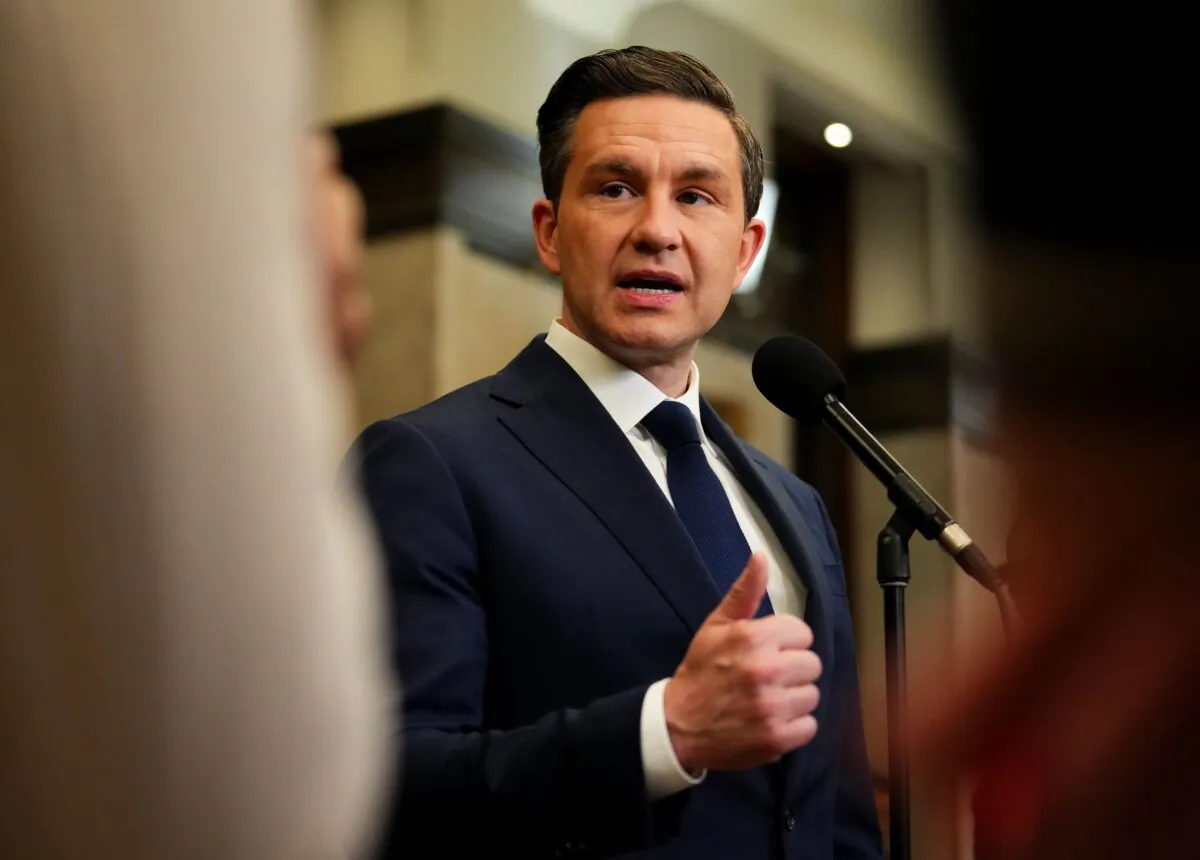

Conservative Leader Pierre Poilievre is criticizing Prime Minister Mark Carney’s government for dropping counter-tariffs on the United States and getting “nothing in return.”
At an Aug. 22 press conference, Poilievre called the tariff removal, “yet another capitulation and climbdown by Mark Carney. His elbows have mysteriously gone missing,” referencing the prime minister’s “elbows up” election campaign messaging.
Carney announced earlier in the day the removal of some U.S. retaliatory tariffs as a gesture of goodwill to resume stalled trade talks, saying it was a request from U.S. President Donald Trump in order to restart negotiations. Canadian tariffs on U.S. goods covered by the United States-Mexico-Canada Agreement (USMCA) will be removed by Sept. 1, although automotive, steel, and aluminum tariffs will remain for now.
Canada imposed 25 percent tariffs on a long list of American goods in March, including oranges, alcohol, clothing and shoes, motorcycles, and cosmetics, among others.
The United States raised tariffs on Canada from 25 percent to 35 percent on Aug. 1, citing the continuing flow of illicit drugs over the shared border, as well as Canada’s retaliatory measures.
The 35 percent tariffs apply to Canadian goods not covered under the USMCA. The United States has also applied 50 percent tariffs on steel and aluminum, 25 percent tariffs on automobiles and auto parts, and 10 percent tariffs on energy and potash.
Carney told reporters on Aug. 22 the removal of the counter-tariffs is an effort to develop a “new trade and security relationship” with the United States and follows a phone call to discuss trade that Carney and U.S. President Donald Trump had a day earlier.
Poilievre said while he was pleased to hear that Carney spoke with Trump, noting that Carney had not been able to talk to Trump earlier, he was “expecting that when the call was reported, that we’d find that President Trump had given us something in return.”
Poilievre said Ottawa’s removal in late June of the digital services tax which the United States halted trade talks over, had achieved “nothing.” The policy would have imposed a 3 percent tax on tech companies’ Canadian digital revenue and had long irritated the United States. Poilievre also said the government’s increased defence spending as requested by the United States brought “nothing” in return.
The Conservative leader said Carney had promised dollar-for-dollar retaliatory tariffs during the election but had “pulled that back” after claiming that he could “handle Trump” and “negotiate a win” for Canada.
“Those are his promises, and he needs to be judged by his word,” Poilievre said. “It was the promise on which he ran his entire election campaign, and now he’s abandoning it.”
During the press conference, Poilievre highlighted the Tories’ soon-to-be-tabled Canadian Sovereignty Act, which they say will counter U.S. tariffs and make Canada more competitive by repealing Liberal legislation such as the oil tanker ban off Canada’s west coast, the Impact Assessment Act requiring enhanced federal regulatory reviews, the electric vehicle sales mandate, and the industrial carbon tax.
“My message to Mr. Carney: steal this idea,” Poilievre said. “I’ll go into your office with my policy team, and we’ll hand it all over to you. You can even get the credit. You can draft it up. Let’s pass it in September, and let’s get building.”
Carney said during an Aug. 22 press conference that Canada has been able to keep tariff exemptions for products under the USMCA, which he said means Canada has the best deal with the United States when compared to other countries, since the vast majority of Canadian exports fall under the free-trade deal.
“As a result of that decision by the United States, the actual U.S. tariff on Canadians goods is 5.6 percent. Compare that to the 16 percent global average,” he said. “While it’s different from what we had before, it is still better than that of any other country.”
Carney also responded to criticism that he was backpedalling from his “elbows up” messaging by saying that while there was a time at the beginning that Canada had to “drop the gloves in the first period and send a message,” which he credited with getting the “best deal with the Americans right now,” the current situation calls for a different course of action.
“There’s also a time in a game where you want the puck—you want to stick handle; you want to pass; you want to put the puck in the net. And we’re moving later into the game, we’re at that time in the game,” he said.
 Friends Read Free
Copy
Facebook
Tweet
Friends Read Free
Copy
Facebook
Tweet