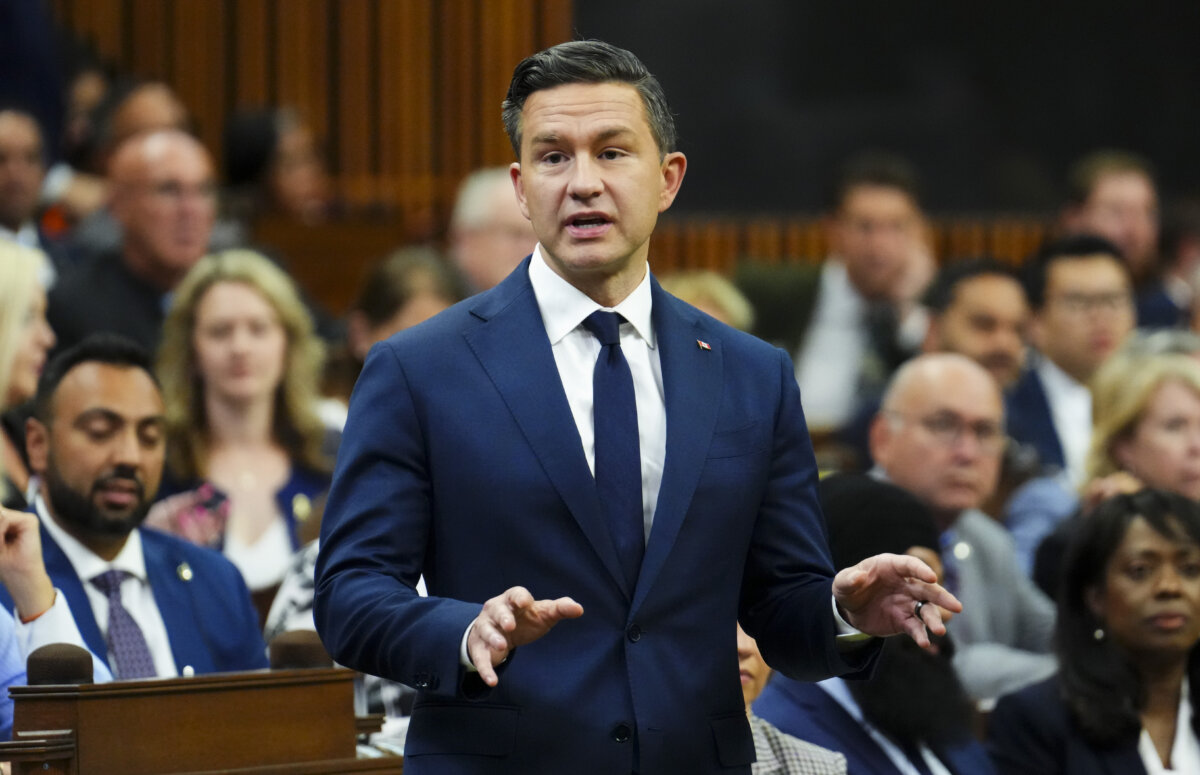

Conservative Leader Pierre Poilievre says Freedom Convoy organizers Tamara Lich and Chris Barber “peacefully” protested restrictions brought in by the Liberal government’s invocation of the Emergencies Act, and that the presiding judge was right to reject the Crown’s request for their imprisonment.
Ontario Court Justice Heather Perkins-McVey ruled on Oct. 7 that Barber and Lich would receive 18-month conditional sentences to be served at home over their roles in the 2022 trucker protest.
Barber and Lich had been found guilty of mischief for their roles in the protest, and Barber was also found guilty of counselling others to disobey a court order. The Crown had sought an eight-year prison term for Barber and seven years for Lich.
Poilievre said on Oct. 8 that Lich and Barber had “peacefully protested the imposition of emergency measures” that a federal court had found in 2024 to be unreasonable and unjustified. The court’s finding was in contrast with the ruling of a public inquiry into the government’s use of the Emergencies Act, with the inquiry finding that the government was right to do so.
Poilievre said that the Crown had focused on lengthy prison sentences for Lich and Barber instead of “pursuing rapists, drug dealers and other monsters.”
The Crown had argued the seven-plus years of jail time should be given to Lich and Barber in order to deter a future “breakdown of public order,” and that while 10 years of imprisonment is the maximum sentence for the offence of mischief, it was “difficult to imagine an offence of mischief with greater impact than that committed” by the convoy organizers.
Poilievre said the judge had “rightly rejected the Crown’s request” for jail time for Lich and Barber.
“We must get to a justice system that ensures the security and freedom of all Canadians. I wish Chris and Tamara a peaceful and happy life,” he said.
Poilievre had previously spoken out against the multi-year sentence sought by the Crown for Barber and Lich, saying in July that the Crown was pursuing this case while he said “rampant violent offenders” were being released on bail hours after committing crimes.
The Epoch Times attempted to contact the Crown prosecutor in the case but did not hear back by publication time. The president of the Ontario Crown Attorney’s Association said in July that “attacks” by “politicians, media, and members of the public” in response to the Freedom Convoy organizers’ court case and the recent world junior hockey players’ court case amount to “affronts to the rule of law.”
“Be they attacks on prosecutorial independence or sexist attacks on principles of fundamental justice, these actions are affronts to the rule of law,” Donna Kellway said in a statement.
“These attacks do not — nor will they ever — drive the decisions made by our prosecutors.”
In her decision on Oct. 7, Justice Heather Perkins-McVey said the Crown’s proposed sentencing of over seven years of jail time for Lich and Barber would not have been “fair, appropriate or consistent with the principles of sentencing.” She also said an overly severe sentence of imprisonment could “have the effect of creating a chill or a fear of participation in political expression” such as demonstrations or protests.
Lich was given an 18-month conditional sentence, and will be under house arrest for the first 12 months, with some exceptions for medical appointments and work. For the remaining three and a half months, she will be under a curfew between 10 p.m. and 5 a.m., and she will also have to perform 100 hours of community service.
Barber was given a similar sentence, which involves serving 12 months under house arrest and six months under curfew. He will also be required to serve 100 hours of community service.
Crown prosecutors have also sought to seize and auction off Barber’s truck, “Big Red,” which he used during the protest in Ottawa. Perkins-McVey has said her decision on the seizure of the truck will continue in November.
Emergencies Act
The Freedom Convoy saw hundreds of vehicles converge in Ottawa in the winter of 2022 to demand an end to COVID-19 vaccine mandates and later called for the end of other pandemic restrictions. Following three weeks of demonstrations in downtown Ottawa, the federal government invoked the Emergencies Act on Feb. 14, which gave the government additional powers to compel towing companies to remove the encamped vehicles and freeze the bank accounts of protesters.
Lich and Barber were both arrested days later. They were both charged with mischief, counselling mischief, intimidation, obstructing police, and counselling others to obstruct police, while Barber was additionally charged with counselling others to disobey a court order.
A public inquiry held to evaluate the use of the Emergencies Act found that the government acted within its rights in invoking the measures, with Commissioner Paul Rouleau saying cabinet had met the “very high” threshold in doing so. However, a subsequent federal court ruling by Justice Richard Mosley presiding over a civil suit brought on by some of the protesters said the invocation of the act violated protestors’ Charter rights and was unreasonable and unjustified.
The Liberal government has said it will be appealing the federal court’s decision, with former Deputy Prime Minister Chrystia Freeland saying at a press conference last year that invoking the act was a “hard decision to take” but also “the necessary thing to do” at the time.
 Friends Read Free
Copy
Facebook
Tweet
Friends Read Free
Copy
Facebook
Tweet