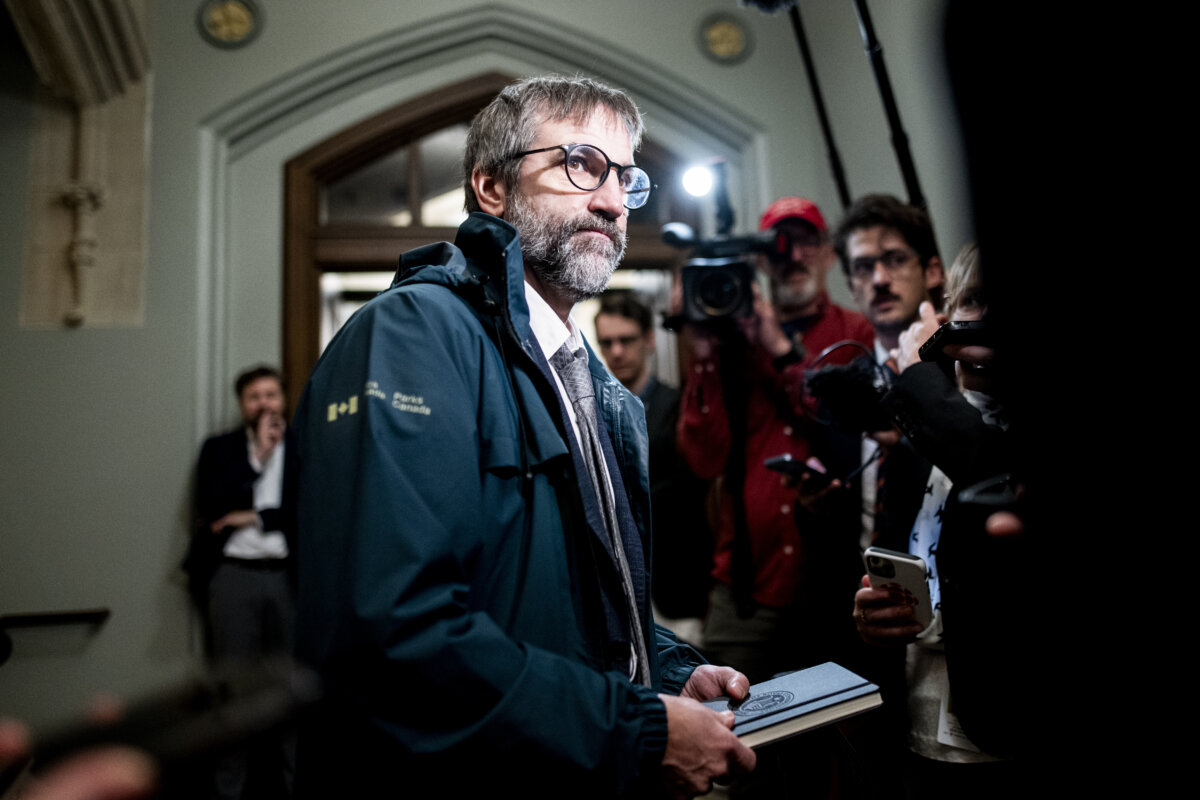

Steven Guilbeault’s resignation from Prime Minister Mark Carney’s cabinet was lamented by his Liberal colleagues and MPs from other progressive parties, and celebrated in Alberta, where the governing UCP has long opposed the policies he brought in as environment minister.
Guilbeault, who was the minister of culture in his latest portfolio, resigned from cabinet hours after Carney and Alberta Premier Danielle Smith signed a memorandum of understanding (MOU) on Nov. 27. The agreement paves the way for the building of a new pipeline to the B.C. coast should a private proponent come forward, and overhauls a number of Trudeau-government net-zero emissions policies, in exchange for Alberta making certain commitments to reduce greenhouse gas emissions.
The Quebec MP, who will remain in the Liberal caucus, said while he understands that the changes in Canada’s relationship with the United States have brought in a new economic reality for Canada and that Carney needs to ensure unity in the country, climate change issues remain a top priority for him.
Carney said in a post on social media the same day that he was “deeply grateful” for Guilbeault’s counsel and contributions to his government, but added that a climate strategy “based solely on regulations and prohibitions” won’t get buy-in from all parties and therefore won’t be effective.
“While we may have differing views at times on how exactly we make essential progress, I am glad Steven will continue to offer his important perspectives as a Member of Parliament in our Liberal caucus,” Carney said.
“Canada’s new government is committed to a building a sustainable economy through ambitious investments undertaken in a process of cooperative federalism and in full partnership with Indigenous peoples.”
Liberal MP Bill Blair, who together with Guilbeault served in the cabinet of former Prime Minister Justin Trudeau, told reporters on Nov. 27 that he had worked closely with Guilbeault, calling him a “man of principle.” Blair added that the government respects that there is a diversity of opinion, “but at the same time, I think the initiative that the prime minister has undertaken in Alberta was necessary.”
Finance Minister François-Philippe Champagne, a fellow Quebec MP, said on Nov. 28 that Guilbeault is a “great friend,” adding that his voice will still be heard in the government, but that the Carney government is proceeding with the MOU it has signed with Alberta.
“We’re going to continue to listen to him, and at the same time, provide the roadmap that the prime minister provided yesterday for responsible and sustainable use of our natural resources,” Champagne said.
Government House Leader Steven MacKinnon said while Guilbeault had an “impressive track record,” he “respectfully” disagreed with his interpretation of the MOU signed by Ottawa and Alberta.
“I think it offers a number of pathways to major environmental advances in Western Canada, in Alberta notably. These include things like carbon capture, like a better spreading out of renewable energy across the Prairies through interconnects,” MacKinnon said.
Toronto-area Liberal MP Ali Ehsassi said that Guilbeault’s decision to resign is “very regrettable,” adding that both the prime minister and Guilbeault “take the environment very seriously.”
Other Parties and Alberta
Bloc Québécois Leader Yves-François Blanchet said he has known Guilbeault for about 20 years and shared his background in environmental activism. He praised Guilbeault for pushing policies aimed at reducing oil and gas development in Canada.
“No-one will ever reproach Steven for not having tried to the very end to change the Canada he found too oil-dependent,” Blanchet said on Nov. 27. “I extend to him all my wishes for serenity in the face of the harsh reality and the grave decision that will change his life, and Quebec a little too.”
Green Party Leader Elizabeth May called on Guilbeault to cross the floor and join her party.
“Steven Guilbeault has given up on Mark Carney. Don’t give up on democracy, don’t give up on climate action. Join us, now’s the time,” May told reporters on Nov. 27.
NDP MP and leadership hopeful Heather McPherson said her party does not accept floor-crossers. When asked by reporters about Guilbeault’s resignation, she said, “Mr. Guilbeault quit cabinet but he did not quit the party and he did not quit the caucus.”
“If he really believed this was a fundamental problem for him, why didn’t he walk away? This just means he’s not interested in doing his work,” she said.
In Alberta, Justice Minister Mickey Amery celebrated Guilbeault’s resignation in the provincial legislature on Nov. 27, and many of his fellow MLAs clapped in response.
“This day is full of incredibly good news. We got rid of the emissions cap, Mr. Speaker, we have a new pipeline coming here to Alberta, and we just learned that Steven Guilbeault has resigned from the federal cabinet. So good news all around,” he said.
Meanwhile, Conservative MP Dan Albas said on X that the day before Guilbeault’s resignation, he had accused him of “not having the courage of his convictions by not resigning from cabinet.”
“I was wrong. He does. While I don’t agree with him on policy, I will say resigning over principle is an honourable act,” Albas said on Nov. 27.
Conservative Leader Pierre Poilievre has not commented publicly on Guilbeault’s resignation. Alberta Premier Danielle Smith, who had an adversarial relationship with Guilbeault when he was environment minister and once called him a “menace” while urging Trudeau to replace him, has also not commented.
 Friends Read Free
Copy
Facebook
Tweet
Friends Read Free
Copy
Facebook
Tweet