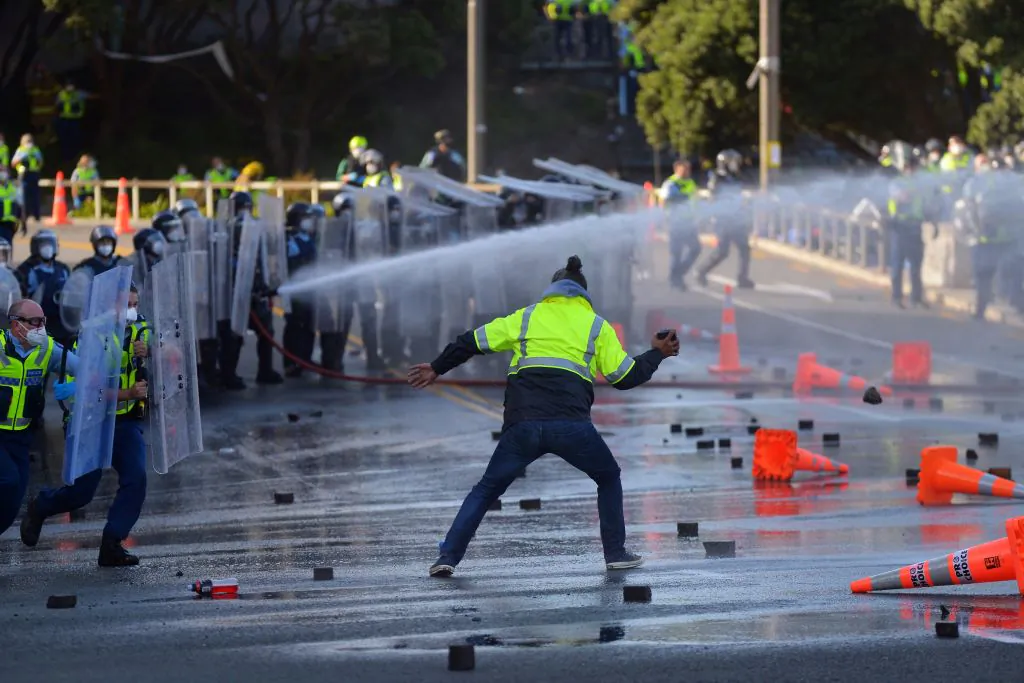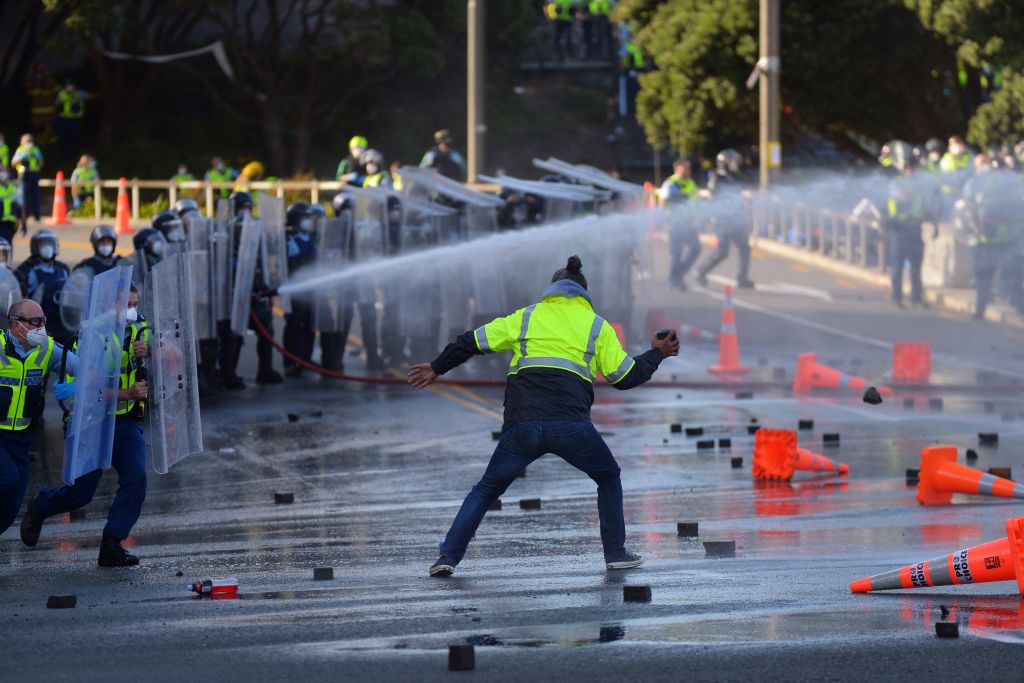

A new poll reveals that around 25 percent of Māori Party supporters and 20 percent of ACT Party supporters believe violence is necessary to “get New Zealand back on track.”
While predominantly race-based, most Māori Party policies are to the left of any other parties in Parliament, while ACT is a libertarian party. In total, one in seven people thought violence may become necessary.
Based on the latest polling, ACT has 8 percent support, enough to guarantee them representation in the next Parliament under New Zealand’s Mixed Member Proportional (MMP) system, which sets a threshold of 5 percent or one electorate seat. The Māori Party is on 3 percent, but its seven MPs all hold electorate seats.
Support for the idea dropped to 16 percent among Labour voters, 13 percent for National voters, 10 percent for those who said they supported NZ First and 8 percent among Green voters.
Men were nearly twice as likely to agree then women, at 18 and 10 percent respectively.
Young people were also more likely to agree: 21 percent of 18- to 39-year-olds agreed, compared with 14 percent of those aged 40 to 59 and 6 percent of people aged 60 and over.
Danger of Extremism
The poll also revealed that fewer younger New Zealanders said they have friends with different political views.
“It’s alarming that so many New Zealanders think violence might be justified to ‘fix’ the country,” said Taxpayers’ Union Executive Director Jordan Williams. “This isn’t a fringe issue any more; it’s a massive red flag for the health of our democracy.
“Younger people are not only more open to violence, but they’re also less likely to have friends who see the world differently. That kind of political isolation breeds extremism.
“It is frustrating that, having had staff receive death threats and direct intimidation, the police take absolutely no interest. It puts off good people from participating in public affairs, although for some, that is the very purpose. We should not have to wait for a tragedy for the police to get their act together,” Williams said.
He said party leaders also needed to shoulder some of the respomsibility and “tone down the rhetoric before it escalates further.”
“Democracy depends on debate, not intimidation. Once people stop talking to each other and start seeing violence as an answer, we’re in real trouble,” Williams said.
The Taxpayers’ Union-Curia poll was carried out in early October. It asked 1,000 people various questions about their attitude to those who held different views, and compared the results with a similar poll (pdf) undertaken last year in the United States.
That found 30 percent of Americans agreed they may have to resort to violence (up from 20 percent in March 2024), which split to 28 percent of Democrats (versus 12 percent a year before) and 31 percent of Republicans (up from 28 percent).
Surprisingly, given the relative level of media coverage and political debate on the issue, there is significantly higher support among New Zealanders than Americans for the statement “all illegal immigrants should be deported”—16 percent net agreement (“yes” minus “no”) verus 4 percent.
 Friends Read Free
Copy
Facebook
Tweet
Friends Read Free
Copy
Facebook
Tweet