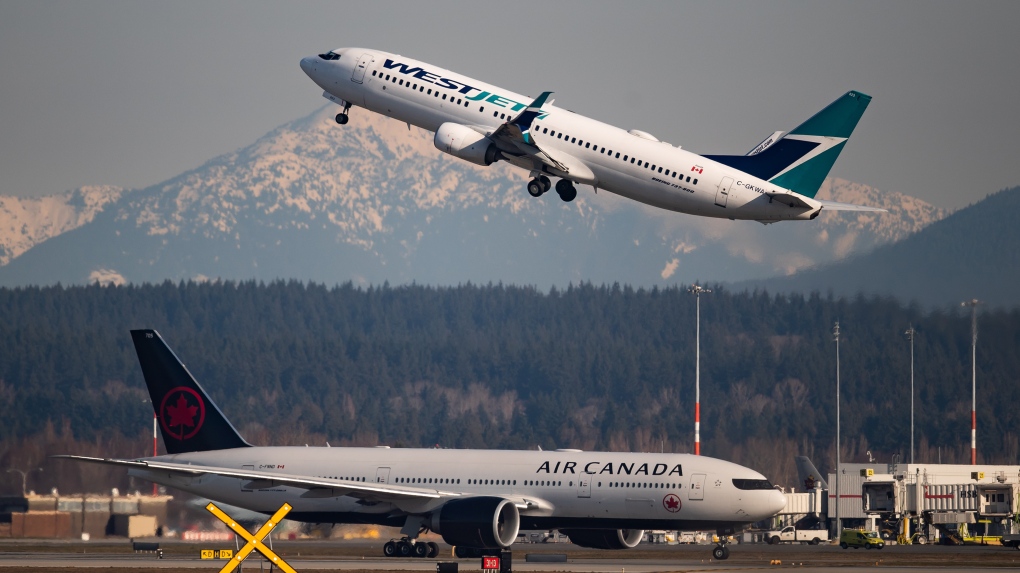

Safety incidents on airport runways in Canada have risen to unprecedented heights in recent years, even as the number of extremely close calls appears to be stabilizing, new government data shows.
Canadian runway incursions—when an aircraft, vehicle, or person is on or near a runway and shouldn’t be—reached a 15-year high of 639 in 2024, according to a report by the Transportation Safety Board of Canada (TSB). Numbers have yet to be compiled for 2025.
Each incident is broken down into four categories: extreme risk, high risk, some risk, and minimal risk. Only one incident in 2024 was rated high risk, while 151 involved some risk and 487 involved minimal risk.
Extreme-risk incidents have been rare over the past 15 years, the TSB said, with one in 2010, three in 2011, one in 2013, and none since.
High-risk incursions have also levelled off in the years since 2016, when the highest number was recorded at 20 incidents. There were 19 the following year, before dropping to three in 2018 and two in 2019.
Extreme and high-risk incidents may have dropped, but TSB Chairman Yoan Marier says the continued increase in runway incidents overall is still worrying. Such incidents stem partly from growing air traffic, a shortage of air traffic controllers, and increasingly complex ground operations at large airports, he said.
“These are complex and long-standing issues, but they are not unsolvable,” Marier said in a statement. “Real progress requires leadership, accountability, concerted efforts, and sustained action by both industry and regulators.”
The rising number of incidents remains a “growing concern,” the agency said, noting that incursions have been on its watchlist of the most critical safety issues in Canada’s air, marine, and rail sectors since 2010.
Since then, the TSB “has completed 17 detailed or limited scope investigations,” the agency said. “While few were deemed high risk, even a single collision could have catastrophic consequences.”
One such incident involving a Canadian plane occurred recently at a New York airport. An Air Canada Express jet en route from Montreal slammed into a fire truck at LaGuardia Airport, killing 30-year-old Capt. Antoine Forest and 24-year-old first officer Mackenzie Gunther. More than half of the 72 passengers aboard and the two firefighters in the fire truck that overturned in the crash were injured.
The U.S. National Transportation Safety Board is investigating the crash. NTSB investigators have said they are examining the circumstances that led to the fire truck crossing the runway during the landing of the plane, and why it did not come to a stop after the control tower issued urgent warnings.
Questions also persist about the role of air traffic controllers in the crash. One air traffic controller was heard on a radio transmission authorizing a vehicle to cross a portion of the tarmac, only to try to stop it upon realizing that the aircraft had already received clearance for landing.
Recordings captured a controller yelling, “Stop, Truck 1. Stop,” in the moments before the plane struck the back end of the truck.
The NTSB has not said how long the investigation is expected to take.
Safety Incidents on Canadian Runways
The data showed runway incursions dropped in 2020, the first year of the COVID-19 pandemic. Air traffic in Canada was low in 2020 and 2021 due to pandemic restrictions and did not begin to increase until mid-2022, according to government numbers.
Incursions were low in these years compared to 2019 and 2024.
Incursions hit 623 in 2019, and dipped to 424 in 2020, and 471 in 2021. They rose to 515 in 2022 and 566 in 2023, before hitting the record of 639 in 2024.
Data provided by air navigation service provider NAV CANADA for the period from October 2024 to June 2025 found a correlation between incursion rates and airports with flight training units (FTUs)—organizations authorized to offer flight instruction.
The highest incursion rates came from airports with FTUs, particularly at towered airports in British Columbia and Quebec, the report said. Fifty-eight percent of incursions occurred at 20 airports, including 13 associated with FTUs, and five of these account for a quarter of all incursions in Canada, the data indicated.
The TSB said it has been concerned about runway incursions for many years, and more needs to be done to bring runway safety regulations up to international standards. It used a 2019 safety investigation into two closely spaced parallel runways known as the “south complex” at the Toronto Pearson international airport as an example.
The investigation resulted in four recommendations to address some of the risks, but only one has been assessed as “fully satisfactory” to date, the TSB said.
“While no recent collision has resulted from a runway incursion in Canada, the risk remains elevated until stronger defences are in place across airports, in aircraft, airport ground vehicles, and air traffic service (ATS) facilities,” the agency said in its report.
Reducing the risk of collisions due to runway incursions requires the installation of better signage and lighting and the creation of active local safety teams, as well as broader uptake of technology to keep pilots and controllers more attuned to movements on the tarmac, the report said.
 Friends Read Free
Copy
Facebook
Tweet
Friends Read Free
Copy
Facebook
Tweet