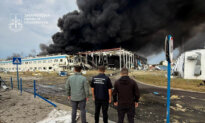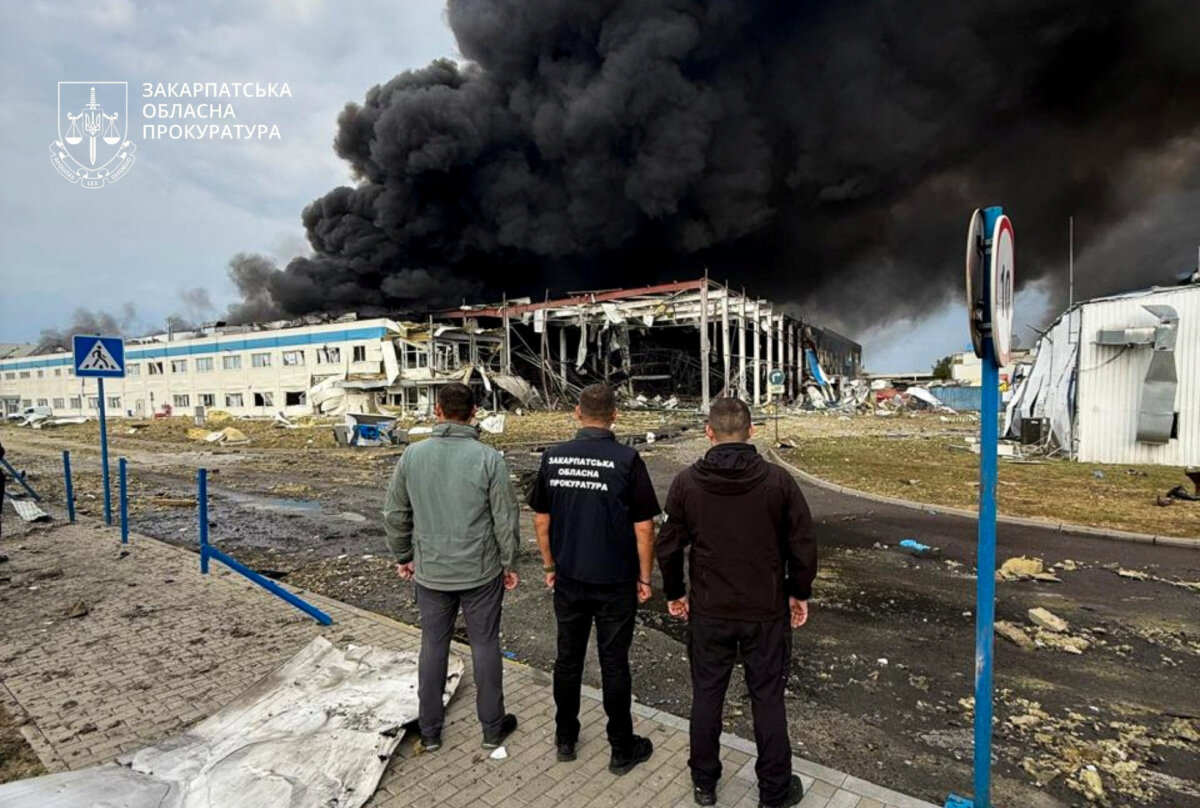

A Russian drone and missile attack on western Ukraine on Aug. 21 struck several targets, including an American-owned electronics factory, Ukrainian authorities said.
The factory, owned by Flex Ltd., opened in Mukachevo, Zakarpattia Oblast, in 2012 and employs more than 2,600 people, according to the Kyiv Independent. It is responsible for around 1 percent of the company’s global revenue, according to the newspaper.
“On the morning of August 21, 2025, our facility in Mukachevo, Ukraine, was damaged during a missile strike. Our emergency protocols were executed to ensure the full evacuation of the site,” Flex said in a statement.
“A few employees and contractors were injured during the strike and remain in the hospital. Flex is providing full support to them and their families, and we are engaging with our relevant U.S. Government officials and agencies.”
Flex said the facility is “dedicated to consumer and lifestyle products and has no role, past, or present in military or defense production.”
Ukrainian President Volodymyr Zelenskyy said in a post on X that “the Russians knew exactly where they lobbed the missiles.”
“We believe this was a deliberate attack against American property and investments in Ukraine,” Zelenskyy wrote. “A very telling strike, as is this entire massive attack, right as the world awaits a clear answer from the Russians, an answer on negotiations to end the war.”
Russia’s Ministry of Defence said in a Telegram post that its armed forces “carried out six group strikes with high-precision weapons and strike unmanned aerial vehicles” between Aug. 16 and Aug 22, “during which Ukraine’s military-industrial enterprises and the energy facilities that ensure their operation were hit” were destroyed.
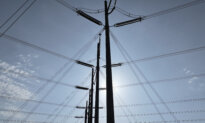
On Friday, Russia said that an energy facility at Unecha in Russia’s Bryansk region, through which the Druzhba oil pipeline runs, was set alight as a result of Ukrainian missile and drone attacks. Regional governor Alexander Bogomaz later said the fire had been extinguished.
Earlier on Friday, Hungarian Foreign Minister Peter Szijjarto said that oil supplies via the pipeline had been halted due to an attack.
“During the night we received the news that once again—for the third time in a short period—the Druzhba oil pipeline at the Russian-Belarusian border has come under attack. Oil deliveries to Hungary have been halted again!” Szijjarto said in a Facebook post.
“This is yet another attack against our country’s energy security. Another attempt to drag us into the war. It will not succeed! We will continue to support efforts for peace with all our strength, and we will defend our national interests!”
Hungary and Slovakia are both heavily reliant on Russian gas and oil for their energy supplies.
“Let it be clear to everyone: with these attacks, Ukraine is not primarily harming Russia, but Hungary and Slovakia,” Szijjarto said in a later post. “The Druzhba oil pipeline plays a key role in our country’s energy supply; without it, supplying the country with crude oil is physically impossible.”
Szijjarto said on Monday and last week that Ukraine was responsible for the previous attacks on the pipeline.
Ukraine’s military said late on Thursday it had struck the Unecha oil pumping station.
The attacks come as U.S. President Donald Trump continues his efforts to bring the war to an end, following meetings with both Russian President Vladimir Putin in Alaska and Zelenskyy in Washington.
On Aug. 21, Trump wrote on Truth Social that Ukraine cannot win its war without launching attacks on Russia, criticizing prior U.S. policy that only allowed Kyiv to defend itself, not attack.
“It is very hard, if not impossible, to win a war without attacking an invaders country,” he wrote. “It’s like a great team in sports that has a fantastic defense, but is not allowed to play offense. There is no chance of winning! It is like that with Ukraine and Russia.”
Zelenskyy said on Aug. 20 that he wants clarity within the next 10 days on the nature of security guarantees for Ukraine before he agrees to a meeting with Putin.
Speaking to reporters on Aug. 20, after returning from Washington, Zelenskyy told reporters: “We want to have an understanding of the security guarantees architecture within seven to 10 days. And based on that understanding, we aim to hold a trilateral meeting. That was my logic.”
Russian Foreign Minister Sergei Lavrov said the same day that there was no point in discussing security guarantees without the involvement of Moscow.
“I am sure that in the West and above all in the United States they understand perfectly well that seriously discussing security issues without the Russian Federation is a utopia, it’s a road to nowhere,” Lavrov said.
The location for any trilateral talks has not yet been decided. Hungary has offered to host it.
 Friends Read Free
Copy
Facebook
Tweet
Friends Read Free
Copy
Facebook
Tweet