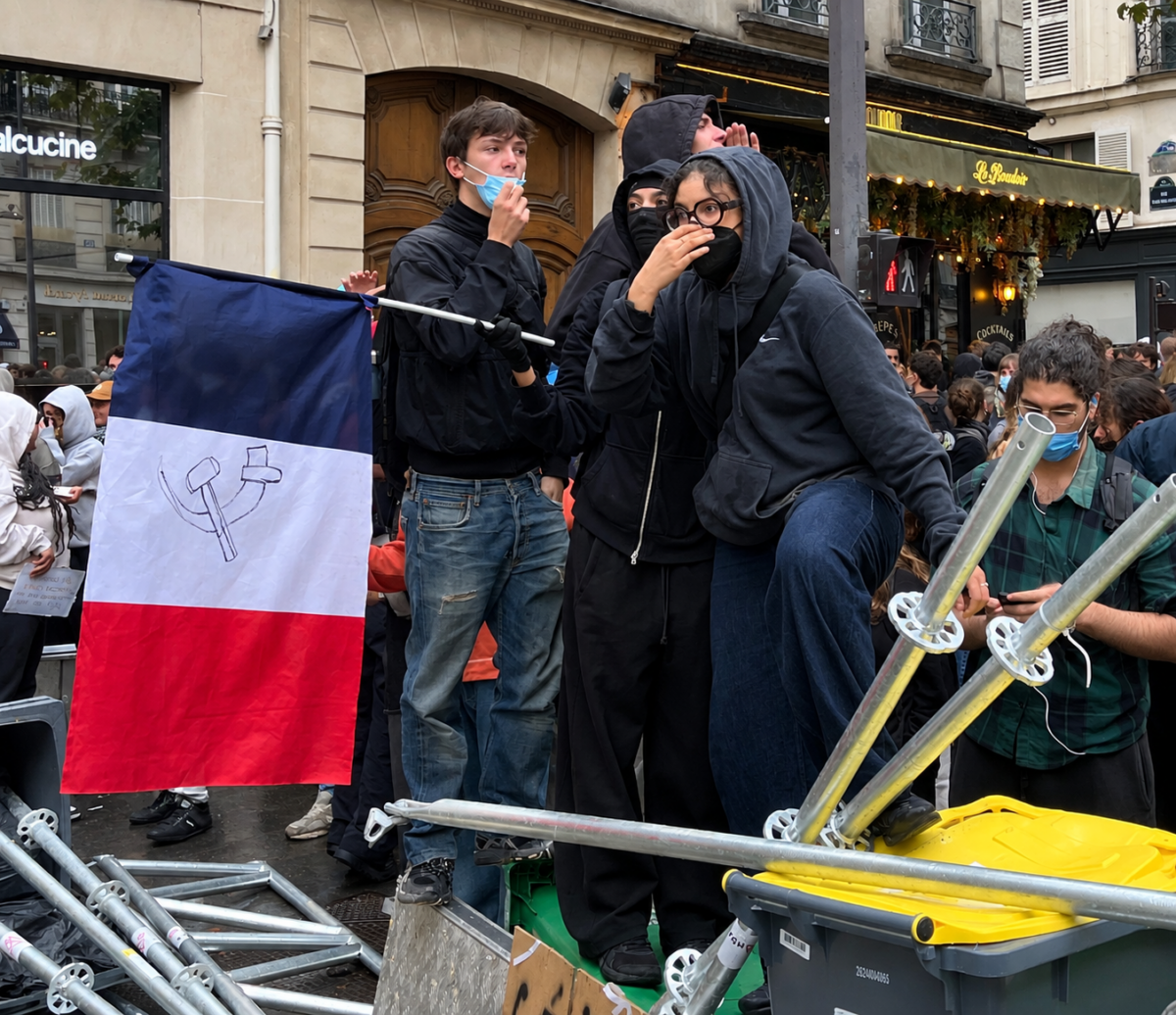

PARIS—Blockades at high schools and universities continued across France on Oct. 7, a day before students and teachers were expected to return to the streets for another nationwide protest.
The Student Union called on high school and university students to resume blockades on the morning of Oct. 8 before “converging on Bastille” in Paris at 3 p.m., a call seen as a reference to the storming of the Bastille on July 14, 1789, during the French Revolution.
Several education unions, including SNES-FSU, France’s largest secondary school teachers’ union, also called for strikes and demonstrations in support of the students.
The number of disrupted high schools fell significantly on Oct. 7. Classes were fully or partially suspended at 459 schools, compared with 891 the previous day, according to the Education Ministry, which described the movement as being in sharp decline.
The Oct. 8 demonstrations will mark the fourth nationwide day of action in a protest movement led largely by far-left student organizations and initially fueled by grievances over school conditions.
‘To Arms!’
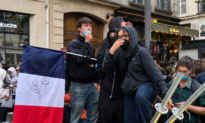
In central Paris, the protest took a more confrontational turn at the Institute of Political Studies, commonly called Sciences Po, where students barricaded entrances to the elite school and a tense standoff developed with police.
“To arms!” and “Everybody hates the police,” protesters chanted outside the school on the morning of Oct. 7.
Among the signs held up in the crowd were messages reading “High schools repressed, universities enraged,” “Sexy antifa girl,” and “Bismillah, it’s darkness,” using the Arabic expression meaning “in the name of God.”
Lawmakers from the far-left France Unbowed (LFI) party, including Antoine Léaument, arrived to support the protesters. From behind the police line, they tossed food and bottles of water toward the blockaders as officers sought to contain the crowd.
The demonstration also unfolded on the third anniversary of the Oct. 7, 2023, Hamas terrorist attack on Israel. A woman who arrived carrying an Israeli flag had it ripped from her hands by a protester, who called her a “dirty Nazi” and “genocidal.”
The woman later told reporters at the scene that in her view, the demonstration was no longer about the grievances of high school students, but about causes supported by the far-left, such as support for Palestinians.
The blockade began at around 6 a.m., when students piled trash bins and metallic objects in front of entrances on Rue Saint-Guillaume. Sciences Po shifted the day’s classes online. By late morning, hundreds of high school and university students had gathered outside, and shortly after 11:30 a.m. the crowd spilled onto Boulevard Saint-Germain.
Jeanne, a 19-year-old Sciences Po student, told The Epoch Times that she had joined the blockade in solidarity with high school students “who are repressed by the police.”
Her concerns extended beyond the immediate dispute over schools. She said young people faced a gloomy future in both the job market and their broader lives, arguing that “[President Emmanuel] Macron’s government is not doing anything to solve the climate crisis.”
Dahlia, 20, another Sciences Po student, framed the protest in broader ideological terms.
“The world we are being offered today was forged by a capitalist system that we contest and reject,” she told The Epoch Times.
She also said she was deeply concerned about the prospect of a National Rally victory in the 2027 presidential election, arguing that “the studying conditions of minorities who are already victims of racism and Islamophobia will worsen.”
‘Only a Pretext’
Théo Chêne, a representative of the right-wing student union UNI at Sciences Po, offered a sharply different interpretation of the blockade.
“The reasons put forward by the demonstrators are only a pretext for blockading and mobilizing,” he told The Epoch Times.
“At Sciences Po, as at other institutions, these actions are always carried out by the same active far-left minority, which is not at all representative of high school or university students as a whole.”
Chêne said he was particularly struck by the presence of LFI lawmakers bringing supplies to the blockaders.
“Facing the police, you had lawmakers who were doing nothing but encouraging the blockade, and even implicitly violence,” he said.
He said the incident involving the Israeli flag came as little surprise to him.
“We can clearly see that we are dealing with an anti-Semitism that is now openly embraced within this movement,” Chêne said.
He also alleged that the blockade was unlawful because it prevented other students from attending classes.
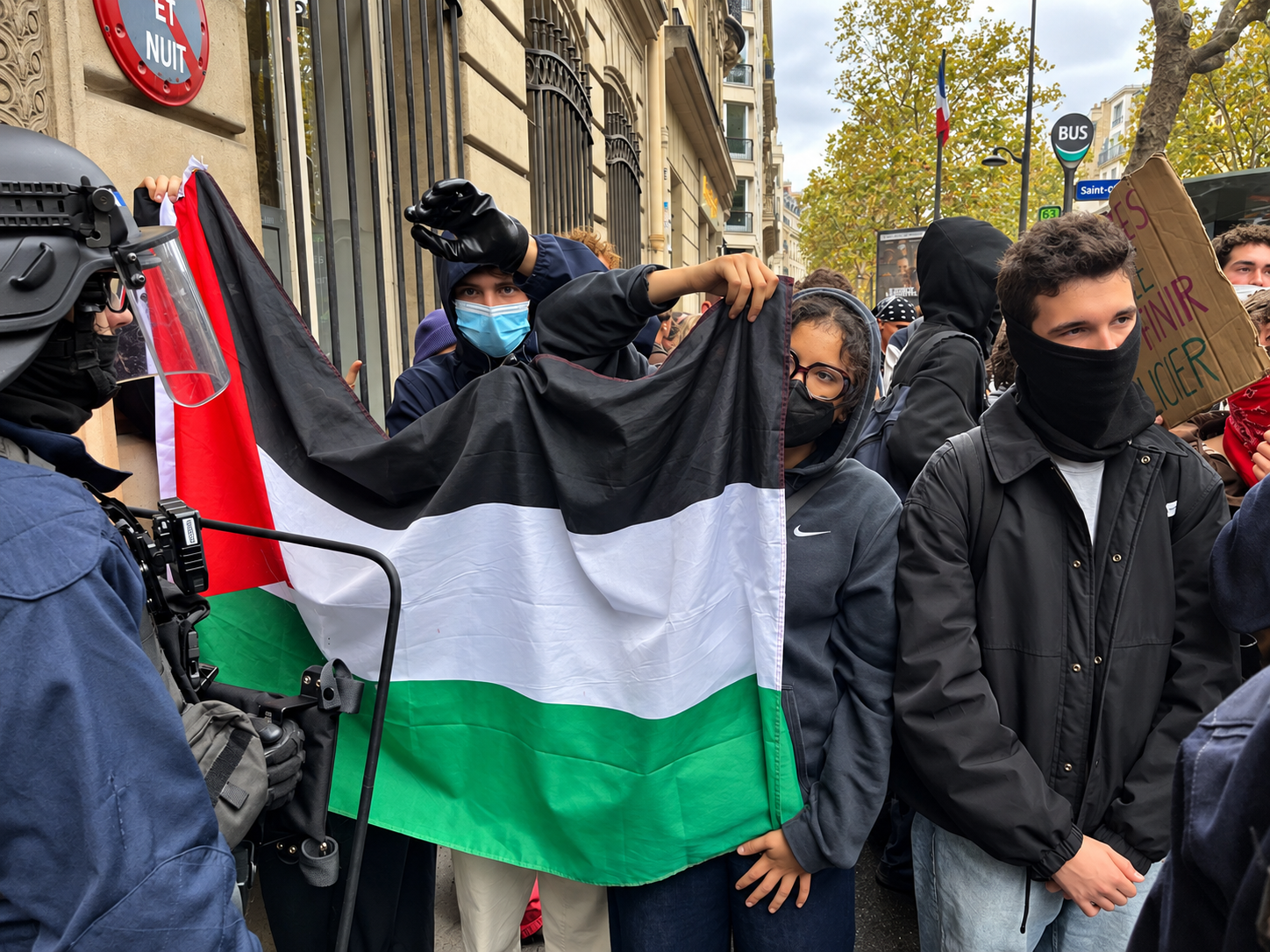 Protesters hold up a Palestinian flag during the student blockade near Sciences Po Paris on Oct. 7, 2026. (Etienne Fauchaire/The Epoch Times)
Macron Asks for ‘Empathy’: Interior Minister
The Oct. 7 blockades unfolded against a growing political controversy over the government’s handling of the unrest, after Interior Minister Laurent Nuñez suspended the use of stun grenades during the high school protests.
Nuñez told RTL radio on Oct. 7 that the measure would remain in place “until light has been shed” on an incident two days earlier in the northern city of Lens, where a 15-year-old lost a hand.
The decision came after Nuñez joined the ministers of national education and higher education for an Oct. 6 meeting chaired by Macron.
“He reiterated the need to maintain order and intervene when violence occurs, while asking that interventions be proportionate,” Nuñez told RTL, recounting Macron’s instructions.
“The president asked us to show empathy,” he said.
The suspension of stun grenades, coupled with Macron’s remarks, drew sharp criticism from opposition figures and police representatives.
Marine Le Pen, the National Rally’s presidential candidate, accused Macron of undermining officers confronting the unrest.
“Emmanuel Macron always takes the side that consists of attacking the police,” she said on Oct. 7 during a visit to a livestock fair in central France.
Le Pen said that what she described as “fake news spread by the far left” since the events began had been immediately disproved by the prosecutors in charge of the cases. She accused France Unbowed of churning out such claims to cast blame on the police, and said that this was stirring up violence against officers by making young people believe the police were the ones being violent toward them.
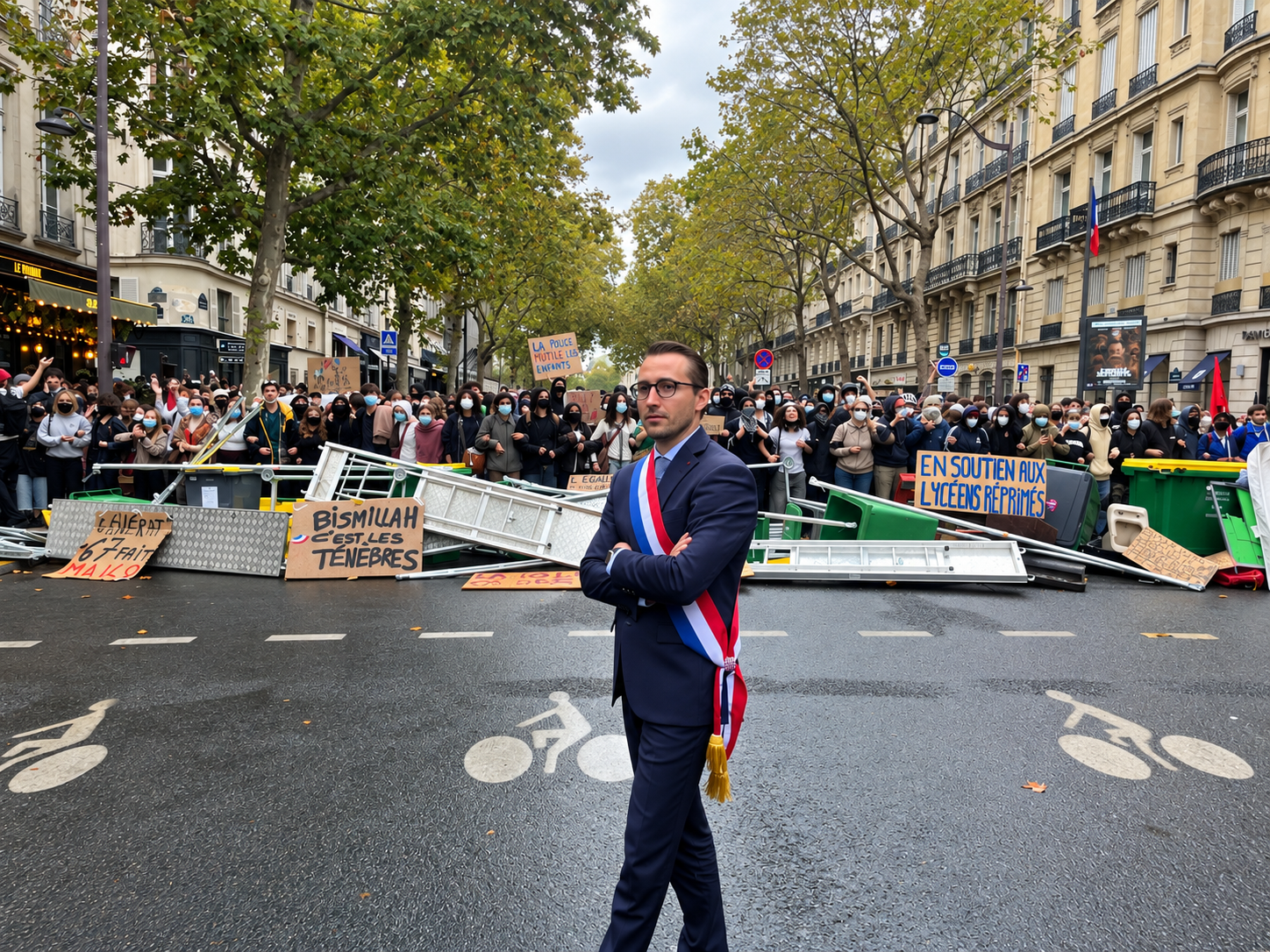 French LFI lawmaker Antoine Léaument stands in front of protesters and a makeshift barricade during the student blockade near Sciences Po Paris on Oct. 7, 2026. (Etienne Fauchaire/The Epoch Times)
“Yet he was quite happy to have them during the Yellow Vest [crisis], when he and his entourage seemed holed up in the Élysée, very worried about seeing the Yellow Vests get into the Élysée,” she added, referring to the movement of anti-government protests sparked by a tax on fuel in 2018.
Axel Ronde, national president of the CFTC Police union, went further, calling on X for “an end to public-order operations” following the suspension. He warned of the risk of officers being injured while deprived of the means to respond.
The scale of the unrest was laid out later that day before lawmakers. Nuñez told the National Assembly’s law committee that 761 police officers and gendarmes had been injured since the protests began.
He said authorities had also recorded injuries to 89 education staff members and 215 students, while 6,600 arrests had been made.
Violence and injuries continued to be reported on Oct. 7.
In Strasbourg, eastern France, a 16-year-old student from Lycée Couffignal high school suffered a serious hand injury that morning while handling a firework mortar outside the school, the Bas-Rhin prefecture told The Epoch Times.
According to the prefecture, the teenager had fired the mortar himself before being hospitalized for emergency treatment.
Even as the government faced mounting pressure over how police should respond, Prime Minister Sébastien Lecornu is seeking dialogue with the students.
“The voices of high school students are valuable and must be heard,” he wrote on X, announcing that discussion sessions would be organized in every high school.
Right-Wing Students Push Back
The government’s response to the protests has drawn criticism from right-wing student organizations, which accuse Macronists of treating left-wing unions as representative of France’s students and of making concessions that give the idea that violence and rioting get results.
Baptiste Gili, national delegate of the right-wing student union UNI, said many students simply want campuses to remain open.
“UNI wants to give a voice to the large silent majority that the government has abandoned and that asks only to study in peace and prepare for its future,” Gili told The Epoch Times.
He accused the Education Ministry of giving disproportionate attention to organizations on the left.
“These young people have had enough of the far left,” he said, noting that the ministry had received a delegation from several left-wing student groups, but not UNI.
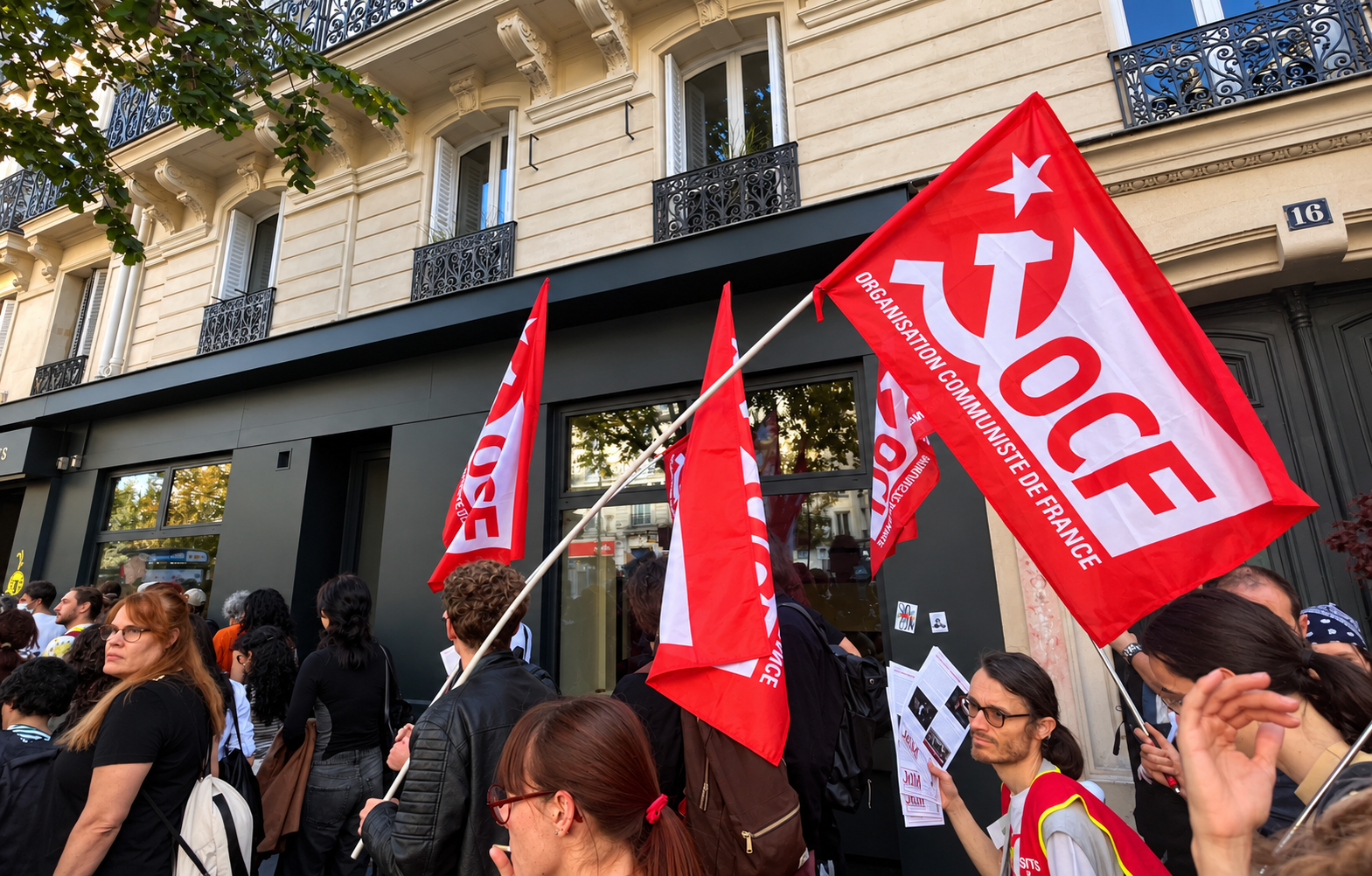 Flags of the French Communist Workers’ Organization (OCF) are displayed during a nationwide high school and student protest over education conditions in Paris on Oct. 6, 2026. (Etienne Fauhaire/The Epoch Times)
“For years, La France Insoumise has been pursuing a deliberate strategy of establishing itself in high schools and universities through the student unions the government treats as legitimate,” Liebard told The Epoch Times.
Liebard also blamed successive governments for allowing such organizations to expand their influence.
La Cocarde Étudiante has itself become directly involved in confronting campus blockades.
On Oct. 1, members of the group dismantled a barricade made of trash bins at a Paris 1 Panthéon-Sorbonne University campus. LFI lawmaker Thomas Portes subsequently criticized the organization on social media as “fascist.”
Liebard said the intervention reflected what he considers the union’s responsibility toward students who oppose the blockades.
“We decided to unblock the universities because our responsibility as a student union is to protect the vast majority of students, those who want to go to class and who do not want to see their university blockaded,” he said.
 Friends Read Free
Copy
Facebook
Tweet
Friends Read Free
Copy
Facebook
Tweet