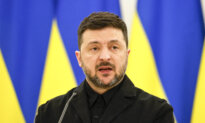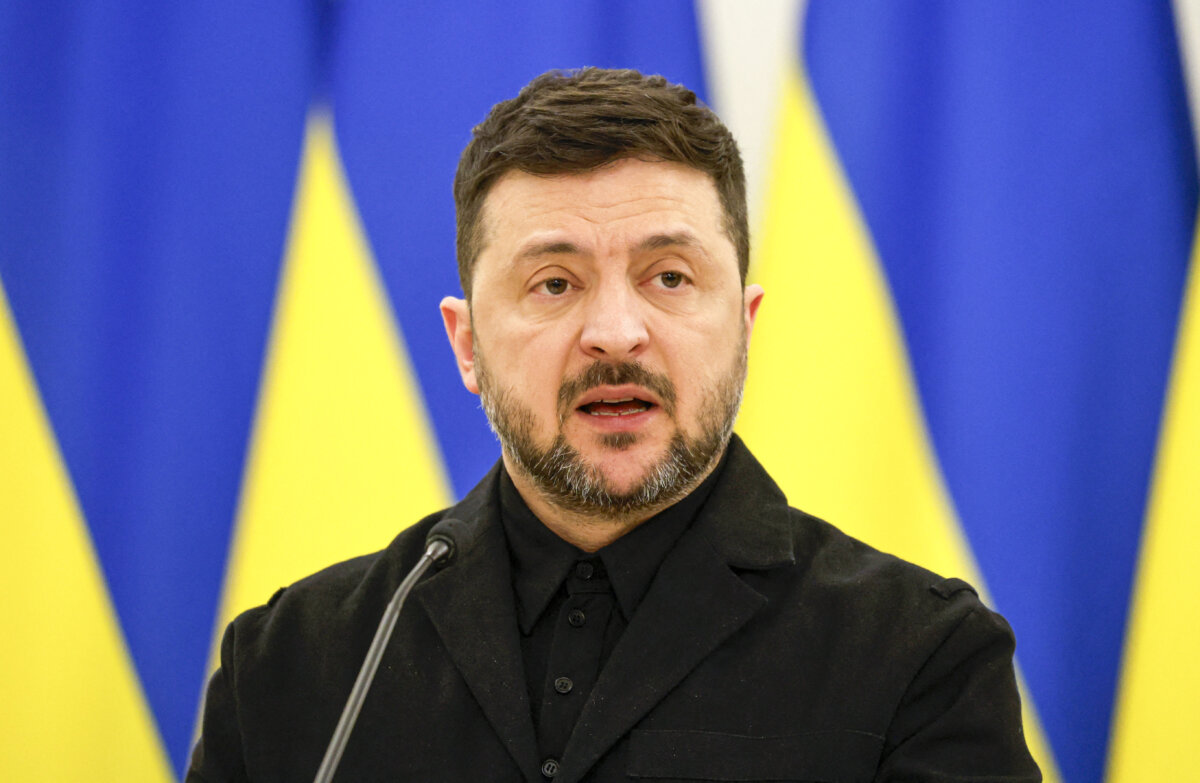

South Korea’s intelligence agency believes that Ukrainian President Volodymyr Zelenskyy’s public revelation about North Korean prisoners of war (POWs) being transferred to South Korea was likely a ploy to get more support from Seoul, a South Korean lawmaker said on Sept. 30.
Zelenskyy’s announcement at the U.N. General Assembly about repatriating two North Korean POWs to South Korea sparked an outcry in Seoul, which said that the Ukrainian leader had breached an agreement to keep it a secret.
Since Zelenskyy’s speech on Sept. 23, South Korea has summoned Ukraine’s acting ambassador to demand an official explanation and apology from Kyiv, which so far has not been forthcoming.
South Korea’s National Intelligence Service (NIS) briefed lawmakers on the incident on Sept. 30.
Yoo Young-ha of the opposition People Power Party said the agency had told a parliamentary committee that it believed Zelenskyy’s motivation was to get more support from Seoul.
“The intelligence authorities’ analysis is that the reason [Ukrainian] President Zelenskyy unilaterally announced the repatriation of prisoners was likely due to the expectation that ‘if Ukraine repatriates the prisoners, public opinion might arise on the South Korean side to provide various support, such as weapons, to the Ukrainian government,'” Yoo told reporters at a press briefing, according to South Korean news agency Yonhap.
While Seoul has backed Kyiv by providing financial, humanitarian, and diplomatic support since Russia launched its full-scale invasion of Ukraine in 2022, it has maintained a hardline on not providing any lethal weapons, despite South Korea being a major arms manufacturer.
Yoo, who serves as co-chair of the South Korean National Assembly Intelligence Committee, added that “to date, the Ukrainian side has not expressed regret or apologized to our government, whether officially or unofficially.”
Describing the way the repatriation was negotiated, Yoo said that South Korea and Ukraine had agreed that “this case will be handled privately.”
“I am unaware of whether there was a confidential agreement or consultation between the leaders of the two countries regarding this matter. However, there was a confidential agreement through various channels during the process of communication between diplomatic officials and the embassy,” Yoo said, adding that Kyiv had requested confidentiality from Seoul “fearing the impact on the prisoner exchange between Russia and Ukraine and the negative effects on exchanges with third countries.”
In a later statement from the South Korean Presidential Office on Sept. 27, senior presidential secretary for public relations Seong Ghi-hong also expressed “strong regret” over Zelenskyy’s disclosure of the repatriation and the subsequent denial of any confidentiality agreement, according to Yonhap.
Seong said the Ukrainian government had asked for confidentiality, as the revelation could spark domestic criticism over Kyiv giving up the chance to exchange the North Korean prisoners for Ukrainian prisoners held by Russia.
Seoul agreed to keep the repatriation confidential because of security, diplomatic, and humanitarian concerns, including the safety of the prisoners and their families still in the north, he said. The soldiers said in media interviews that they wanted to resettle in South Korea.
The Epoch Times contacted the Ukrainian Ministry of Foreign Affairs for comment but did not receive a response by the time of publication.
Ukraine captured the two North Koreans in Russia’s Kursk region in January 2025, with Zelenskyy at the time describing the pair as the first North Korean soldiers to be captured alive since Pyongyang sent troops to fight alongside Moscow’s forces.
Yoo’s co-chair on the intelligence committee, Yoon Gun-young of the governing Democratic Party of Korea, revealed at the same meeting that there are “no major problems” regarding the health of the two North Korean soldiers, and that they arrived in South Korea in “mid-September.”
The diplomatic fallout with Ukraine comes at a time when South Korean President Lee Jae Myung has thrown his weight behind U.S. President Donald Trump’s push to reengage with North Korean leader Kim Jong Un.
Tensions have flared on the Korean Peninsula in recent weeks after the militaries of South Korea and its allies finished annual security drills. Pyongyang responded with its own drills and missile launches.
Recently, the United States, Japan, and South Korea wrapped up their five-day trilateral Freedom Edge 26 exercise. The earlier U.S.–South Korean Ulchi Freedom Shield exercises were scaled back on Trump’s orders, with the president saying that they sent the wrong message to Kim and were costly to the American taxpayer.
On Sept. 29, South Korean Defense Minister Kang Shin-chul said that a North Korean mine had been responsible for injuring two of Seoul’s troops in the Demilitarized Zone, which divides the Koreas.
 Friends Read Free
Copy
Facebook
Tweet
Friends Read Free
Copy
Facebook
Tweet