

The Liberal government’s first Spring Economic Update projects a $66.9 billion deficit for the 2025–26 fiscal year, which is lower than the $78.3 billion shortfall forecast in its November budget.
The update, tabled exactly a year after the Liberal Party’s April 28 electoral win, outlines $37.5 billion over the next six years in new social measures, such as addressing food security, easing access to disability tax credits, extending Employment Insurance for seasonal workers, and encouraging more people to work in skilled trades.
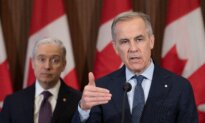
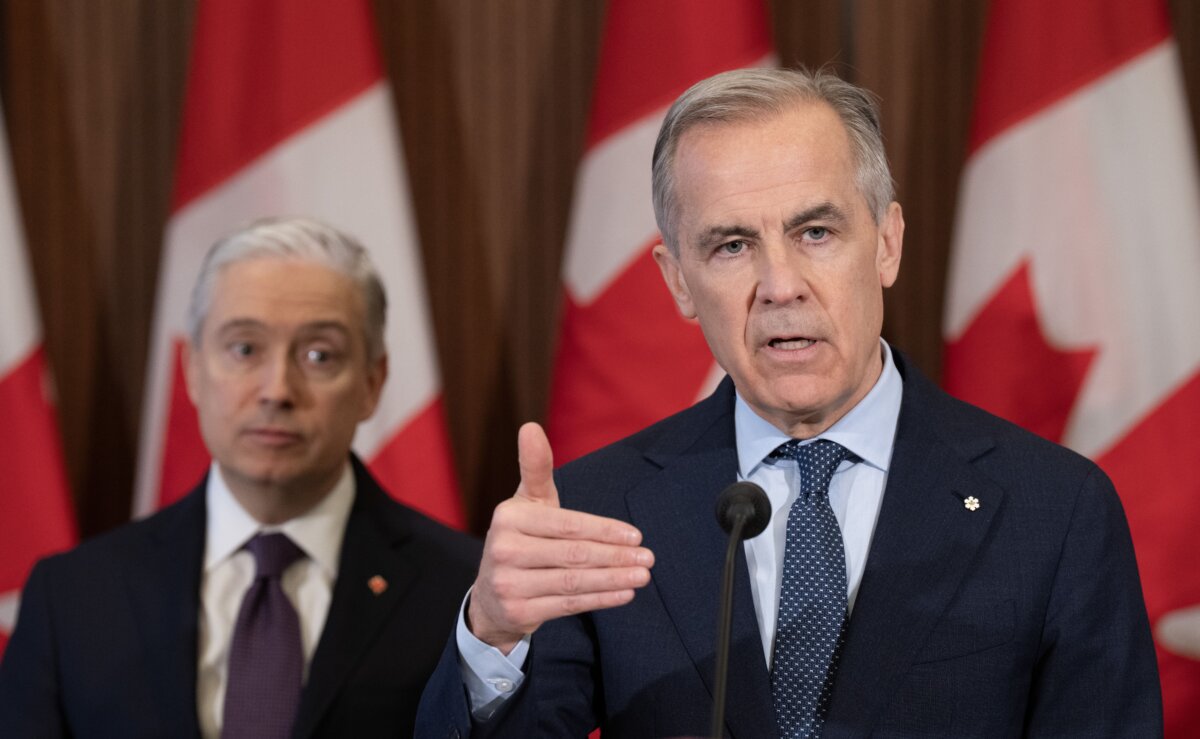
Speaking to reporters before the update’s release, Prime Minister Mark Carney said nearly half of its measures were based on affordability. Carney said Canada had the strongest fiscal position in the G7, and that strength was being deployed “first and foremost for affordability for Canadian households.”
When introducing the document in the House of Commons, Finance Minister François-Philippe Champagne said Canada’s economy had been “resilient” over the last year, which was due to the Liberal government making investments, reducing taxes for businesses, and diversifying trade.
“We have ensured that as revenues have grown, two-thirds of this increase over the past year have been directed toward affordability measures that make a real difference in the lives of Canadians,” Champagne said.
The Liberals estimated that last year’s deficit was $11.5 billion below their 2025 budget forecast because of improved economic performance and some lapses in planned spending.
The government’s Nov. 4 budget had projected a $78.3 billion deficit for 2025–26, the highest outside the COVID-19 era. In comparison, Prime Minister Justin Trudeau’s last fiscal update released in 2024 projected a $42.2 billion deficit for the 2025–26 fiscal year.
Last week, the Finance Department released its Fiscal Monitor showing the deficit was $25.5 billion between April 2025 and February 2026, well below the budget forecast. That report did not include data for March, when the government typically posts a larger monthly deficit.
New Measures
The document states that $6 billion will be invested over the next five years in “Team Canada Strong,” a strategy to recruit and train between 80,000 and 100,000 new workers in the skilled trades. The government says the measure will boost housing, infrastructure and resource development and construction.
The economic update also proposes $5 million for the Canadian International Trade Tribunal to conduct safeguard inquiries into imports of certain wood products and of canned and frozen vegetables.
Aiming to improve Canadians’ access to the disability tax credit, the report proposes streamlining the application process for people with certain long-lasting medical conditions, as well as expanding the list of medical practitioners who can certify eligibility for the tax credit. The report said these changes are expected to provide $345 million in tax relief over six years, and $86 million per year afterward.
A total of $25 billion will be put into the creation of the Canada Strong Fund, which Carney announced a day earlier. However, the document does not say where the money for Canada’s first sovereign wealth fund will come from. Champagne had suggested on April 28 that the money would be borrowed, as he cited Canada’s strong credit rating that allows it to borrow cheaply.
The document said these changes are expected to provide $345 million in tax relief over six years, and $86 million per year ongoing, beginning in 2025–26.
The base Canada Pension Plan contribution rate would also be reduced from 9.9 percent to 9.5 percent beginning in 2027, which would provide $133 in annual savings for employees earning $70,000 a year, and equivalent savings for their employer.
The document also contains a nature strategy that aims to help conserve 30 percent of Canada’s lands and waters by 2030 and ensure that industrial strategies complement conservation efforts.
Additionally, $755 million is pledged to expand access to sports in Canada and make better use of existing and new infrastructure, in order to “support Canada’s world class athletes.”
Economic Outlook
The document painted a rosy picture of Canada’s economy, noting it grew by 1.7 percent in 2025 and avoided a recession, “even as tariff increases and trade tensions weighed on activity.” It said businesses and workers have shown resiliency, business sentiment has recovered, and global investment in Canada is increasing.
GDP growth is expected to be 1.1 percent in 2026 and 1.9 percent in 2027, according to the document, which is “marginally lower” than Budget 2025’s predictions of 1.2 percent in 2026 and 2 percent in 2027.
The conflict in the Middle East, which has led to Iran virtually closing down the key Strait of Hormuz waterway, is expected to result in higher energy incomes and government revenues for Canada, but also higher costs for households and businesses. “The conflict in the Middle East is adding to an already fragile global economic environment,” the document said.
The document said while the economy is continuing to grow, the outlook is “subject to heightened global uncertainty” that includes trade tensions with the United States and geopolitical risks around the Iran war that have raised energy prices.
“Canada is not immune to this global energy shock. Higher oil prices will put upward pressure on inflation in the near term, but overall economic conditions remain broadly stable, with the labour market continuing to hold up,” the document said.
Opposition Reaction
Conservative Leader Pierre Poilievre had sent a letter to Carney on April 26 calling for the deficit to be capped at $31 billion, which was the level set by former Prime Minister Trudeau in 2024. Poilievre also called for Carney to outline a medium-term plan to balance the budget.
Poilievre said on X after the tabling of the budget that Carney “doubled Trudeau’s deficit” from $31 billion to $65.3 billion. “It is more costly credit card budgeting. He will further inflate the cost of living for hardworking Canadians,” Poilievre said.
In a statement, Poilievre thanked Champagne for his commitment “as a father” to simplifying the disability tax credit. “Our people should be spending their time living their lives rather than filling out forms,” said Poilievre, whose daughter is autistic.
The Bloc Québécois, meanwhile, had requested that the document contain measures like a federal wage subsidy to support businesses impacted by U.S. tariffs, Employment Insurance reform, increased health transfers to the provinces, and more support for the media and the arts.
Bloc Leader Yves-François Blanchet said he saw the statement as a “bit of a show” and that the deficit was reduced because the government did not spend money on some items, and inflation increases the government’s income. He also said the statement did not contain many measures for Canadian businesses.
“Last week, the prime minister promised me in the Question Period that there would be measures to adapt present and acting businesses—not future projects—to the situation. And the update contains absolutely not a word about that,” he said.
New Democrat Leader Avi Lewis said the Liberal government failed to address the cost of living crisis that Canadians are facing, including by introducing measures to bring in revenue from “extremely profitable corporations,” particularly in the oil and gas sector.
Lewis said while the NDP is in favour of the grocery and essentials benefit to support more than 12 million Canadians, other measures like the gas tax holiday and middle-class tax cut are “extremely expensive measures that cost billions and billions and billions of dollars every single year, and they do not fundamentally change the equation for Canadians who are struggling to put food on the table for their kids.”
The Liberals recently secured a majority government through both floor-crossings by MPs and victories in recent byelections. Given that the Liberals have 174 seats and the combined opposition parties have 169 seats, votes on new fiscal measures contained in the Spring Economic Update are sure to pass.
 Friends Read Free
Copy
Facebook
Tweet
Friends Read Free
Copy
Facebook
Tweet