
Voters in Terrebonne will need to cast write-in ballots at polling stations next month in response to the Longest Ballot Committee targeting the Quebec riding’s byelection with more than 40 candidates, the head of Elections Canada says.
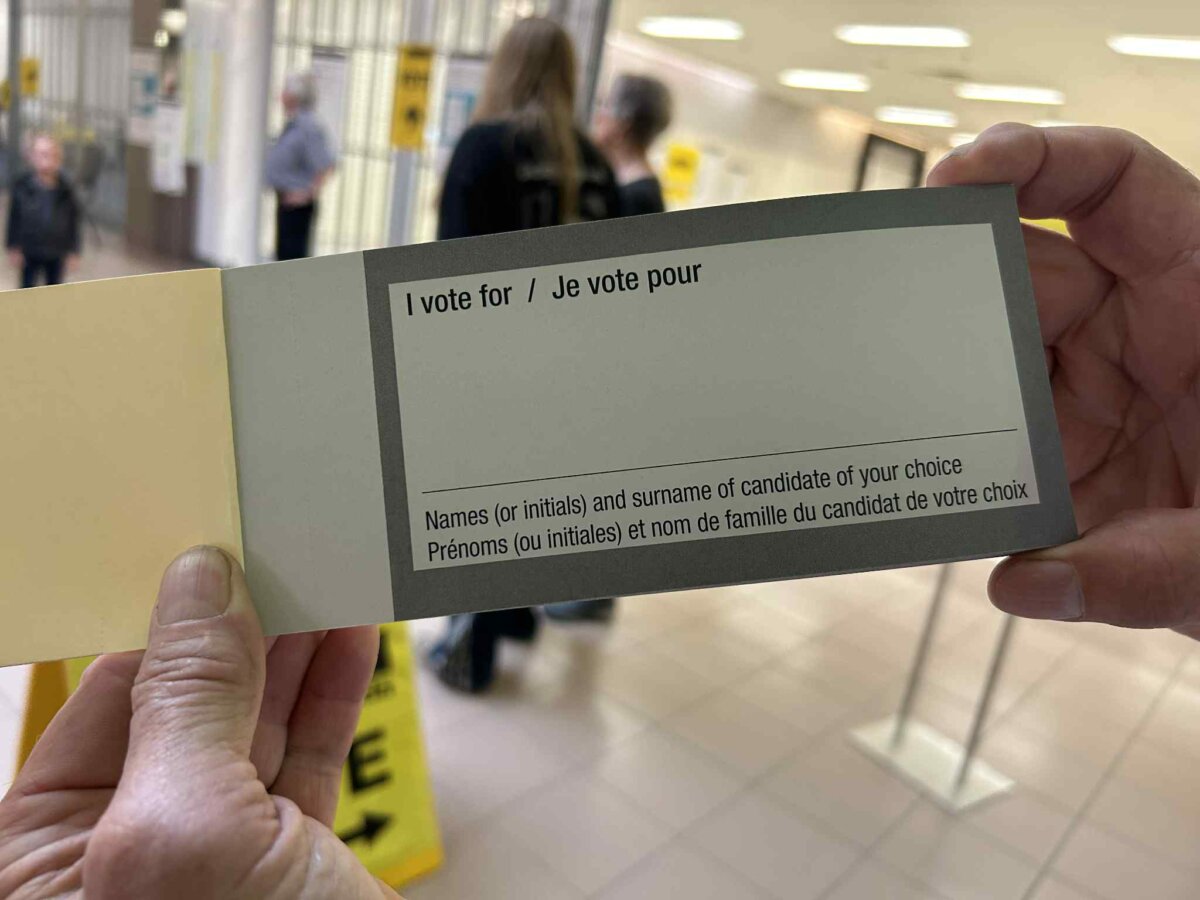
Chief Electoral Officer Stéphane Perrault told a parliamentary committee this week that a total of 48 candidates are running in the Terrebonne riding. He said the write-in ballot was the “lesser evil” when compared to a lengthy folded ballot listing all the names.
“This is an approach that did work well the last time we used it,” Perrault said during the Standing Committee on Procedure and House Affairs meeting on March 24.
Voters will write the name of their chosen candidate in a space provided on the ballot. Even those with spelling errors will count as long as it is clear who the voter is supporting.
This style of ballot was first used in the Alberta riding of Battle River-Crowfoot last summer when protest group the Longest Ballot Committee targeted the byelection in which Conservative Leader Pierre Poilievre ran to regain a seat in the House of Commons.
“We had very few complaints about the use of that ballot,” Perrault told MPs. “We felt this was a better experience for the voters in general.”
Forty-two of the 48 candidates running in Terrebonne are affiliated with the Longest Ballot Committee, committee vice-chair and Tory MP Michael Cooper said.
He asked Perrault if write-in ballots were difficult for voters with disabilities or literacy issues.
“It proved to be satisfactory and 97 percent of voters found it easy to use,” Perrault replied. He noted that polling stations will provide voters with a full list of candidates in both alphabetical order and by party affiliation.
Report Recommendations
The Longest Ballot Committee has mobilized hundreds of candidates in several elections over the past five years but the byelection last August in Alberta was the first time Elections Canada implemented a write-in ballot.
The protest group enlisted nearly 200 people to run against Poilievre to protest Canada’s first-past-the-post electoral system and Perrault said the write-in strategy enabled Elections Canada to avoid an excessively lengthy ballot that would hinder both the voting and vote-counting processes.
Cooper described the Longest Ballot Committee as a “rogue” group who has made it more difficult for voters to cast their ballots.
He said write-in ballots may be a workaround to avoid metre-long ballots, but it still isn’t ideal.
“It’s the best that can be done in a set of difficult circumstances because of the malicious activities” of the group, he said.
The parliamentary committee is also addressing the issue. It released a report on March 24 urging the government to revise the candidate nomination procedures in an attempt to restrict the group’s influence over the electoral process.
A candidate currently requires 100 signatures from voters within the riding to run for an election or byelection. The long ballot group has had voters sign multiple nomination sheets in the past.
The report suggests the government establish a violation under the Canada Elections Act for signing multiple nomination forms, and clearly state on the forms that an individual is permitted to sign for only one candidate.
The report also advocates for the government to criminalize the act of persuading a voter to sign multiple nomination forms, stating that such conduct should be “subject to penalties.” It did not specify what those penalties should be.
Any changes made by Ottawa will not be in time for the April 13 byelections in Quebec and Ontario, although the Longest Ballot Committee is seeking to disrupt only the race in Terrebonne, a Montreal suburb.
Terrebonne is expected to be the most hotly contested of the three byelections, after the Supreme Court of Canada overturned the Liberals’ single-vote victory from last year’s federal election due to a clerical error on mail-in ballots.
The other two ridings, University-Rosedale and Scarborough Southwest, are considered “safe” Liberal seats.
If the Liberals were to win all three ridings, the party’s seat count in the House of Commons would jump to 173, one seat above the threshold necessary to form a majority government.
 Friends Read Free
Copy
Facebook
Tweet
Friends Read Free
Copy
Facebook
Tweet