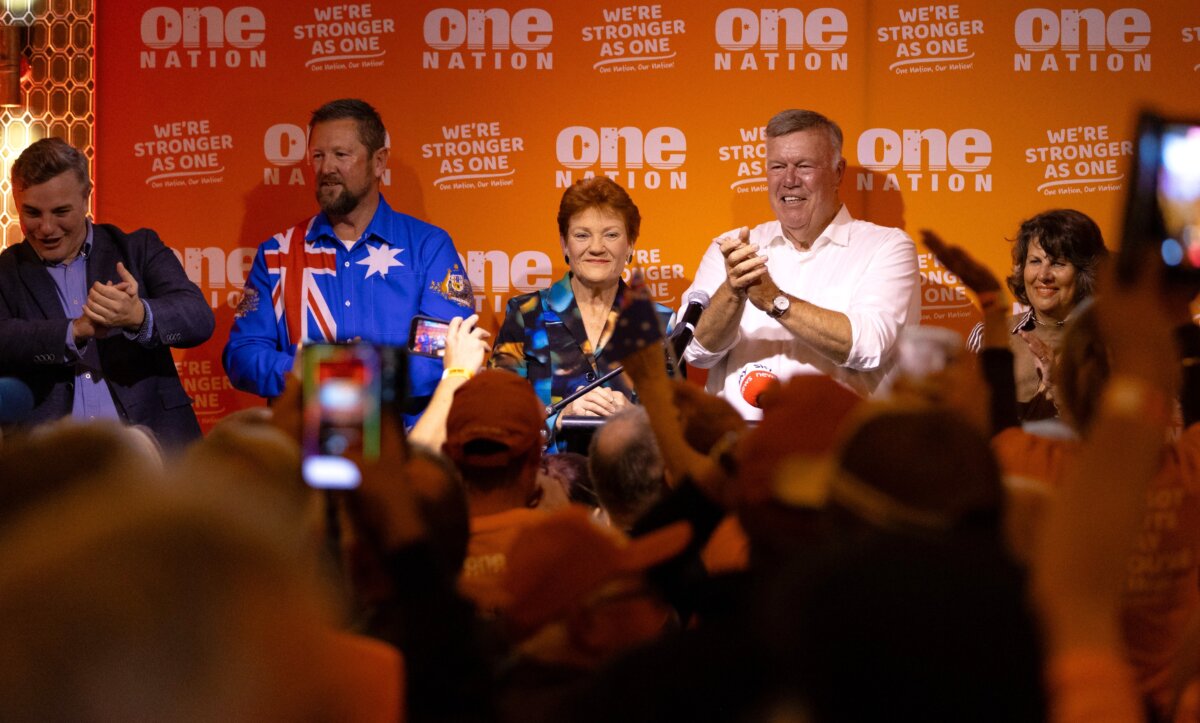

One Nation has set more sights on Australia’s political status quo after breaking through a glass ceiling with by-election success.
David Farley swept to victory for One Nation in the sprawling southern New South Wales (NSW) electorate of Farrer on Saturday night, ending the Liberal-National Coalition’s 77-year reign in the federal seat.
With at least 80 percent of ballots counted, Farley had claimed more than 57 per cent of the two-candidate-preferred vote to comfortably beat independent Michelle Milthorpe.
It was One Nation’s first federal lower house election victory since the party was founded by Senator Hanson in 1997.
After declaring that her party was coming for more seats, the One Nation leader put no limit on her goals for the next federal election.
“It’s not up to me to put a number on that … it’s up to the people of Australia,” she told Sky News Australia on Sunday from Albury, standing in front of a private plane recently donated by mining magnate Gina Rinehart.
Former Nationals leader-turned-One Nation MP Barnaby Joyce also suggested the political earthquake would spread.
“Western Sydney here we come,” he said.
Farrer comprises more than 126,560 square kilometres and fills out the southwest corner of NSW.
The race, which became a two-way competition between a minor party and an independent, signals a broader shift in voting away from the major parties.
Electoral analyst and blogger Ben Raue said Milthorpe was unable to offset Farley’s strong results in regional and rural booths by running up the score in the major centre of Albury and its surrounds.
“One Nation has dominated the right-wing bloc,” he told AAP.
Monash University politics lecturer Benjamin Moffitt said the result was not unexpected with the ongoing rise of One Nation, although the decisiveness of the Liberals’ drubbing came as a surprise.
“One Nation has clearly built legitimacy, at least for now,” the academic said.
“It will now be OK after South Australia and this election to vote One Nation. The dam wall has burst.”
Moffitt said the swing to One Nation reflected a broader global trend toward right-leaning populist parties, pointing to the dominance of Reform in the UK’s recent council elections.
“There are no more tests,” he said.
“I don’t think people should be acting surprised anymore … the other parties have got to seriously work out what they do.”
The by-election was triggered when long-time MP Sussan Ley resigned after being ousted as Liberal leader by Angus Taylor in February.
Support for the Coalition crumbled, down to 12 percent of the primary vote for the Liberals and less than 10 percent for the Nationals.
Ley secured more than 43 percent of the primary vote when she retained the seat at the May 2025 election.
Shadow Treasurer Tim Wilson did not rule out forming a minority government with One Nation to defeat Labor at the next election.
“It all comes down to what Australians put up,” he said.
“I want to stop the Albanese government from continuing to wreck Australia.”
Deputy Liberal leader Jane Hume said trust with voters had been broken after the Coalition split twice and it would take time to rebuild.
But the former Opposition Leader Ley said it would be wrong to attribute the result to the Coalition ruptures and parroted Taylor’s catchcry of “change or die,” which he deployed after February’s leadership spill.
“Three months later, the result in Farrer demonstrates that statement to be far truer today than it ever was then,” Ley said.
Treasurer Jim Chalmers described the result as a “bloodbath” and said it showed the Coalition would have to join One Nation to compete.
Labor did not contest the by-election.
By Callum Godde, Adrian Black and Maeve Bannister in Melbourne.
 Friends Read Free
Copy
Facebook
Tweet
Friends Read Free
Copy
Facebook
Tweet