President Donald Trump has endorsed Armenian President Nikol Pashinyan ahead of next month’s elections. The endorsement comes as Washington and Yerevan signed a strategic partnership agreement.
“Nikol has my COMPLETE and TOTAL Endorsement for Re-Election on June 7, 2026,” Trump said in a post on Truth Social on May 27.
“With Nikol’s help, we will bring the United States, Armenia, the South Caucasus, and Central Asia to greater heights than ever before. Make (Armenia) Great Again—MAGA!”
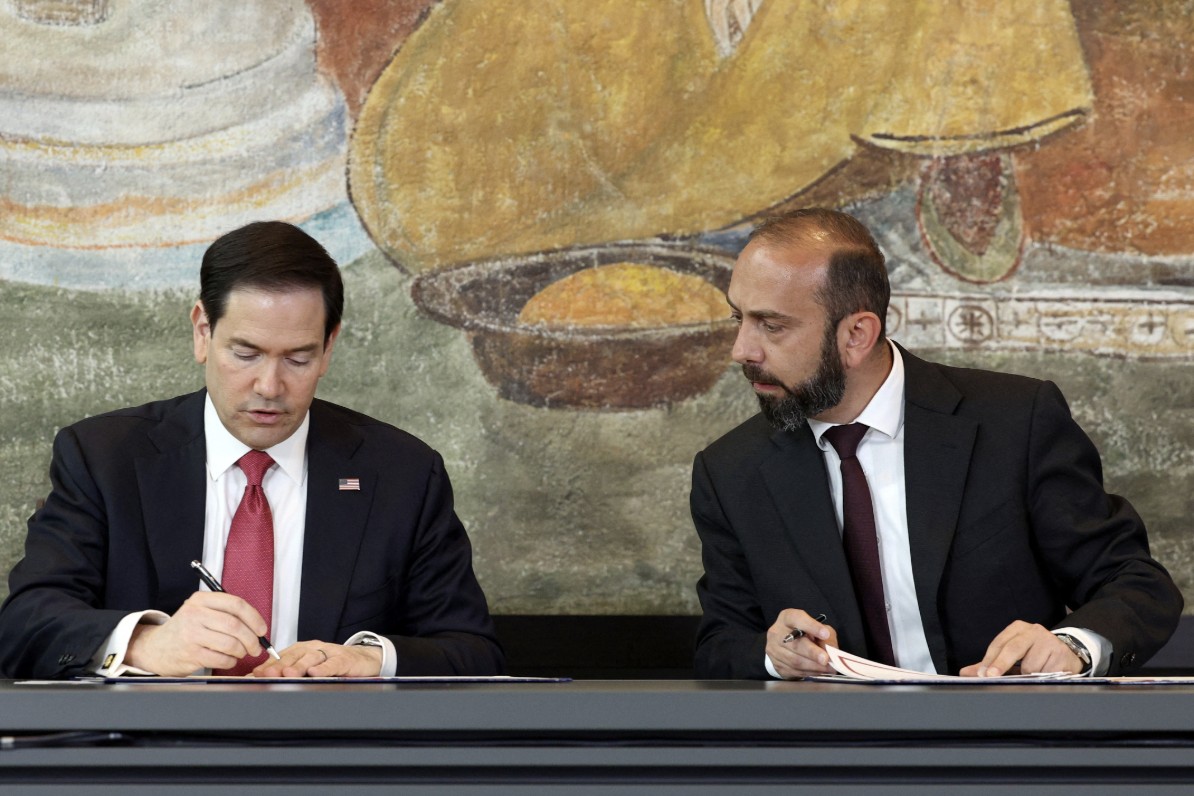
On May 26, Secretary of State Marco Rubio and Armenian Foreign Minister Ararat Mirzoyan signed a strategic partnership agreement during a brief meeting at Zvartnots International Airport, near the Armenian capital, Yerevan.
They also signed a framework agreement on critical minerals and another agreement that would open a 27-mile transit corridor, allowing neighboring Azerbaijan to have a direct route through southern Armenia to its Nakhchivan exclave and on to its political and military ally Turkey.
Armenia and Azerbaijan have fought several bitter wars in recent years, most recently in 2020, when Azerbaijan recaptured the Nagorno-Karabakh region—a historically Armenian area, which Yerevan had held since 1994—during a six-week conflict in which thousands of soldiers from both sides were killed.
During that conflict, Azerbaijan used large numbers of Turkish-built Bayraktar drones, which proved decisive.
In August 2025, Trump hosted the leaders of Armenia and Azerbaijan at the White House, where they signed joint declarations ending decades of conflict.
Trump Says Pashinyan Shares ‘Vision’
Trump wrote on Truth Social: “Prime Minister Nikol Pashinyan, of Armenia, a great friend and Leader, is making his Country strong, wealthy, and very secure! Nikol completely shares my vision of PEACE and PROSPERITY for Armenia and the entire South Caucasus region.”
Trump said Rubio had advanced several important deals during his trip to Armenia.
“Soon, the United States and Armenia will break ground together on the Trump Route for International Peace and Prosperity, which will transform the South Caucasus and help our wonderful American Energy Companies gain access from Central Asia all the way to the United States,” he said.
In a post on X on May 28, Pashinyan wrote, “Thank you, President Trump, for the high appreciation and friendly words.”
Armenia is due to hold elections on June 7 in which Pashinyan’s Civil Contract party will seek to maintain its control of parliament. It is up against several opposition parties, including the Armenia Alliance, led by Robert Kocharyan, and Strong Armenia, led by billionaire businessman Samvel Karapetyan.
A poll by the International Republican Institute (IRI) on May 22 put the Civil Contract party at 32 percent, with Strong Armenia a long way behind at 6 percent and Armenia Alliance at 3 percent. The poll also found 23 percent were undecided and 21 percent refused to answer.
The EU passed a resolution on April 28 that called on the bloc to “step up financial and technical assistance to Armenia,” with a focus on “strengthening institutional resilience, energy security, digital governance and economic diversification.”
Armenia remains a member of the Eurasian Economic Union (EEU), a single market that includes Russia, Belarus, Kazakhstan, and Kyrgyzstan. When Pashinyan met with Russian President Vladimir Putin in Moscow earlier this year, Putin warned him that he would have to choose between staying in the EEU and joining the European Union.
On May 25, the Kremlin said that Armenia could lose the “very attractive” price it pays for Russian gas if it continues to turn towards the EU rather than Moscow.
Earlier this month, Armenia signed a joint declaration with the EU, bringing them closer and supporting the former Soviet republic’s “sovereignty, resilience, and comprehensive reform agenda.”
Russia Threatens Armenia
Russia, however, said it would suspend or terminate the supply of cheap oil, gas, and rough diamonds to Armenia if the next government pushed ahead with its plans to join the EU.
“The Russian Embassy has officially forwarded a letter … stating that if the process of accession to the EU continues, the Russian side will suspend or unilaterally terminate the Agreement on Cooperation in the Supply of Natural Gas, Petroleum Products and Rough Diamonds,” Russian Foreign Ministry spokeswoman Maria Zakharova told state-controlled RIA news agency.
The Kommersant newspaper reported that Russian Energy Minister Sergey Tsivilev has sent Armenia a letter warning it of the consequences of further integration with the EU.
Tsivilev wrote that Armenia’s tilt toward the EU was “inconsistent with the nature of the partnership between the governments and economic entities of our countries, built over decades on the basis of respect and mutual benefit,” according to a text of the letter published by Kommersant.
The Armenian ministry told state media on May 27 that it had not received Tsivilev’s letter.
Earlier this month, in a symbolic gesture of improving relations, Turkey agreed to remove a restriction on direct trade with Armenia.
Turkey and Armenia’s border has been closed since the 1990s, and they have no diplomatic relations. Among the reasons for the poor relations are Armenia’s insistence that Turkey apologize for carrying out genocide against 1.5 million ethnic Armenians between 1915 and 1923, something Ankara has always denied.
“In the light of the historic opportunity seized to strengthen lasting peace and prosperity in the South Caucasus, Türkiye will continue to contribute to the development of economic relations in the region and to further advancing cooperation for the benefit of all countries and peoples of the region,” Turkish Foreign Ministry spokesman Oncu Keceli posted on X.
The Associated Press and Reuters contributed to this report.
 Friends Read Free
Copy
Facebook
Tweet
Friends Read Free
Copy
Facebook
Tweet