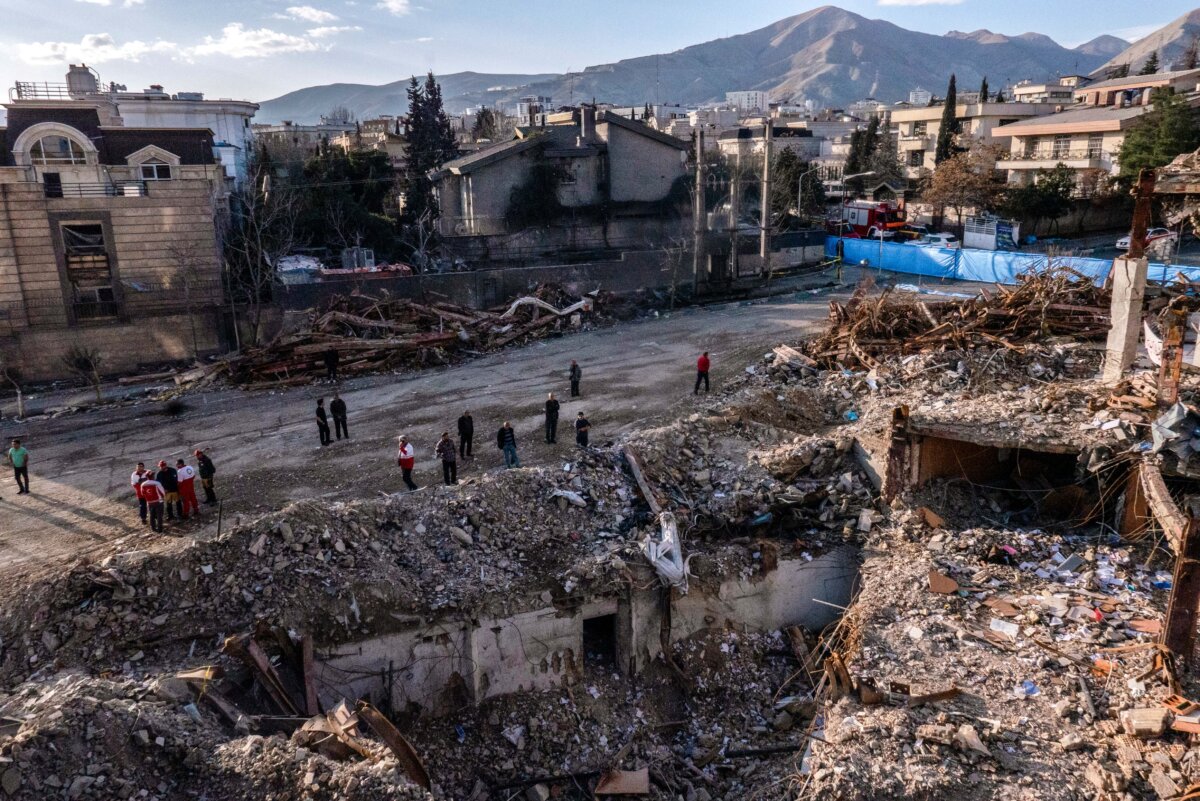

President Donald Trump said on May 20 that the United States was prepared to resume attacks on Iran within days if negotiations fail to produce what he called the “right answers.”
Speaking to reporters at Joint Base Andrews, Trump said the situation remained unstable six weeks after he paused Operation Epic Fury under a ceasefire agreement.
“Believe me, if we don’t get the right answers, it goes very quickly. We’re all ready to go,” Trump said.
When asked how long the United States would wait before authorizing further military action, he said a decision could come within days and warned that the situation could escalate quickly.
Trump also reiterated that the United States would not allow Iran to obtain a nuclear weapon.
“We’re in the final stages of Iran. We’ll see what happens. Either have a deal or we’re going to do some things that are a little bit nasty, but hopefully that won’t happen,” Trump told reporters earlier in the day. “Ideally I’d like to see few people killed, as opposed to a lot. We can do it either way.”
The comments came as indirect negotiations between Washington and Tehran continued through Pakistani mediation amid a fragile ceasefire that has largely halted six weeks of fighting.
Other countries, including Turkey, have called for a diplomatic solution. Trump spoke on May 20 with Turkish President Recep Tayyip Erdogan, who welcomed the extension of the ceasefire and voiced support for further negotiations.
The Turkish president’s office said in a May 20 post on X that Erdogan told Trump that he believed “a reasonable solution is possible” and pledged continued support for diplomatic initiatives.
The latest developments followed Trump’s May 18 announcement that he had halted a planned resumption of military strikes against Iran that was scheduled for the following day.
Trump said in a Truth Social post that leaders from Qatar, Saudi Arabia, and the United Arab Emirates urged restraint because negotiators believed that “a deal will be made” with Tehran.
Iranian Warnings
Iranian officials have warned that renewed attacks could trigger broader conflict beyond the Middle East.
The Islamic Revolutionary Guard Corps said on May 20 that any renewed assault on Iran would expand the war beyond the region.
“The regional war that was promised will this time be extended beyond the region, and our crushing blows will bring you to ruin in places you cannot imagine,” it said in a statement carried by Iranian state media.
Iranian Parliament Speaker Mohammad Bagher Ghalibaf also warned that Iran’s military had used the ceasefire period to rebuild its capabilities.
“Open and covert enemy movements show that they are seeking a new round of war,” Ghalibaf said in an audio message posted May 20 on Telegram. “We will make the enemy regret any renewed attack against Iran.”
Iranian President Masoud Pezeshkian said Tehran remained open to diplomacy, but he rejected pressure from Washington.
“Iran has consistently honored its commitments and explored every avenue to avert war; all paths remain open from our side,” Pezeshkian wrote in a May 20 post on X. “Forcing Iran to surrender through coercion is nothing but an illusion.”
Pezeshkian separately wrote in a May 18 post on X that “dialogue does not mean surrender” and said Iran would continue defending what he described as the nation’s legal rights.
Pakistan Continues Mediation Efforts
Pakistan has emerged as the primary intermediary between Washington and Tehran after hosting the only direct round of talks so far.
Iranian government media said Pakistan’s interior minister traveled to Tehran on May 20 as diplomatic contacts continued between both sides. Iranian Foreign Ministry spokesman Esmaeil Baghaei confirmed that Washington and Tehran were continuing to exchange messages through Pakistani mediation.
Tehran’s latest proposal includes demands for an end to hostilities across multiple fronts, including Lebanon, the lifting of the U.S. naval blockade, and compensation for war-related damage.
Iranian Deputy Foreign Minister Kazem Gharibabadi said on May 19 that the proposal also calls for sanctions relief, the release of frozen Iranian assets, and the withdrawal of U.S. forces from areas surrounding Iran, according to Iran’s state-controlled Islamic Republic News Agency.
Tehran also continues insisting on its right to uranium enrichment and civilian nuclear activities.
The U.S. administration maintains that the Iranian regime cannot be allowed to develop a nuclear weapon. Vice President JD Vance told reporters at the White House on May 19 that it would cause instability in the Middle East and potentially spark a nuclear arms race.
Reuters contributed to this report.
 Friends Read Free
Copy
Facebook
Tweet
Friends Read Free
Copy
Facebook
Tweet