
President Donald Trump suggested on Monday that Iran could face renewed attacks if it fails to comply with a framework agreement reached with Washington, while insisting Tehran had already accepted stringent nuclear inspections and restrictions on the use of unfrozen assets that Iranian officials have publicly disputed.
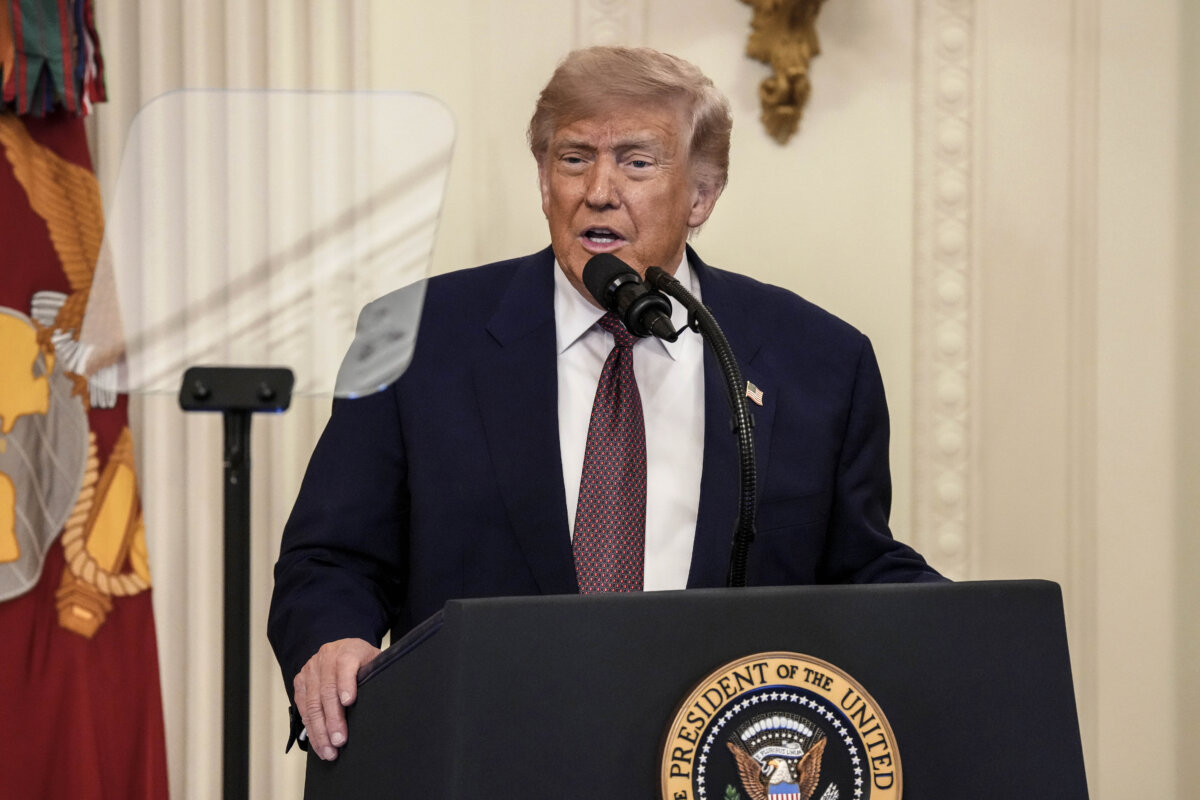
“If Iran doesn’t live up to their agreement, or if they’re not behaving, I will do what I have to do,” Trump told reporters on June 22 in the Oval Office.
In a Truth Social post on Tuesday, Trump said Iran had “fully and completely agreed to highest level Nuclear inspections long into the future” and asserted that there would be “no further negotiations” without such a commitment.
“If they did not agree to this, there would be no further negotiations,” Trump wrote.
He also said funds released under the agreement would be held in escrow under U.S. control and used exclusively to purchase American food and medical supplies.
The remarks—and the warning—came less than a week after Trump and Iranian President Masoud Pezeshkian endorsed a memorandum of understanding designed to halt hostilities, reopen the Strait of Hormuz, and launch a 60-day negotiating process aimed at reaching a permanent settlement after months of conflict.
While both sides have hailed progress, public statements by U.S. and Iranian officials have revealed sharply different interpretations of key provisions covering nuclear inspections and access to unfrozen Iranian funds.
Dispute Over Frozen Assets
One area of disagreement centers on the future use of Iranian assets to be released under the terms of the memorandum, point 11 of which states that the United States will make the frozen funds “fully available” for Tehran’s use.
Trump and senior U.S. officials say the funds will remain subject to American oversight and be used for humanitarian purchases from U.S. suppliers, while Iranian officials insist no such restrictions exist.
The U.S. president said Monday that the money unfrozen as part of the framework deal would ultimately benefit American farmers by being directed toward purchases of U.S. agricultural products.
“All that money’s coming back in the form of purchases of food which they desperately need. They have 91 million people, they can’t feed them,” Trump said. “So the money that we lift is going to go to our farmers.”
Trump reiterated that position on Tuesday, stating on social media that the money and sanctions relief being provided by the United States would go into an escrow account controlled by Washington.
“The Money and/or Sanctions that the U.S. Treasury is releasing goes into escrow, controlled by the U.S.A., and will be used for the purchase of food and medical supplies, exclusively from the United States, including Corn, Wheat, and Soybeans from our great American Farmers,” Trump wrote.
His remarks echoed those of Vice President JD Vance following U.S.–Iran talks in Switzerland. Vance said Monday that negotiators had discussed a mechanism under which any future release of Iranian funds would be overseen by Washington and Qatar and used to buy American agricultural products, with safeguards preventing the money from being used to fund terrorist activity.
“We wanted to make sure that we set up a process where … if we ever unfreeze Iranian assets, we can ensure … that that money, that Iranian money, goes to help the people of Iran and not to fund terrorism,” Vance said.
“So Jared Kushner actually came up with a with a very interesting solution with the Qataris, where basically … if there is any frozen Iranian assets that are unfrozen … then the money would actually go to buy American soy, American corn, and American wheat for the benefit of the Iranian people.
“That’s a very, very good and very classic Trump deal.”
Iranian officials, however, rejected suggestions that Tehran had accepted restrictions on how any released funds could be spent.
When asked during a Tuesday press briefing whether Iran would be required to use unfrozen assets to buy food from the United States, Foreign Ministry spokesman Esmail Baghaei dismissed the reports.
“It’s interesting to us that the stated philosophy and goal of the war—which they had previously announced was to destroy Iranian civilization and bring about Iran’s collapse—has been reduced to making American farmers richer,” Baghaei said.
“Regarding Iran’s released assets, we will decide however is in the country’s best interest and benefit.”
He said that decisions on imports would be made by Iranian authorities based on price and quality considerations and that “there are no restrictions in this regard.”
Baghaei added that authorizations to waive sanctions on Iranian oil exports had already taken effect and that frozen Iranian assets were also available for Tehran’s use.
“The important thing is that Iran’s frozen assets are available for Iran’s free use, however it sees fit, to provide for the goods the country has in mind,” he said.
Iranian Central Bank Governor Abdolnaser Hemmati similarly said on Monday that Tehran was under no obligation to purchase farm products from the United States and that released funds could be used for a broader range of non-sanctioned goods.
Questions Over Nuclear Inspections
The two sides have also offered conflicting descriptions of what has been agreed regarding international nuclear inspections.
Following talks in Switzerland over the weekend, Vance said Iran had agreed to invite International Atomic Energy Agency (IAEA) inspectors back into the country, calling the move a major breakthrough.
“The Iranians have agreed to invite IAEA inspectors back into their country,” Vance said. “That is a major milestone for the American people.”
Trump went further on Tuesday, declaring that Iran had accepted what he described as the “highest level” of nuclear inspections indefinitely.
“Iran has fully and completely agreed to highest level Nuclear inspections long into the future (Infinity!!!),” Trump wrote, saying the inspections would ensure what he called “Nuclear Honesty.”
However, Iranian officials rejected suggestions that they had agreed to inspections of bomb-damaged facilities and have not publicly confirmed Trump’s characterization of the inspection arrangements.
Baghaei said at Tuesday’s press conference that Tehran had not met with IAEA director general Rafael Grossi during the Switzerland talks and that Iran had “no plans” to allow inspections of bomb-damaged facilities.
“We have no plans for the agency to inspect Iran’s damaged nuclear facilities,” he said, adding that there is currently no protocol governing such inspections.
The spokesman nevertheless said Iran would continue to comply with its obligations under the Nuclear Non-Proliferation Treaty and existing safeguards agreements.
In his remarks to reporters on Monday, Vance did not specifically say Iran had agreed to inspections of nuclear facilities damaged during the conflict. He did, however, describe the renewed IAEA inspections as “the first step in permanently denuclearizing or permanently ending a nuclear weapons program in Iran.”
Iranian officials have maintained that the country’s nuclear program is peaceful and that they have never planned to pursue the development of a nuclear bomb.
 Friends Read Free
Copy
Facebook
Tweet
Friends Read Free
Copy
Facebook
Tweet