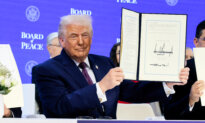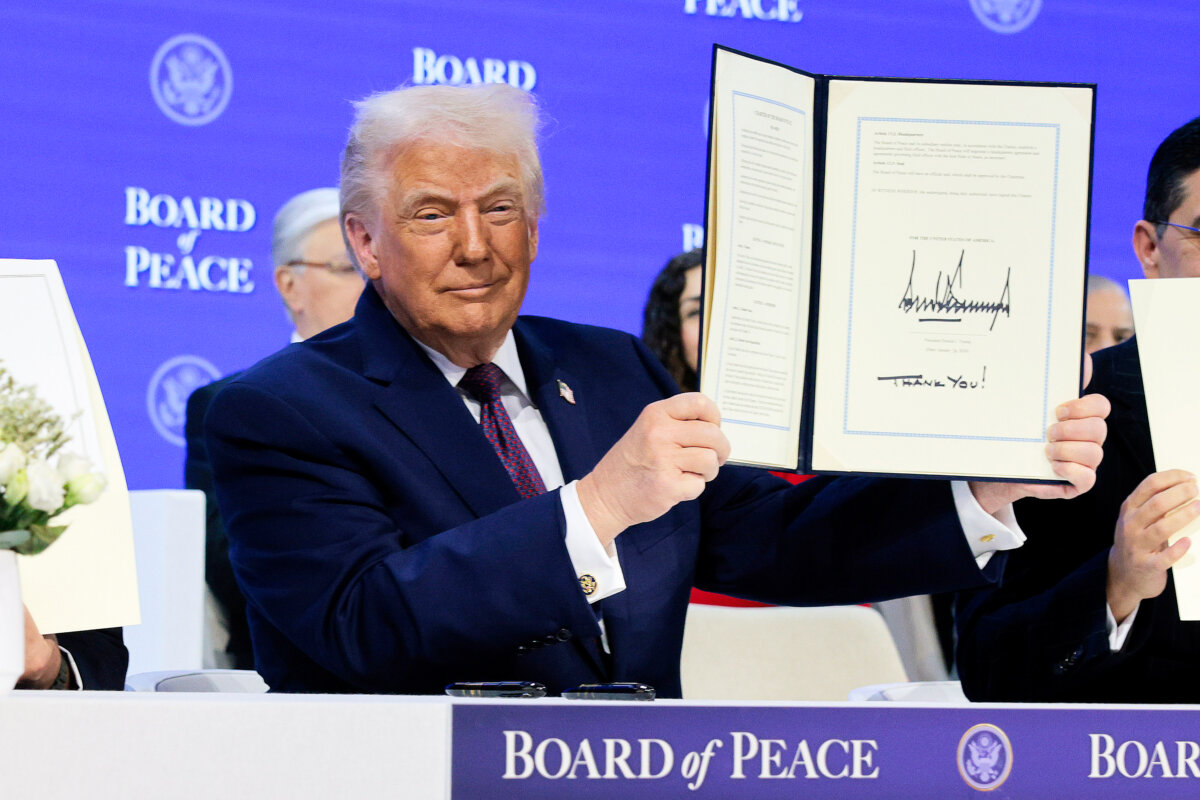
President Donald Trump’s Board of Peace will hold its first official meeting on Feb. 19 in Washington, bringing together more than two dozen nations from around the world in the U.S.-backed plan to rebuild the Gaza Strip after years of war between Israel and terrorist group Hamas.
After pledging more than $5 billion toward aid for the Gaza Strip, the member states—which include nations from the Middle East, South America, Europe, and beyond—will meet at the former U.S. Institute of Peace headquarters.
Trump said more details on the funds’ use would be presented during the meeting.
More than 40 nations, including some that have declined to join the board, will send representatives to the inaugural meeting.
Here’s everything we know about Trump’s Board of Peace, including the project’s goals and what to expect from the group’s first meeting later this week.
Trump Launches Board of Peace
The Trump administration started the Board of Peace as a way to rebuild Gaza after a cease-fire brokered between Israel and Hamas late in 2025. It’s part of a multi-faceted approach that includes a Palestinian technocratic committee, led by former Palestinian Authority official Ali Abdel Hamid Sha’ath.
The board aims to provide “strategic oversight, [mobilize] international resources, and [ensure] accountability as Gaza transitions from conflict to peace and development.”
Trump chairs the board and retains full veto power over its decisions and membership.
The U.S. president appointed seven people to serve as the group’s executive board: U.S. Secretary of State Marco Rubio, U.S. deputy national security adviser Robert Gabriel, U.S. envoys Steve Witkoff and Jared Kushner, former UK Prime Minister Tony Blair, private equity executive Marc Rowan, and World Bank Group President Ajay Banga.
Trump has said he sees the Board of Peace as a potential launching pad for addressing future conflicts beyond the Israel–Hamas war, but the United Nations has limited its initial authorization of the board to a focus on Gaza.
Trump recently said the project could replace the U.N. Security Council, which is tasked with ensuring international peace and has the authority to make decisions that member states are obligated to implement under the U.N. Charter.
The four other most powerful Security Council members—China, Russia, France, and the UK—have either not yet indicated whether they will join the Board of Peace or have publicly rejected Trump’s offer.
Rebuilding Gaza
The countries that have already signed on to or have indicated their intentions to join the Board of Peace are Argentina, Albania, Armenia, Azerbaijan, Bahrain, Belarus, Bulgaria, Cambodia, Egypt, El Salvador, Hungary, Indonesia, Israel, Jordan, Kazakhstan, Kuwait, Kosovo, Morocco, Mongolia, Pakistan, Paraguay, Qatar, Saudi Arabia, Turkey, the United Arab Emirates, Uzbekistan, Vietnam, and the United States.
The combined $5 billion that the Board of Peace’s member states have pledged includes humanitarian aid and reconstruction efforts in the Gaza Strip.
The United Nations has said that the Gaza Strip faces a humanitarian crisis, as millions face hunger and malnutrition. In October 2025, it estimated that 81 percent of all structures in the Gaza Strip were damaged.
The nations have also committed “thousands of personnel to the International Stabilization Force and Local Police to maintain Security and Peace for Gazans,” Trump wrote in a social media post on Feb. 15.
He said that “very importantly, Hamas must uphold its commitment to Full and Immediate Demilitarization.”
The inaugural meeting will feature both delegations and heads of state from the nations that have joined the Board of Peace so far.
The White House said on Feb. 18 that nearly 50 nations and the European Union (EU) would be sending representatives to the board’s first meeting on Thursday, including some that have declined Trump’s invitation to join the board as member states.
Those sending representatives are Albania, Argentina, Armenia, Austria, Azerbaijan, Bahrain, Bulgaria, Cambodia, Croatia, Cyprus, Czech Republic, Egypt, El Salvador, the EU, Finland, Germany, Greece, Hungary, India, Indonesia, Israel, Italy, Japan, Jordan, Kazakhstan, Kosovo, Kuwait, Mexico, Mongolia, Morocco, Netherlands, Norway, Oman, Pakistan, Paraguay, Poland, Qatar, Romania, Saudi Arabia, Slovakia, South Korea, Switzerland, Thailand, Turkey, United Arab Emirates, United Kingdom, Uzbekistan, and Vietnam.
Speakers will include Trump, Rubio, Kushner, Blair, Witkoff, U.S. Ambassador to the U.N. Mike Waltz, former U.N. Middle East envoy and Board of Peace Director-General Nickolay Mladenov, and other attendees, according to a senior administration official.
Criticism of the Board
Multiple countries, including key U.S. allies and major world powers, had declined to join Trump’s Board of Peace by late January: France, Germany, Greece, Italy, Norway, Slovenia, Sweden, the UK, and Ukraine.
Those that have yet to respond to Trump’s invitations include China, Croatia, Cyprus, India, the European Union’s executive arm, Russia, and Singapore.
Some foreign leaders have raised concerns about the board’s structure.
“We have serious doubts about a number of elements in the charter of the Board of Peace related to its scope, its governance and its compatibility with the UN Charter,” European Council President António Costa wrote in a statement.
Polish Prime Minister Donald Tusk cited similar issues when declining Trump’s invitation to join.
New Zealand also recently declined Trump’s offer, citing a need for clarity on how the initiative will coexist with the United Nations, and other nations—Croatia, Ireland, Poland, Slovakia, and Spain—have indicated they would not join the board.
Although Trump has suggested the Board of Peace could replace the Security Council, which he said “just hasn’t been very helpful” in his efforts to end conflicts around the world, he also said the U.N. must be allowed to continue “because the potential is so great.”
The Associated Press and Reuters contributed to this report.
 Friends Read Free
Copy
Facebook
Tweet
Friends Read Free
Copy
Facebook
Tweet