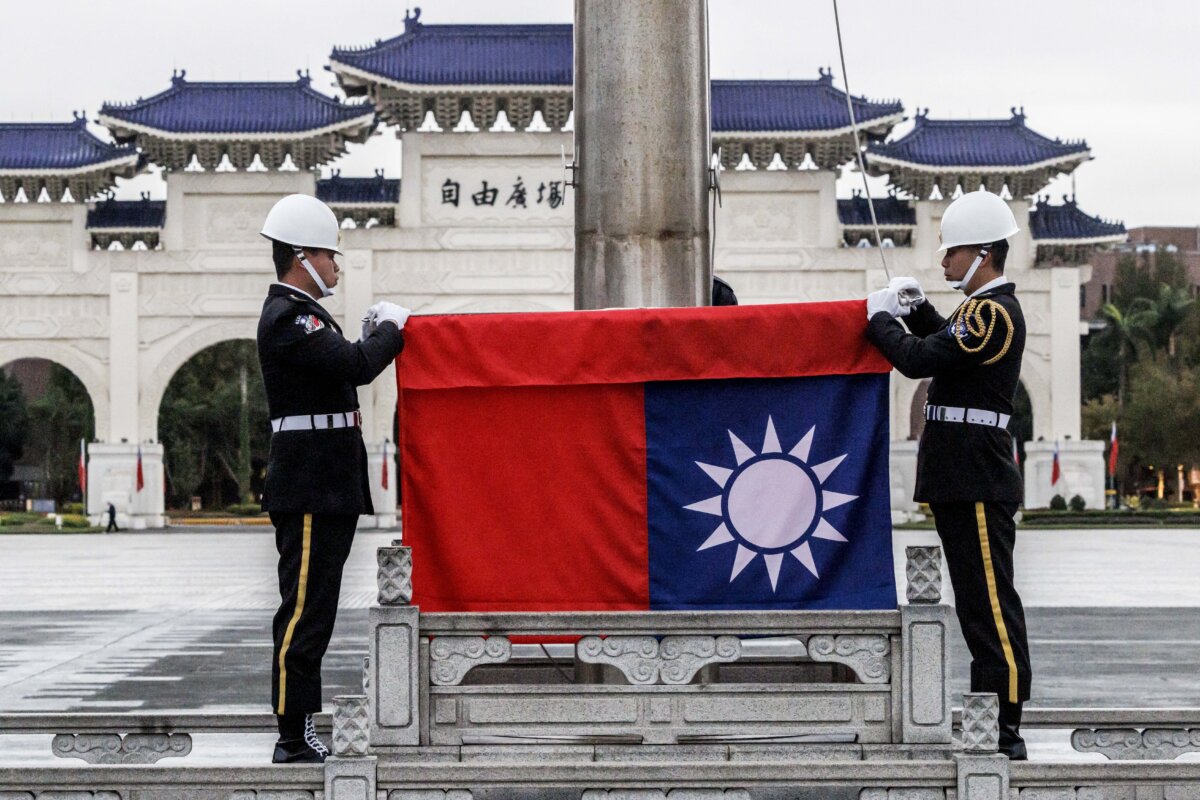


The United States, the UK, France, and Germany raised concerns over the Chinese regime’s activities off the east coast of Taiwan, saying Beijing’s actions threaten regional stability, freedom of navigation, and the safety of international shipping.
Earlier this month, China sent coast guard ships into the waters east of the island for a “special maritime traffic law-enforcement operation.”
The British Office in Taipei—which acts as a de facto embassy—issued a joint statement with French and German equivalents in the Taiwanese capital, in which they stated: “We have noted with concern novel Chinese activity in the waters east of Taiwan.
“These actions threaten regional stability and the freedom of navigation and safety of international shipping.
“We reiterate our opposition to any unilateral change to the status quo, particularly by threat or use of force or coercion. It is fundamental that all navigational rights and freedoms and the safety of seafarers and vessels are guaranteed and respected.”
The American Institute in Taiwan (AIT), which acts as the de facto U.S. embassy, also expressed concern over Chinese coast guard and patrol vessels in waters east of Taiwan, according to Taiwan’s Central News Agency (CNA).
AIT said Beijing’s attempt to exercise control over waters Taiwan has peacefully administered for more than 70 years would only increase tensions and undermine Beijing’s stated pursuit of peaceful dispute resolution.
AIT also rejected any Chinese claim to interfere with freedom of navigation and overflight, the freedom to lay undersea cables, and other lawful uses of the sea.
The Chinese Communist Party (CCP), which has never ruled Taiwan, considers the self-ruled island to be a renegade province and has never ruled out the possibility of using force to seize it.
The Chinese regime does not recognize any separate Taiwanese sovereignty and, in recent years, has frequently sent military jets and ships close to the island on an almost daily basis.
China stated that the coast guard operation was in response to statements from Japan and the Philippines that they would begin formal talks on their maritime boundaries.
Chinese Foreign Ministry spokesperson Guo Jiakun rejected the U.S. and European concerns on June 25, repeating Beijing’s claim that Chinese authorities have jurisdiction in waters east of Taiwan and accusing other countries of distorting the facts.
Taiwan’s coast guard stated that Beijing has no jurisdiction in its waters and that it would “forcefully” drive away Chinese ships to maintain “freedom and safety of navigation.”
Taiwan Asserts ‘Maritime Sovereignty’
“Our nation’s maritime sovereignty cannot be violated,” Taiwan’s coast guard said in a statement. “Any country that asserts jurisdiction will be expelled without exception.”
Beijing has also been sending maritime survey ships into the waters east of Taiwan.
Taiwan’s Mainland Affairs Council said a Chinese research vessel, the Xiangyanghong 22, sailed back and forth in Taiwan’s eastern exclusive economic zone in the guise of a scientific survey before Taiwan’s coast guard monitored it and broadcast warnings to drive it away, CNA reported.
The council said the Chinese research vessel’s activity was a gray-zone intrusion aimed at creating the appearance that Beijing has jurisdiction over Taiwan’s waters, according to CNA.
Taiwanese President Lai Ching-te said on June 25 that China’s recent maritime actions around the East China Sea, South China Sea, and waters near Taiwan were being carried out in the name of law enforcement, patrol, or surveying.
Lai said the actions were no longer merely technical activities but amounted to “fake law enforcement” and expansion in practice, according to Taiwan’s Presidential Office.
“China is the destroyer of the status quo in the Taiwan Strait and of peace and stability in the Indo-Pacific region,” Lai said.
Lai made the remarks while chairing the eighth meeting of Taiwan’s Whole-of-Society Defense Resilience Committee, after a tabletop exercise on gray-zone harassment and high-intensity maritime coercion.
Joseph Wu, secretary-general of Taiwan’s National Security Council, thanked the United States, Germany, France, and the UK for speaking out, saying the rules-based international order, the status quo, and regional peace and stability are shared concerns.
Wu said Beijing should stop its maritime expansionism.
Taiwan’s Ocean Affairs Council, which oversees the island’s coast guard, said freedom of navigation and maritime safety in the Taiwan Strait and the waters surrounding Taiwan are essential to global trade.
The council said China’s maritime harassment of Taiwan and related political pressure violate international law and harm shared international interests.
The council called for the actions to be contained and rejected collectively, and said Taiwan would continue working with friendly countries to defend maritime order through lawful, appropriate, and firm measures.
Several Western countries, including the United States, the UK, France, and Germany, have policies under which they maintain formal diplomatic relations with Beijing rather than Taipei while maintaining unofficial ties with Taiwan.
The latest U.S. and European statements did not announce a change in diplomatic recognition. They framed the concern around freedom of navigation, shipping safety, opposition to coercion, and the status quo in waters around Taiwan.
Taiwan is officially known as the Republic of China (ROC), which was the legitimate government in mainland China until its defeat by the communist forces of Mao Zedong in 1949.
After Chiang Kai-shek withdrew to Taiwan, several Western governments broke off relations with the ROC and switched to the communist People’s Republic of China.
The UK did so in 1950, France in 1964, and West Germany in 1972, a position that was reiterated after Germany became unified in 1990.
In December 1978, U.S. President Jimmy Carter broke off official relations with Taiwan and switched to recognizing Beijing.
The U.S. maintains a “robust, unofficial relationship” with the Taiwanese government, according to the U.S. State Department.
Reuters contributed to this report.
 Friends Read Free
Copy
Facebook
Tweet
Friends Read Free
Copy
Facebook
Tweet