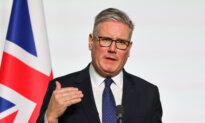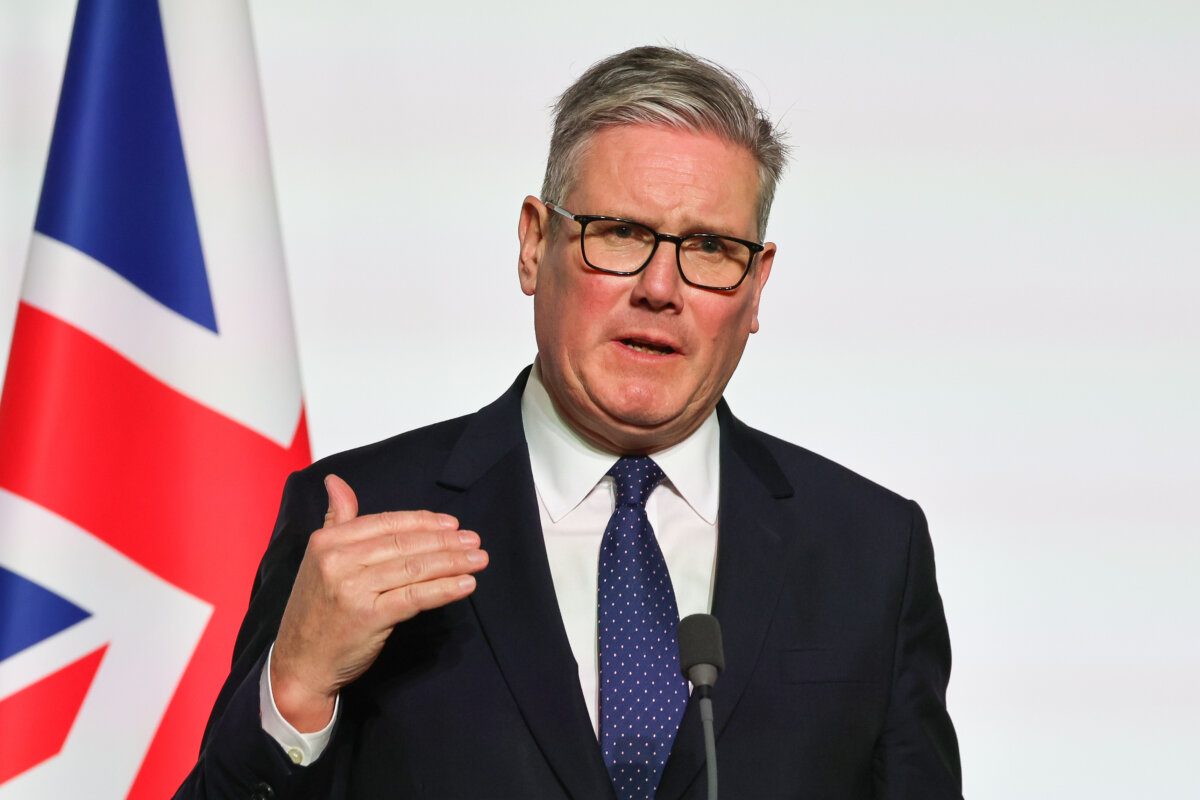

British Prime Minister Keir Starmer said on Feb. 16 that the UK must “step up” its defense and security to deter “the threat of Russian aggression.”
Starmer told reporters that the fourth anniversary of the start of the Ukraine–Russia conflict was approaching, and that even if a peace agreement is made between the two countries, it “will not extinguish the Russian threat, and we need to be alert to that.”
“That means on defense spending, we need to go faster,” the prime minister said.
The UK has committed to increasing defense spending to meet a new NATO target agreed by allies in June 2025, raising defense spending targets from 2 percent of gross domestic product to 5 percent by 2035.
This move was driven by U.S. President Donald Trump, who has long argued that other members of NATO—the vast majority of which are in Europe—should pay more toward their own defense.
Starmer said that part of this commitment to rapidly reinforce defense and security involves working with other countries, including by making NATO a stronger “European NATO.”
“NATO has been the most successful military alliance the world has ever seen. Countries which, across the continent, used to be on the battlefield against each other for centuries now stand together ready to defend each other,” Starmer said.
“That’s what we need to build on that will affect every person in this country, and that’s where I’m absolutely determined that the United Kingdom will show the leadership that’s necessary.”
Russia, which began its invasion of eastern Ukraine in February 2022, has consistently denied that it has any intention of initiating conflict, particularly with Europe or NATO.
The prime minister’s comments follow the British and German defense chiefs’ writing of a joint letter calling for the public to back an increase in military spending to deter a possible war with Russia.
“Moscow’s military buildup, combined with its willingness to wage war on our continent, as painfully evidenced in Ukraine, represents an increased risk that demands our collective attention,” Air Chief Marshal Richard Knighton, the UK’s chief of the defense staff, and Gen. Carsten Breuer, Germany’s chief of defense, wrote in The Guardian and Die Welt newspapers on Feb. 15.
Deeper Ties With EU
Starmer said during a speech at the Munich Security Conference on Feb. 14 that the UK should forge deeper links with the European Union—the majority of EU member states are also in NATO—in matters of defense, industry, technology, and politics “because these are the foundations on which our security and prosperity will rest.”
“There is no British security without Europe, and no European security without Britain,” he said, according to an official transcript of the speech.
While Starmer called for more coordination with European NATO allies, he added that maintaining this security still required partnership with the United States.
“The U.S. remains an indispensable power. Its contribution to European security over 80 years is unparalleled. And so is our gratitude,” Starmer said, according to the transcript. “At the same time, we recognise that things are changing. The U.S. National Security Strategy spells out that Europe must take primary responsibility for its own defence. That is the new law.”
Also speaking at the Munich Security Conference, U.S. Secretary of State Marco Rubio reaffirmed the United States’ commitment to NATO but called on Europe to strengthen its own defenses and accept more responsibility for its security.
“We want allies who can defend themselves so that no adversary will ever be tempted to test our collective strength,” Rubio said in a Feb. 14 speech to European leaders.
The Pentagon on Jan. 23 released its new National Defense Strategy, which outlines the United States’ prioritization of homeland defense, including “defending America’s interests throughout the Western Hemisphere,” according to the document.
It also said that it would encourage partners in other parts of the world, including Europe, to take primary responsibility for their own defense “with critical but limited support from U.S. forces.”
The reorientation of priorities for the United States was acknowledged by the EU, whose foreign policy chief, Kaja Kallas, said days after the National Defense Strategy was released that Europe must “step up” to ensure its own defense.
 Friends Read Free
Copy
Facebook
Tweet
Friends Read Free
Copy
Facebook
Tweet