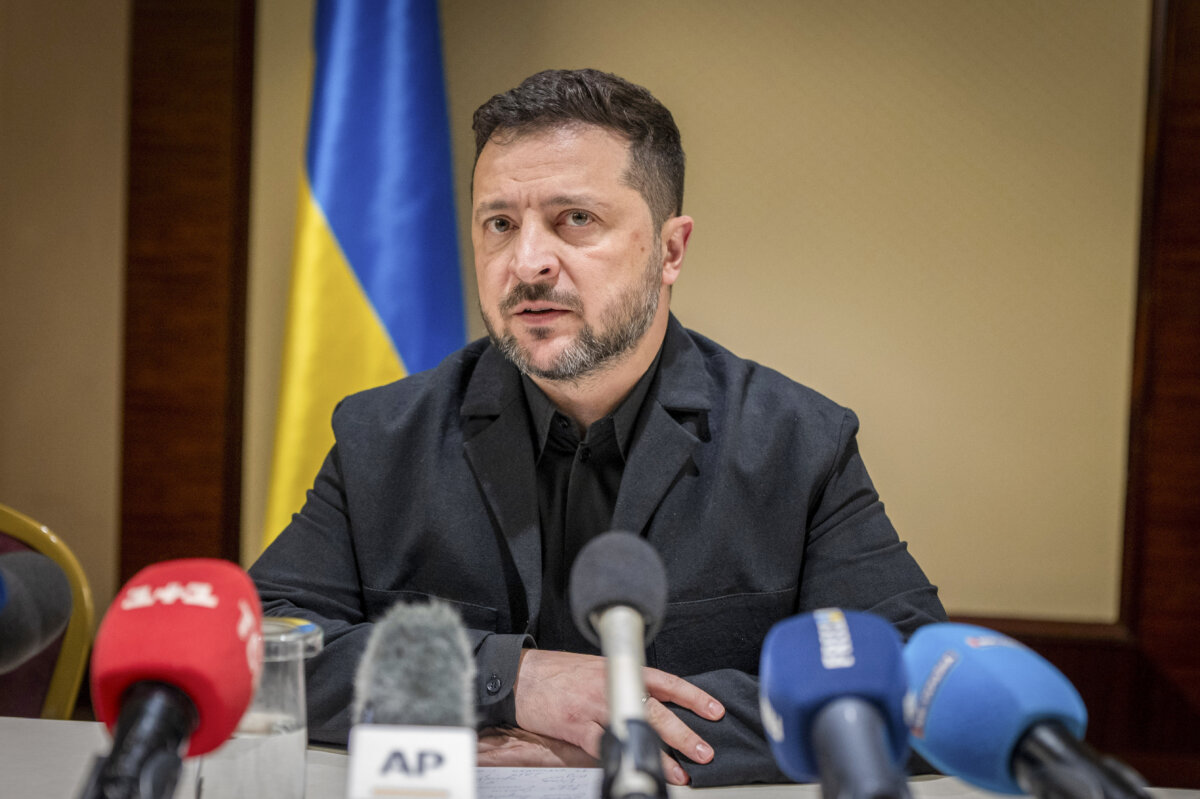

Ukrainian President Volodymyr Zelenskyy has said that his country will intensify attacks on oil refineries in Russia but will not target civilians.
Zelenskyy said in an interview with Reuters published on Oct. 3 that the decision was in response to documents Ukrainian intelligence had received showing that Russian President Vladimir Putin had authorized a new directive allowing military attacks on civilian targets.
“We saw documents, and we know that they allow them to attack infrastructure, logistics, and especially to attack in the cities, in the villages, everywhere, roads, schools, hospitals,” Zelenskyy said.
“To pressure people to leave the capital, leave different cities: this is the goal of the operation.”
The Ukrainian president said that his military would respond to changes in Russian tactics in kind, but without targeting civilians.
“We have to respond in any way [we can],” he said. “With their attacks on our energy, we have to respond on their energy. First of all, oil refiners … what gives money to them for this war.”
The Russian Defense Ministry said on Oct. 5 that it would intensify strikes on “military and military-industrial facilities, as well as related infrastructure in Kyiv and other Ukrainian regions,” according to Russian state-run news agency TASS.
Ambassador-at-large of the Russian Foreign Ministry Rodion Miroshnik told Izvestia that the strikes are to limit Zelenskyy’s ability to damage the Russian economy.
This followed the ministry’s Oct. 3 warning to foreign nationals and diplomatic personnel against remaining in Kyiv or near military facilities in Ukraine, as the Russian forces continue to carry out strikes against military targets in cities.
Both sides deny targeting civilians.
Strikes on Energy Infrastructure
President Donald Trump has urged both Kyiv and Moscow to cease attacking each other’s energy infrastructure, saying that it was causing fuel shortages and driving up diesel prices globally.
However, Russia and Ukraine continued the strikes apace. Last month, a Ukrainian drone attack damaged the Novoshakhtinsk oil refinery.
Last week, Kyiv came under attack by Russian drones and missiles, targeting energy assets, as well as telecommunications sites and road and rail infrastructure.
Ukraine started attacking Russian oil refineries and terminals, gas stations, and other energy sites months ago, as part of its wider targeting of military, commercial, and other infrastructure that Kyiv says is responsible for bolstering Moscow’s war efforts.
Targeting energy infrastructure resulted in fuel shortages in parts of Russia.
Last week, Moscow extended its ban on fuel producers exporting diesel and marine fuel until the end of October.
The ban was initially introduced early in July, in a bid to stabilize the domestic fuel market, and has been extended a number of times since.
The Russian government said this most recent extension was due to expected increased demand for motor fuel during the autumn harvest season.
The Ukrainian Defense Ministry said in an Oct. 4 post on X that 51 percent of Russia’s oil refining capacity is out of action, according to analysts and Ukrainian intelligence.
It said that recent strikes hit refineries and processing plants in cities including Moscow, Perm, Ilsky, Saratov, and Syzran.
Russian officials have not publicly revealed data on damage caused to its oil infrastructure but on Oct. 2 indicated that damage to refineries was decreasing.
Speaking in the Federation Council, Russian Deputy Prime Minister Alexander Novak said oil companies and government agencies were undertaking work to protect energy assets.
“We have seen lately that damage from continuous raids against refineries is much more mitigated,” Novak said. “Passive protection was established, corresponding to threat models. Active protection by air defense assets was strengthened.”
Reuters contributed to this report.
 Friends Read Free
Copy
Facebook
Tweet
Friends Read Free
Copy
Facebook
Tweet