
A category five inflation storm is bearing down on Australian consumers.
As war in the Middle East continues to roil global energy markets, the impact is already being felt domestically.
Not only are motorists feeling under the pump as they fill up, industries ranging from construction to aviation are warning prices will have to increase as they pass on the rising cost of fuel.
The impact of the conflict on already-high inflation prompted the Reserve Bank of Australia (RBA) to hike interest rates for a second straight month on Tuesday.
Money markets have doubled down on bets the RBA will follow up with another in May, amid mounting inflation expectations as the war has dragged on.
The central bank will closely scrutinise inflation data for February, set to be published by the Australian Bureau of Statistics on Wednesday.
Commonwealth Bank head of Australian economics Belinda Allen said the release will offer one last bit of information about how prices were tracking before the conflict.
She expects a fall in annual headline inflation from 3.8 percent to 3.7 percent, driven in part by a 2.8 percent decline in fuel costs.
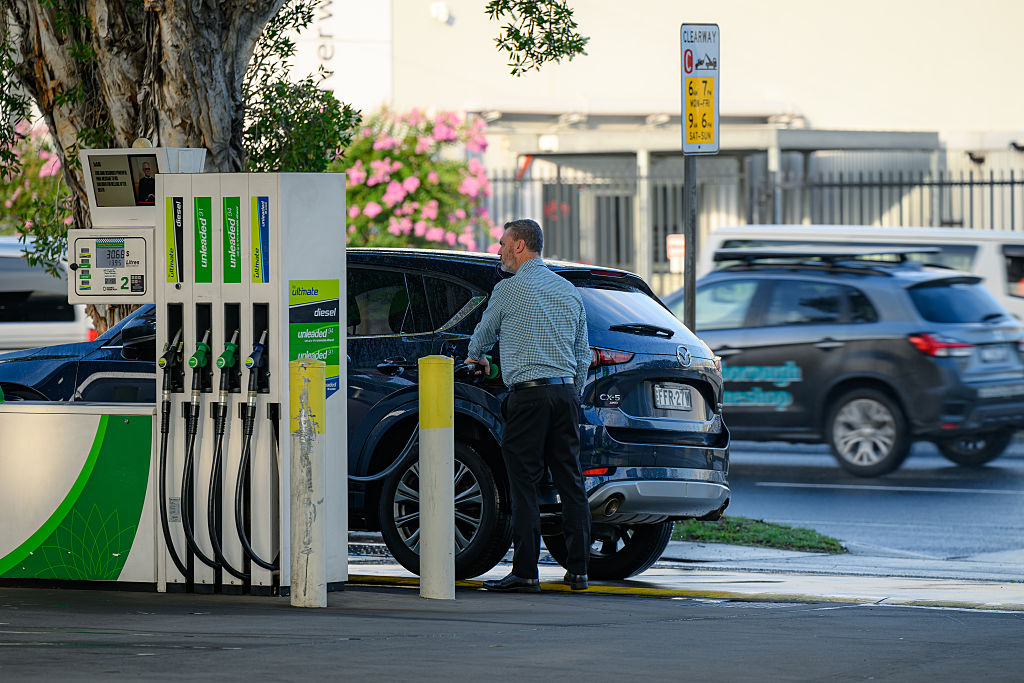
As the sight of petrol prices approaching $3 a litre indicates, it’s the calm before the storm.
The ABS’s February reference period predates the recent surge in the price of fuel, which is set to jump beyond 25 percent through March, said NAB senior economist Taylor Nugent.
“In broad terms, the cost shock emanating from the Middle East will appear first and most obviously through automotive fuel prices, which will add around one percentage point to March CPI, sending the year-ended rate up to around 4.6 percent,” he said.
Higher airfares will flow through from April for domestic and May for international flights, while higher costs passed through other industries such as transport, logistics, agriculture, packaging, manufacturing, and construction will be evident over the coming months, he said.
None of this will show up in Wednesday’s data.
But luckily for the RBA, March inflation data is due to be released before its next meeting in May and will provide a much clearer impression of the direction of the economy post-conflict.
The increase in fuel costs won’t show up in the RBA’s preferred quarterly trimmed mean inflation measure, which omits volatile items.
Because the price spike came late in the quarter, most of the impact will only be felt in the June quarter, where NAB currently predicts headline inflation peaking at 5 percent, Nugent said.
“The (March) data has in some ways been overtaken by events but it remains important as the RBA refines its assessment of how inflationary domestic conditions were before the Iran shock,” he said.
Investors on Wall Street are similarly worried about inflation and higher interest rates, and appear resigned to the fact that the Iran conflict will run longer than expected.
The S&P 500 lost 99.01 points, or 1.49 percent, to end at 6,508.32 points, while the Nasdaq Composite shed 436.98 points to 21,653.71 and the Dow Jones fell 422.32 points to 45,599.11.
Australian share futures slumped 156 points, or 1.83 percent, to 17,617.
With the ASX trading at its weakest level in nine months, the S&P/ASX200 fell 69.4 points on Friday, down 0.82 percent to 8,428.4, as the broader All Ordinaries lost 62.4 points, or 0.72 percent, to 8,628.3.
 Friends Read Free
Copy
Facebook
Tweet
Friends Read Free
Copy
Facebook
Tweet