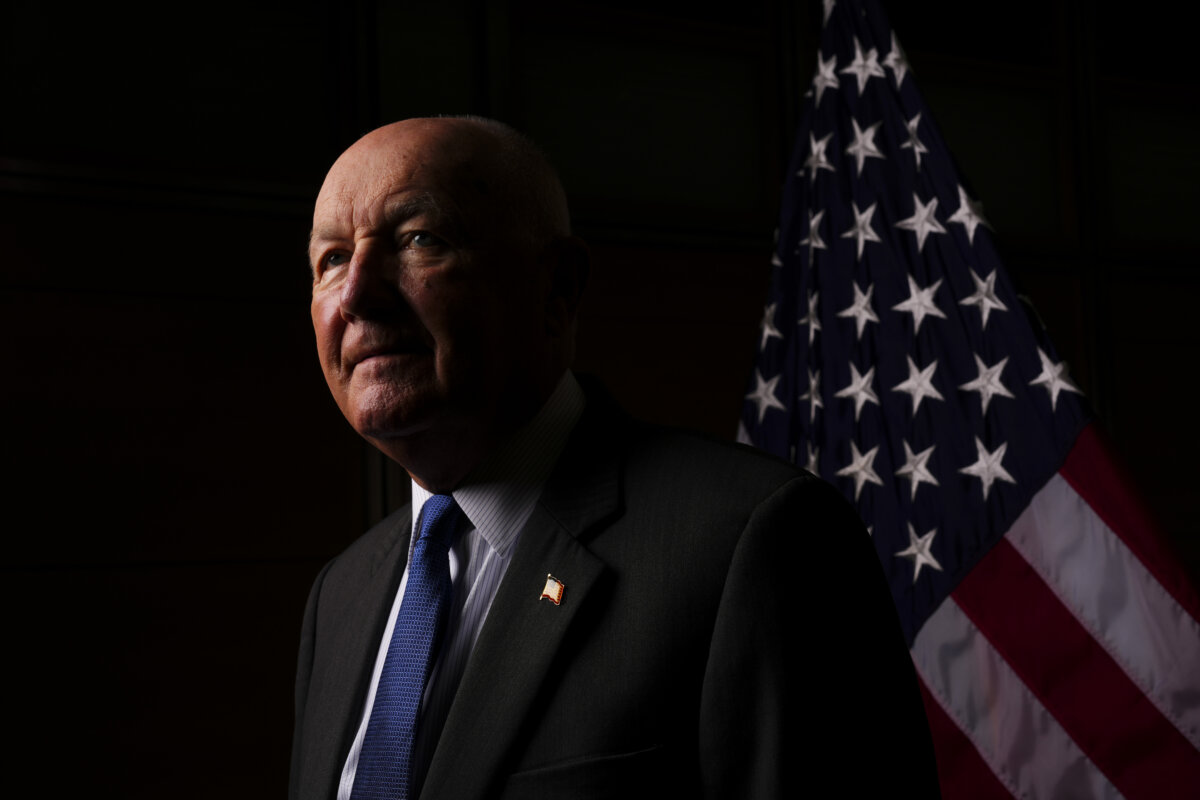

U.S. Ambassador to Canada Pete Hoekstra will no longer be speaking at the Canada Strong and Free Conference in Ottawa, pulling out hours before his scheduled appearance.
Organizers of the conference said Hoekstra was called back to Washington, D.C., for urgent meetings on May 8. He was set to speak at 11:45 a.m. in a fireside chat with the CEO of The Canada Strong and Free Network Adam Bolek.
With Canada-United States-Mexico Agreement (CUSMA) negotiations between Canada and the U.S. set to begin, Hoekstra was to be a featured speaker at the conference. Conservative Leader Pierre Poilievre delivered a keynote address the previous day, former U.S. Secretary of State Mike Pompeo participated in a panel, and Alberta Premier Danielle Smith will speak later in the day on May 8.
The conference is also set to feature a panel on the Canada-U.S. relationship, including Conservative MP Jamil Jivani, who is a close personal friend of U.S. Vice President JD Vance. Jivani recently returned from a second trip to Washington, D.C., where he and Canadian oil and gas companies met with U.S. Trade Representative Jamieson Greer.
Hoekstra said in a March 29 interview that in trade negotiations, Ottawa should take a page from Alberta’s approach, pointing to Premier Danielle Smith’s message that “America has been a very reliable and positive partner for Alberta” and that the relationship should be strengthened and expanded.
Hoekstra also said that while Canada has responded to U.S. tariffs by aiming to diversify its trade with China and Europe, Canada is still “going to be doing a lot of business with the U.S.” Hoekstra said that while Ottawa could double its exports with other countries, “A strong Canada is good for the United States,” adding, “I don’t know why you can’t do both.”
U.S. Commerce Secretary Howard Lutnick said at a conference on April 17 that U.S. President Donald Trump believes CUSMA is a “bad deal.” He also criticized comments by Steve Verheul, who was Canada’s chief trade negotiator from 2017 to 2021, who said that “time is on [Canada’s] side” in trade talks because the U.S. administration faces increasing pressure.
“That is like the worst strategy I’ve ever heard. They suck,” Lutnick said.
Canada-U.S. Trade Minister Dominic LeBlanc had said a day earlier that Canada would not be the reason for any delay in CUSMA negotiations. However, Prime Minister Mark Carney said on April 23 that Ottawa was both ready to “go into detailed negotiations” with the United States or to “wait, if that’s what has to happen.”
If the United States, Canada, and Mexico agree to renew the CUSMA at talks in July, then the trade agreement would remain in force until 2032. If the renewal is denied or delayed, the agreement could enter a period of annual reviews. If one or more countries withdraw from the trilateral agreement altogether, the three countries could then make bilateral agreements.
The Canadian Press and Olivia Gomm contributed to this report.
 Friends Read Free
Copy
Facebook
Tweet
Friends Read Free
Copy
Facebook
Tweet